
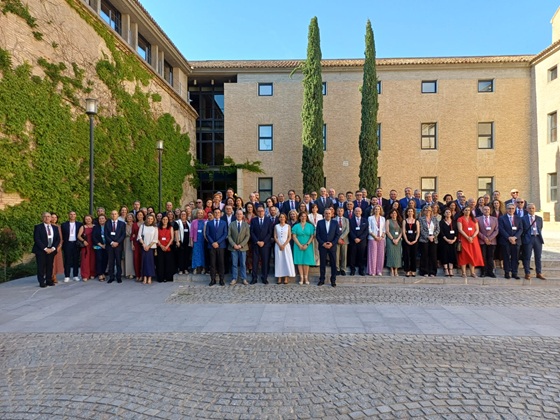
Zaragoza.- The General Secretary of Penitentiary Institutions, Ángel Luis Ortiz, inaugurated today in the Aragonese capital the annual meeting of heads of penitentiary centers. During three days of work they will analyze the current situation and evolution of the penitentiary system and mark the strategic priorities for the future.
Along with him, the government delegate, Fernando Beltrán, the president of the Courts of Aragón, María Navarro, and the general director of Criminal Execution and Social Reintegration, Miguel Ángel Vicente, were present.
First of all, the head of Penitentiary Institutions has expressly thanked the professionalism of the management teams and all the penitentiary staff, recalling that the Spanish penitentiary system has been consolidated as an international reference: “Not only do we receive delegations from other countries, but our professionals are called upon to participate in projects outside Spain.”
During his speech, Ortiz highlighted the complexity of prison work and the need to coordinate and standardize management criteria. The goal, he stressed, is not only to recognize what works, but to identify what remains to be done to continue “moving forward and improving.”
In this regard, it has identified several challenges as priorities. Among them, to deepen the digitization of management and administrative procedures; to meet the treatment needs of two emerging groups, such as the elderly and future convicts in application of Organic Law 1/2026, known as the law of multi-recidivism; to guarantee the provision of health care by the health systems of the autonomous communities, in compliance with Law 16/2003; to continue with the consolidation and expansion of the 31 canine units, whose work has effectively contributed to reduce and deter the introduction of drugs in penitentiary centers; and to develop the Centre for Penitentiary Studies as a benchmark of excellence, among other initiatives.
The Secretary General has also focused on the state of progress of the initiative to recognize the status of prison officials as agents of authority, a proposal that last week received the support of the Interior Committee of the Congress of Deputies.
PROGRAMS OF TREATMENT
He stressed that one of the priority objectives for the General Secretariat is to offer each convicted person the treatment program best suited to their needs and mentioned as innovators the one aimed at people convicted of child pornography crimes “Off the Net” and PIDECO, Program for economic crimes and corruption.
With regard to Penalties and Alternative Measures to Prison, it has highlighted centralized telematic programs for people who live in depopulated areas or areas far from urban centers and are not able to travel to Social Insertion Centers. More than 200 people have already been cared for by this route. These actions allow the effective execution of the more than 135,000 sentences and alternative measures received in the last two years.
The work of the staff of the Public Law Entity for Prison Work and Training for Employment, which manages paid prison work for about 12,000 inmates, has also been recognized.
REINFORCEMENT OF PERSONNEL AND TRAINING
Ortiz has reported the incorporation of 8,700 new professionals in the last eight years, a figure to which will be added the 1,360 places included in this year’s public employment offer.
Since its arrival, a total of 67,194 professionals have participated in training actions promoted by the institution, with a significant growth in that period: from 4,798 people trained in 2018 to 9,825 in 2025. The objective, as he stressed, is to offer training oriented to excellence, under the premise that “only with a well-trained staff is it possible to achieve everything else”.
During his speech, Ortiz wanted to highlight the work of the health staff of the penitentiary centers, whose commitment and dedication he described as “exemplary”. He also recalled that the General Secretariat continues to make progress towards the full integration of prison health in the autonomous health services, in compliance with the provisions of the Law on Cohesion and Quality of the National Health System.
The Secretary General has also acknowledged the effort being made by the management teams in the face of the temporary coincidence of numerous improvement and modernization works in different penitentiary centers. “Today’s inconveniences will be rewarded in the future with better and more architecturally appropriate facilities,” he said.
COMMITMENT TO LEGALITY AND REINTEGRATION
In conclusion, the head of Penitentiary Institutions has stressed that the work of professionals in the penitentiary system is “complex, demanding and, in many cases, not visible, but absolutely essential for the functioning of the rule of law”.
“You guarantee not only security, but also dignity, legality and the possibility of a second chance”, he said, before encouraging workers to continue to carry out their responsibility “with rigour, criteria and vocation of service”.