
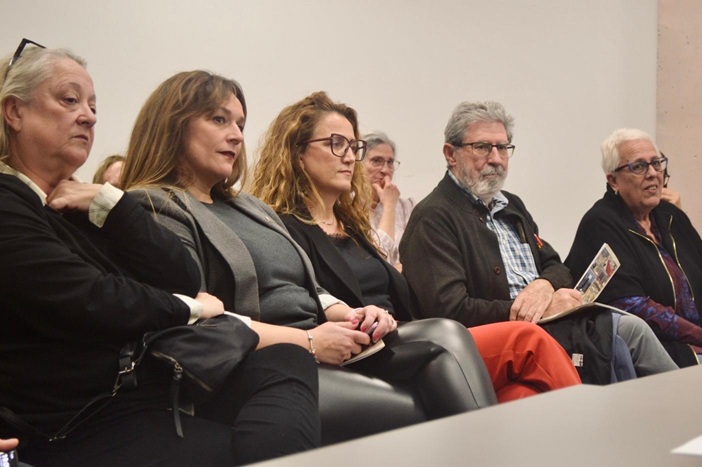
Zaragoza.- The Association of Democratic Memory of Calatayud and Comarca (Amedecc) has been officially presented this afternoon in the city of Bilbao. The event, which was attended by about a hundred people, was attended by the general director of Attention to Victims and Promotion of Democratic Memory in Spain, Zoraida Hijosa, and the subdelegate of the Government in Zaragoza, Noelia Herrero.
This entity, chaired by Julia Olivas, has been created with the aim of offering support and advice to the families of the area in the process of recovering the remains of their reprisals, investigating the oral and documentary sources related to the disappeared, managing the administrative procedures for the location and identification of the remains, and constituting seminars, conferences and other activities for information and awareness about the Democratic Memory to society.
The main objective of the association in the short term is to locate the pit of the Cortasogas ravine. There, according to the studies of researcher Nacho Moreno, are the remains of at least four people killed in 1936 by the rebellion. In 2022 and 2023, two tastings were carried out in the area without success. Now, they are going to try it at a third point, in the course of the ravine itself. This work will be possible thanks to the support of the General Directorate of Attention to Victims (attached to the Ministry of Territorial Policy and Democratic Memory) and the Subdelegation of the Government in Zaragoza.
The Director General of Victim Care, Zoraida Hijosa, assured that the Government of Spain "has a very strong commitment to historical and democratic memory" and explained that they are finalizing the memory of the project of that third tasting so that in the next week the procedures of the contract can begin. In addition to promoting this type of work, the Directorate General also continues to work on DNA analysis: “Many associations have run out of funds following the exhumations. We have launched two sheets, one of them for the analysis of the remains recovered from the Cuelgamuros Valley, in order to continue with the analysis of samples. There are 33,000 bodies there, among them, neighbors and neighbors of Calatayud. Their boxes have been located in the chapel of the Holy Sepulchre.”
Hijosa pointed out that this year the Provincial Council of Zaragoza will receive €50,000 in aid for exhumations, which will be added to last year’s €100,000. “Of the three provincial deputies, Zaragoza is the only one participating in this task. We also allocated a million euros managed by the FEMP, although it is a pity that the city of Calatayud does not request it because what we are talking about is Human Rights”.
In the same vein, the deputy delegate of the Government of Spain in Zaragoza, Noelia Herrero, has guaranteed that the Executive will maintain and strengthen its commitment to the memory, historical truth and justice and reparation of victims and their families, in the face of the regression and fracture of regional policies: «Two and a half years ago, we saw how the Popular Party and, specifically, Mr. Jorge Azcón, did not hurt clothes in repealing the Democratic Memory Law of Aragón to reach the Government. It was one of Vox’s requests that he agreed to. Now we are in a scenario where the PP is even more hostage to the far-right, we will see what the result is.” “The truth is that complex times are approaching for democratic memory if PP and Vox form government, but the Government of Spain will be there to give light where they put shadows,” he said.
Herrero also wanted to acknowledge the commitment and work of the people behind this initiative: “We are talking about a job that comes from many years ago and the creation of this partnership is a further step towards achieving its purpose. We know that the Aragonese and the Aragonese who fight for a just memory have encountered obstacles and stones along the way; our purpose has always been to clear it, accompany them and be with them in everything they need».