
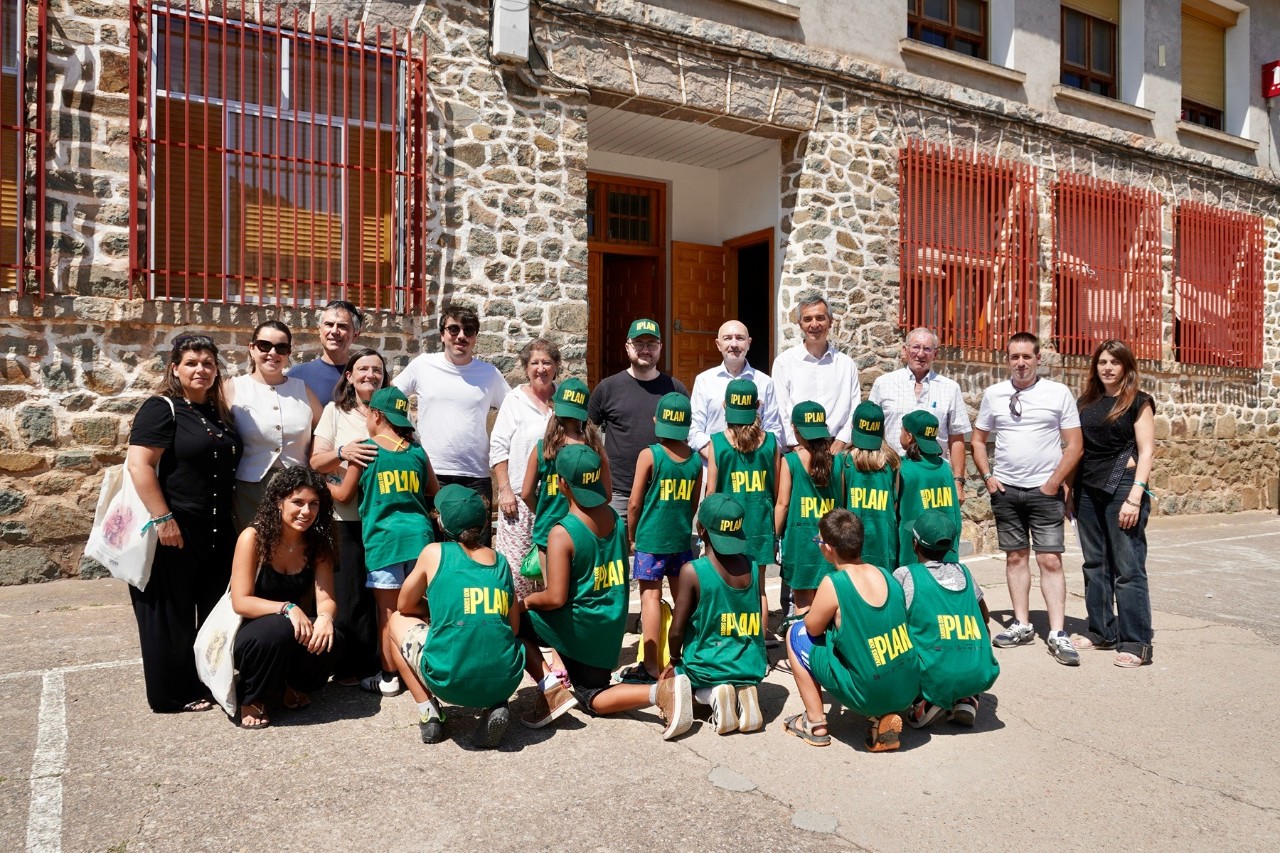
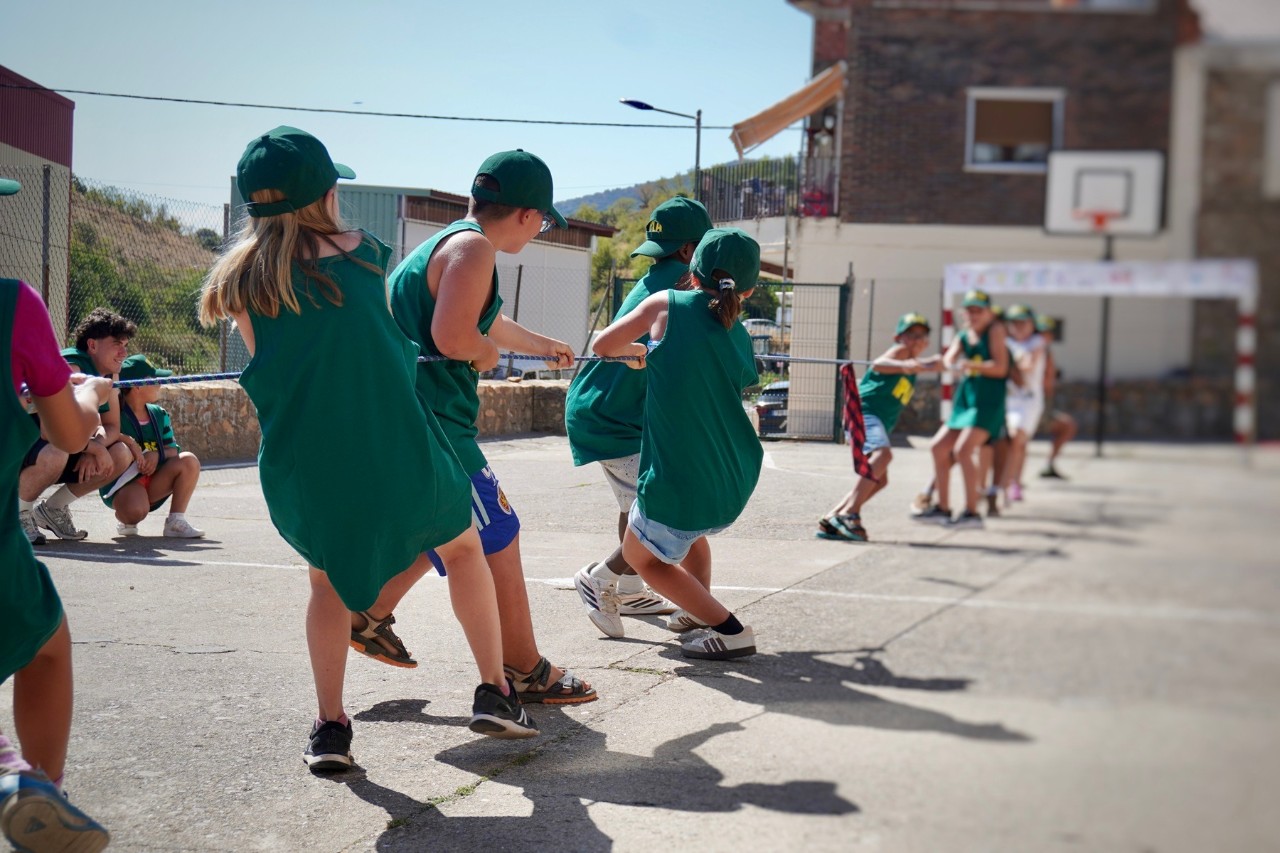
Zaragoza.- The handkerchief, the comba, the egg race, the rope shot, the petanque and the parachute. They are the six games that make up the gymkana with which the boys and girls of the program ‘Tardes con plan’, in Codos, have performed an hour of physical exercise. Before, they have visited the fruit trees of the area and with the pieces they have collected in the field they have made some fruit skewers for lunch. To conclude, they have held a 15-minute breathing workshop to lower pulsations and thus close the day calmly. The delegate of the Government of Spain in Aragon, Fernando Beltrán, has accompanied them in part during his visit to the Grío Rural Development Center.
Fourteen children between 9 and 12 years old are participating in this initiative promoted last year by the Government of Spain through the Ministry of Health and which reaches the Zaragoza town of Codos with the Confederation of Rural Development Centers (COCEDER) and the Río Grío Cultural Association. ‘Tardes con plan’ is an innovative program that focuses on the needs of children, adolescents (NNA) and their families, working to promote healthy habits in food, rest, physical activity and emotional well-being, from their own contexts and realities, especially in those areas subject to greater vulnerability.
Although the overall idea of the project has a more urban perspective (districts with a higher population density, with lower incomes; districts with a more limited range of leisure activities or play spaces), in the case of Aragón takes a rural perspective, thinking of the territory and with equal opportunities as a goal. “Tardes con Plan shows that children’s rights do not depend on the size of the municipality. In COCEDER, together with the CDR Grío, we have been defending for more than thirty years that the rural environment is not a place of fewer opportunities, but a territory with its own resources that is worth putting in value. This program is, today, proof of this”, explains José Luis Ibáñez, managing director of COCEDER.
In this way, Activities such as those of today are the way to bring education to the people and, at the same time, leave the people in the workshops Hand in hand with neighbors and neighbors who are also invited to participate. This is a distinguishing feature of the program and made possible thanks to the close proximity of a small town like Codos with about 240 inhabitants. “Every working session that focuses on that local knowledge reinforces something that is not measured in indicators: the sense of belonging of childhood to its own territory», adds Ibáñez.
Along the same lines, the government delegate has pointed out that the fundamental objective of this program is the health of our children and adolescents, something that does not depend only on their individual decisions, but is marked by the environment in which they grow up: «Children and young people have the right to a healthy leisure time and this is what it is intended to promote with this program. We talk about a part of the population that is growing up in a reality of technological revolution, of hyperconnectivity, of pressing mental health problems… Here what is offered to them is another way to connect between them and the reality that surrounds them. Today, for example, we have seen how a playtime can become a bridge between generations and how fruit is not only a good recommendation but something that is visited, looked at, smelled and touched”.
“It is exciting to see how the projects we promote reach the smallest corners of the country and They become a reality thanks also to the commitment of those who live in the territory», said Beltran. The activities in Codos are part of the first call for ‘Afternoon with plan’ while the Ministry of Health has already launched the second one equipped with more than 106 million euros, co-financed by the EU. It is a direct intervention program developed by entities of the third sector and the social economy.
«Kids sometimes spend many hours playing with mobile phones or prefer other types of things if they are not offered an alternative like this. It means a lot in terms of food and activity. Today, for example, we have made the fruit brochetas and another day something more traditional like pumpkin fritters with the pumpkins here, from the village. And we must bear in mind that it also helps families with conciliation”, explains the director of CDR Grío, Yolanda Vicente Luzón.
Once the academic year begins, the program ‘Afternoons with Plan’ will continue with 32 sessions that will take place after school with content equally related to these healthy habits of food, physical exercise, rest and emotional well-being.
More than three decades of social action
COCEDER has been in rural development for more than thirty years, with a network of 24 centers in ten autonomous communities. One of them is that of Codos, managed by the Grío Cultural Association, a social entity created in 1989 from the culture commissions of Codos, Tobed and Santa Cruz de Grío. Their work and presence can be seen in the daily life of the town.
The government delegate has been closely acquainted with his main projects and lines of action. On the one hand, in the La Lonja Centre care is taken of the elderly people of Codos with the services of day center, dining room and laundry, so that the fact of aging does not oblige the neighbors to leave the town. On the other hand, the Río Grío Children's Centre, in operation since 1997, accommodates minors under the guardianship of the Government of Aragon. In 2025, this project was recognized as good practice by the State Association of Directors and Managers in Social Services and is now immersed in a social innovation project ‘Este es MI Nido’, financed with European Funds and the Ministry of Social Rights, Consumption and Agenda 2030. In addition, in El Casón, located in Tobed, the entity manages a albergue-farm school and nature classroom that receives schools, AMPAS and colonies throughout the year.