
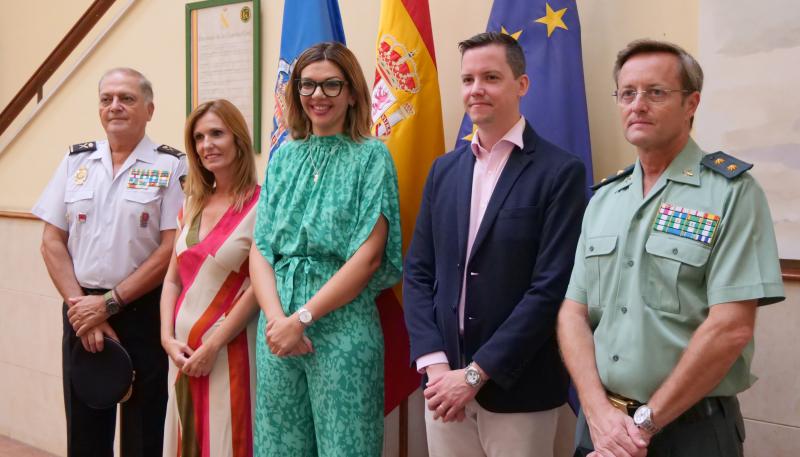
At the opening of the IV Conference on Trafficking in Women and Girls for the Purpose of Sexual Exploitation, which in this edition is entitled “Women in the Context of Prostitution. The response to a violation of human rights”, Government Delegate, Sabrina Moh, has reiterated her commitment to eradicate this scourge.
“We want to continue to show our commitment and we also want to continue to put our predisposition so that, whenever necessary, we can work on issues such as those we have been addressing throughout the different hearings,” he said.
The head of the Government Delegation stressed that it is essential to work in a united and coordinated way to “end a problem that is not only of the victims, but of society as a whole.” For this reason, he thanked the work of the Coordination Unit against Violence Against Women and the NGO, Fiet, for the coordination and organization of the days, as well as the Civil Guard for the cession of the space, and the State Security Forces and Bodies “for the commitment, participation and work they do day by day to fight this scourge.”
Moh has valued awareness and education in this area. In this regard, he stressed that “it is important to make the problem visible, it is important to sensitize society and it is important to do so also from education so that, especially from an early age, we are aware of what a scourge like this is, what a violation of Human Rights like this is and, above all, so that we have the necessary and essential tools to put an end to it.”
Invisible violence
The Head of the Coordination Unit against Violence Against Women, Laura Segura, has stressed that trafficking in women and girls for the purpose of sexual exploitation is “a very invisible violence” to which they are now putting data, but that “it is unknown to most of society”.
In this regard, he explained that trafficking and exploitation are not usually associated with prostitution, so one of the objectives of this day is “to show that trafficking is not an end in itself, that trafficking is a means that what it uses is the recruitment of women so that they are finally exploited.”
“We are talking about a terrible violation of human rights that especially affects society, women and girls,” he lamented while stating that more than 90% of people who are sexually exploited are women and girls.
Segura has insisted that it is a violence that must be overcome and addressed from different administrations, and also from society itself. “We must raise awareness of the need to make visible the reality of women who are exploited, commercialized and used as a consumer good,” he said.
Therefore, on this occasion, the solutions will be addressed through abolitionist policies “that point to the exploiters, that point to the pimps”, something that has advanced, fundamental and necessary to end this situation “that is terrible and that affects thousands and thousands of women and girls in our country every year”.
Abolitionism as a response
For his part, Ezequiel Escobar, Executive Director of the NGO Fiet and first speaker of the day, explained that abolition is the only response, from a human rights perspective, to be able to attend to the victims that we serve every day and that we try to get them out of this environment of vulnerability.
Since Fiet has clarified that abolitionism is not only prohibiting, “it is educating, betting on dignifying, raising, giving answers for a complete restoration, a real reflection that we need in society.” Thus, it has advanced that in Melilla, the NGO is caring for more than 60 women in a situation of extreme risk of falling back into a situation of being victims of trafficking or returning to contexts of prostitution.
Escobar has explained that the great difficulty suffered by the victims is “that the entire weight of the system falls on their statement”, so women must verbalize the situation in which they find themselves. A fact that is complicated by the invisibility they live and that makes it difficult for them to get out.
In this regard, he pointed out the need for an amendment to the Penal Code to “remove the burden on the victim”, and that it should be understood that the crime of trafficking does not exclusively affect the freedom of people, but “is a crime against the State, because in our society we do not admit that it is trafficked with people, with their sexual freedom, with their privacy, or with honor.”