
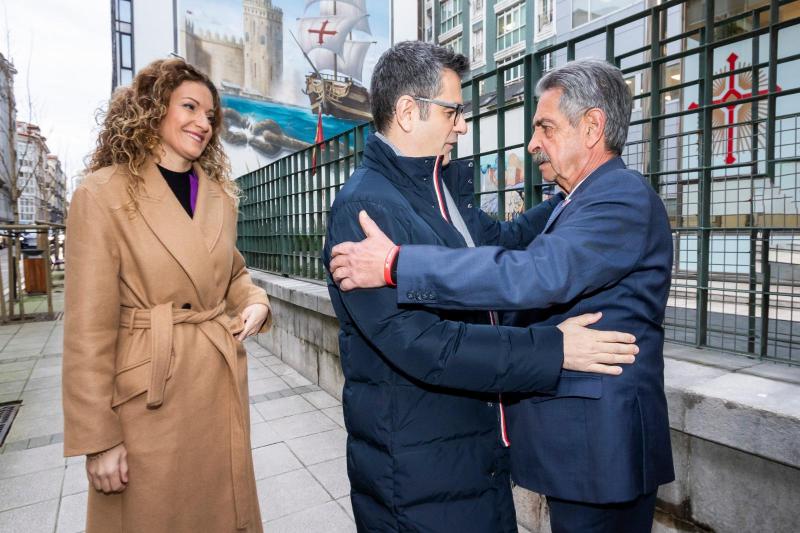
The Minister of the Presidency, Relations with the Courts and Democratic Memory, Félix Bolaños, met today in Santander with the President of Cantabria, Miguel Ángel Revilla. The meeting was also attended by the Vice-President of Cantabria, Pablo Zuloaga, the Minister of the Presidency, Interior, Justice and External Action, Paula Fernández, and the Government delegate in Cantabria, Ainoa Quiñones.
During his subsequent appearance before the media, Bolaños stressed that the commitment of the Government of Spain to Cantabria is translated into figures and goes from words to deeds. Thus, in the last five years, the region has received 32.2% more resources from the State, being the CC.AA. with the highest per capita investment in the General State Budgets by 2023, with 507€/hab and a total of 345 million euros, an increase of 20% compared to the previous year.
Investment in industry, health, education or infrastructure
Among the main items, stand out the 312 million euros of the Recovery, Transformation and Resilience Plan that the Executive will allocate to transform, modernize and promote the productive model and the industrial fabric of the region; or the 2.2 million euros destined to implement the Primary Care Action Plan. In addition, the Hospital of Reinosa will be one of the target centers of the Investment Plan in High Health Technology and the central government will allocate 8.7 million euros to strengthen education in rural environments.
In terms of infrastructure, an additional EUR 29 million was allocated in December for the AVE connection between Palencia and Santander and the Santander-Bilbao rail connection continues to be promoted within the framework of the Cantabrian-Mediterranean corridor.
“It is in these budget lines that the capacity for joint work and cooperation is demonstrated, as well as the institutional loyalty that exists between the Government of Cantabria and the Government of Spain,” said the Minister of the Presidency.
Bolaños has also highlighted that, when the Government of Spain commits to Cantabria, it complies. And he pointed to the example of Valdecilla’s debt: “Successive governments were saying that they would comply with the payment of that debt. The government of Pedro Sánchez has complied and the money is already in the autonomous coffers.”
Impact of government policies on the citizenship of Cantabria
With regard to the impact of the policies developed by the central Government on Cantabrian citizens, it is worth mentioning the revaluation of pensions, which is already benefiting 152,000 older people in the region; the salary improvement for civil servants, which reaches 34,000 public workers; the gratuitous payment of the Neighbourhoods and Half Distance, which benefits 27,000 people; the Thermal Social Bonus, which reaches 12,000 Cantabrians and Cantabrians; the rent bonus, enjoyed by 1,260 young people in the region; and the increase in investment in scholarships for 9,000 students.
Meeting with memorialist associations
The minister also held a meeting this morning with the main memorialist associations of the region in the Central Library of Cantabria, an old prison that today is considered a “place of memory” and in which, between 1937 and 1944, Republican prisoners were imprisoned, more than a thousand of whom were murdered.
“No one forgets in this land the thousand Republican prisoners who left here, from the old prison, and were killed and buried in the cemetery of Ciegan,” said the minister during his speech, adding value to the Democratic Memory Law, which has turned memory policies into state policies. “This means listening and accompanying families, working alongside associations and memorialist entities and allocating resources, such as the 14 million euros in the General State Budgets for 2023.”
MUPAC visit and meeting with archaeologists
The minister has also visited the Museum of Prehistory and Archaeology of Cantabria and the temporary exhibition “Frente Norte. Archaeology of the Spanish Civil War in Cantabria”, in which you can see various objects, documents, audiovisual resources and immersive technologies with which the exhibition allows to deepen the experience of those who fought on the front of Castro Urdiales.
There he also held a meeting with archaeologists from the Service of Cultural Heritage and Historical Memory of Cantabria, in which he was able to learn first-hand about the development of research and prospecting of graves in Cantabria, within the Four-year Plan financed by the Ministry of the Presidency, Relations with the Courts and Democratic Memory.