
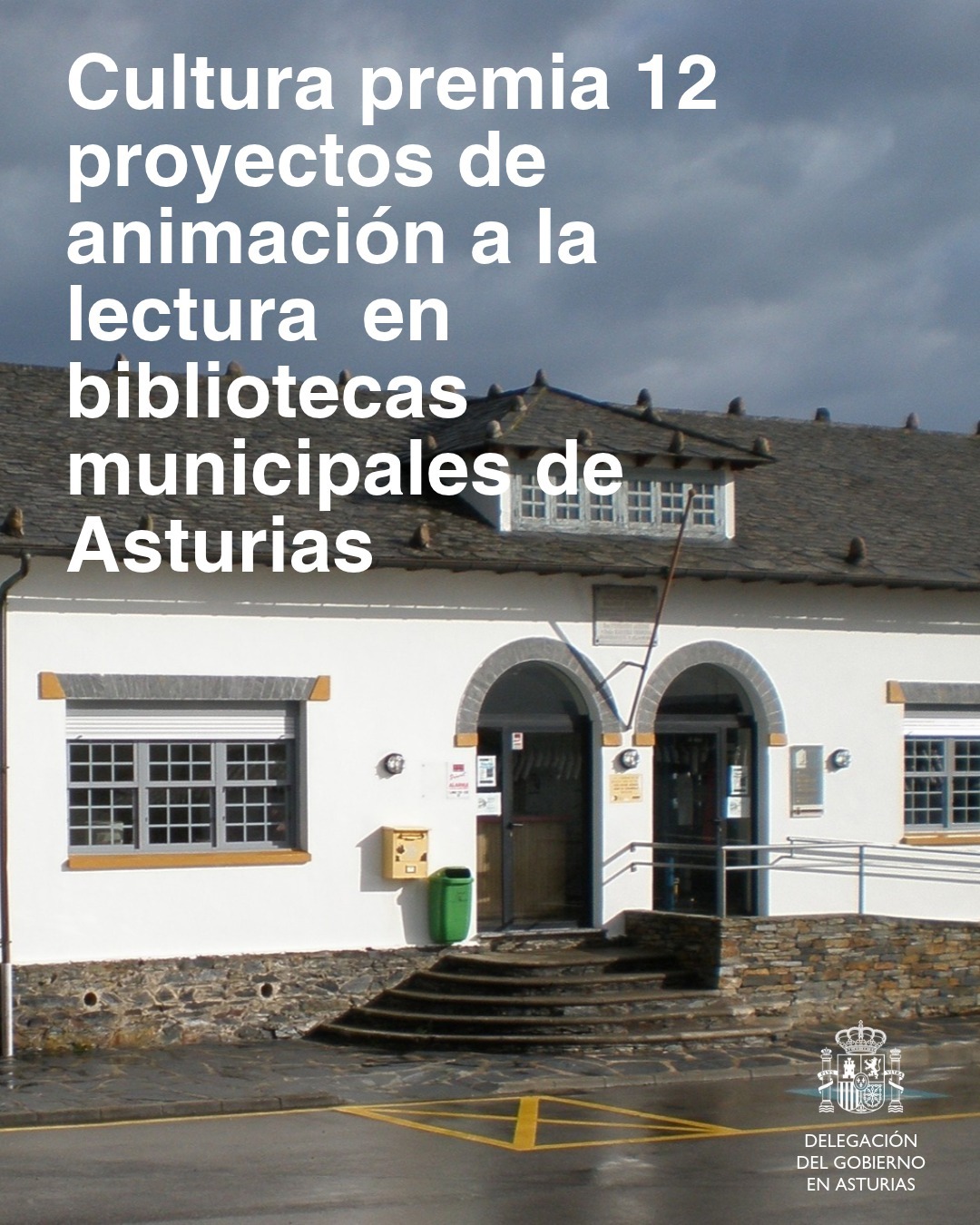
A total of 12 reading animation projects presented by municipal libraries of Asturias have been awarded by the Ministry of Culture, in collaboration with the Spanish Federation of Municipalities and Provinces (FEMP), in the XXVI edition of the María Moliner Awards. The libraries of El Franco, Coaña, Belmonte; Carreño, Grado, Castropol; Taramundi, Mieres, Colunga; Gozón, Soto del Barco and Ribera de Arriba, will receive 2,777.77 euros.
The recognized proposals are endowed with 2,777.77 euros each. The total amount with which these Asturian libraries have been awarded amounts to 33,333.24 euros.
The aim of these awards is to reward the best reading animation projects aimed at all audiences, especially groups with difficulties in accessing it, in any of the official languages of the respective autonomous community and with special attention to the municipalities of less than 5,000 inhabitants.
Of the 658 municipalities throughout Spain that participated in this year’s edition, 370 libraries have been awarded 2,777.77 euros and, among them, the ten best projects will increase the amount to 10,000 euros. The prize will be intended primarily for the purchase of books and/or periodicals by public libraries.
The program, funded by the Ministry of Culture through the General Directorate of Books, Comics and Reading, has a total investment of 1.1 million euros.
This initiative is of great strategic importance in access to books and reading, since approximately half of the Spanish population resides in municipalities with less than 50,000 inhabitants. The goal of the campaign is, following the ideal of María Moliner herself, that any reader anywhere can get the book that interests her.
Ten best projects
The María Moliner Awards for the ten best reading animation projects are as follows:
•City Council of Requena (Valencia, Valencian Community), for the project ‘Reading animation and training always and for everyone’.
•City Council of Paiporta (Valencia, Valencian Community), for the project ‘(Re)Building reading’.
•Alborache City Council (Valencia, Valencian Community), for the project ‘Alborache Reader: Culture, Community and Creativity All Year Round’.
•City Council of Alcántara (Cáceres, Extremadura), for the project ‘Pueblo de Versos Vivo. Roots, voices and community in a rural library’.
•City Council of Aldaia (Valencia, Valencian Community), for the project ‘When the books return to the Library: rebuild, read and share’.
•City Council of Cortes de la Frontera (Malaga, Andalusia), for the project ‘The library that connects us’.
•City Council of Jabugo (Huelva, Andalusia), for the project ‘Don’t be fooled by AI, come to your library’.
•City Council of Catarroja (Valencia, Valencian Community), for the project ‘The library: The beat of the word. New meeting and poetry spaces in Catarroja’.
•City Council of Los Silos (Santa Cruz de Tenerife, Canary Islands), for the project ‘Los Silos: fabric of words’.
•City of Valverde de Leganés (Badajoz, Extremadura), for the project ‘In Valverde, the library moves you’.
The selection of the projects has been carried out according to criteria such as the clarity and interest of the project for reading animation, good planning and feasibility, as well as originality and innovation and social integration activities contained in the proposal and with special attention to the municipalities of less than 5,000 inhabitants.
In addition, this call has especially taken into account the projects presented by municipal libraries located in the areas affected by DANA, insisting on putting culture at the center of reconstruction.
Reading Promotion Plan
These awards are part of the one hundred reading promotion measures set out in the Reading Promotion Plan. Reading is a right! 2026-2030. Specifically, they are part of the axis of access to reading, which has among its objectives to address reading as a fundamental right, a tool of equality, a lever of social cohesion and a condition for full cultural and democratic participation.
This new Plan aims to ensure that any citizen, in any place and under any circumstances, can exercise his or her right to read under equal conditions.
➢