
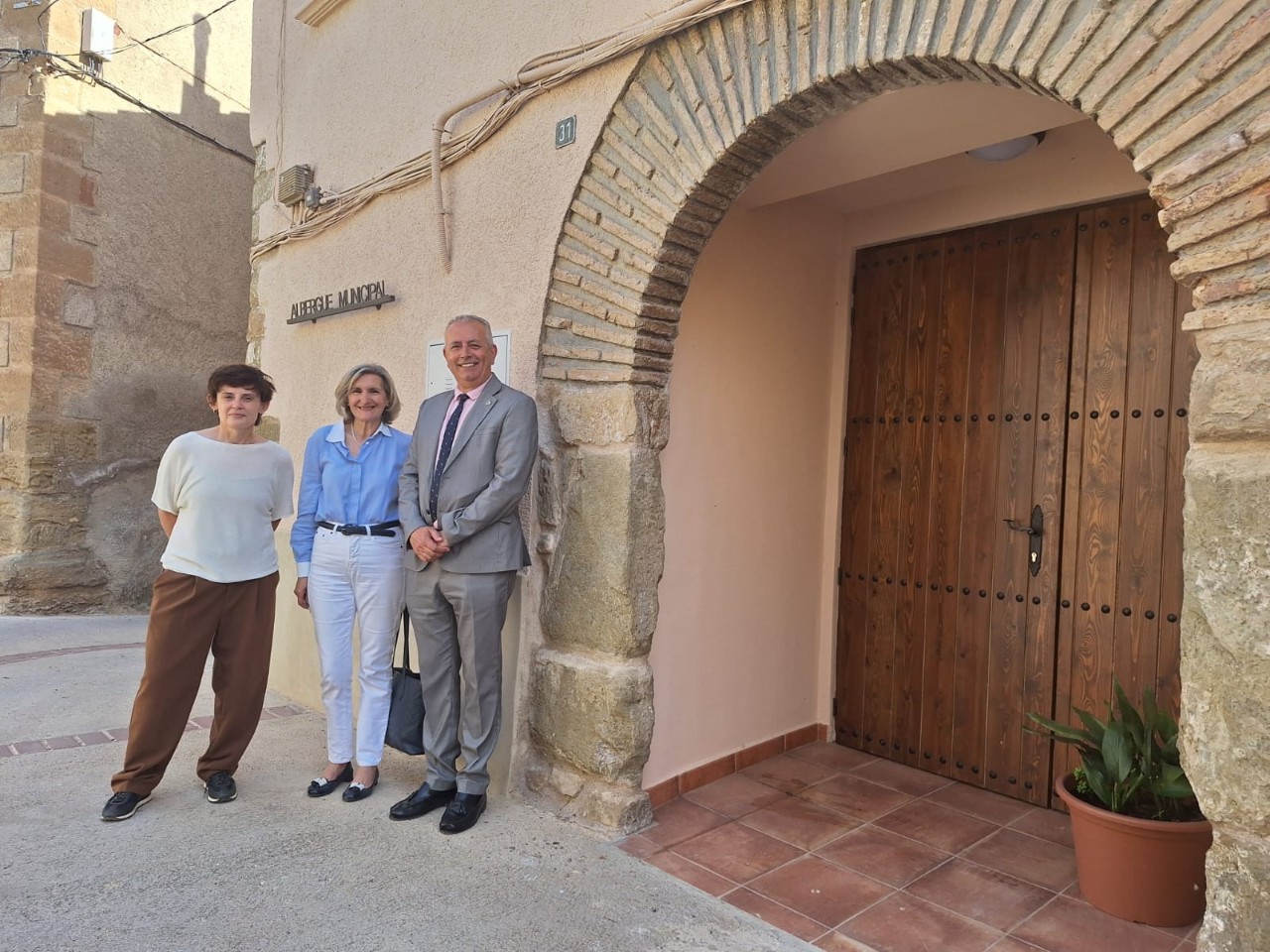
Huesca.- The subdelegate of the Government in Huesca, José Carlos Campo, visited this morning in Bolea the actions developed by the City of La Sotonera thanks to a grant of 1,992,000 euros granted by the Ministry of Industry and Tourism within the framework of the Recovery, Transformation and Resilience Plan and the National Plan of Tourism Sustainability in Destinations Xacobeo 2021.
Among the actions carried out, the construction of a new hostel for pilgrims and visitors stands out, as well as an Interpretation Center that will allow you to visit virtually, through immersive technology, the itinerary followed by the Holy Grail from Jerusalem to Valencia. The project also includes a museum space with the restored Easter Monument with the support of Artificial Intelligence, a new tourist information office with public toilets and the urban improvement of the patrimonial environment of the Collegiate of Bolea through the paving of its accesses.
Likewise, within the environmental axis, the ecological restoration of the Fosal Viejo and the side of the road to Tolato from the urban center of Bolea has been carried out, contributing to the landscape and natural recovery of this environment.
During the visit, Campo highlighted “the institutional collaboration that makes it possible to carry out important projects for the territory” and stressed that these investments allow “to value the history and heritage already owned by peoples such as Bolea, making them more attractive for national and international tourism”.
The subdelegate also recalled that the National Tourism Sustainability Plan in Xacobeo Destinations 2021 has left two important investments in the province of Huesca: the renovation of the Monastery of San Juan de la Peña, executed by the Government of Aragón with 2.2 million euros, and the actions developed in Bolea, executed by the City of La Sotonera with about 2 million euros.
For this reason, Campo also wanted to thank the mayor of La Sotonera, María Isabel Bailo, “for the effort made by the City Council to execute European funds aimed at improving tourism in the province.”
These actions are part of the Recovery, Transformation and Resilience Plan of the Government of Spain, which has already accumulated an execution of 3,804 million euros in Aragon and has benefited more than 53,000 companies, entities and households in the autonomous community.
Among the investments promoted by the European funds in Aragon are strategic projects linked to sustainable mobility, housing, energy rehabilitation or the electric vehicle industry, as well as actions aimed at strengthening the ecological transition and modernization of the territory.