
The subdelegate of the Government in Pontevedra, Abel Losada, went today to Soutomaior to report on the new regulation of historic vehicles approved by the Government and which entered into force on October 1. In a meeting with the councilor, Manuel Lourenzo, in which members of the Club of Classics Seat 600 of Soutomaior also participated, Losada recalled that municipalities now have to adapt their municipal ordinances by establishing formulas that allow the occasional circulation of these vehicles through urban roads, including low-emission areas, provided that they are used as a sporadic and non-habitual means of transport, to minimize their environmental impact.
The new regulation replaces the previous one, from 1995. Its fundamental objective is to reduce and speed up the process of declaration of historic vehicle for owners, with respect to the regulations in force until now. It seeks, therefore, to favor the restoration and conservation of this type of vehicles, betting on the “automotive historical heritage”. It is also intended to promote clubs or entities related to classic cars, since they become able to issue certificates. The regulation also covers agricultural vehicles and mopeds, which were not in the previous regulatory framework.
The government subdelegate stressed that the regulatory change “was very much expected and is having a magnificent reception both among owners and among clubs or associations.” He indicated that it establishes a very important reduction of the procedures to declare a car “historic”. “If before the cost could be around 800 euros, now it will be about 80,” he said. That’s why he insisted that “this rule will also have a very positive impact from the economic point of view, because it will allow more professionals and companies dedicated to the activity of restoring this type of vehicles and increase the activity of buying and selling.”
The mayor stressed that “in the city of Soutomaior there is a great interest in the motor world and with a club of reference classics, which welcomed the normative news very positively”. He explained that “now it is up to the municipalities to do their homework and adapt the ordinances” and celebrated “the facilities introduced by the new regulation.”
Group La or group B
No framework for the simplification of procedures creates an abbreviated procedure for cars with documentation in force (type La). For a vehicle belonging to the “La Group” to be manufactured or registered for the first time at least 30 years ago, stop producing its specific types and be in its original state, with common registration in Spain and ITV in force. The procedure to register them is to request a duplicate of the circulation permit for change of service to “historical”.
Not “Group B” includes vehicles that do not meet the requirements of the first group, in addition to those that do meet, but prefer to obtain a historical registration because the common one assigned to the vehicle does not correspond to that of the date of manufacture or registration. This group also includes imported vehicles, with foreign registration that do not have the ITV in force.
On the other hand, historic vehicles will have a license plate (now they have 2) and on the windscreen they will place a sticker with a capital letter H. Cars over 60 years of age will also be exempted from the mandatory ITV. The regulation harmonizes the Spanish regulations with those of other European countries.
Regulatory changes may mean that Spain will go from having 47,000 historic vehicles to more than 120,000. In Galicia #estimate that there are about 3,100 historic vehicles and that another 7,000 can emerge.
Abel Losada informs the municipalities about the entry into force of the normative news of historic vehicles
17/10/2024
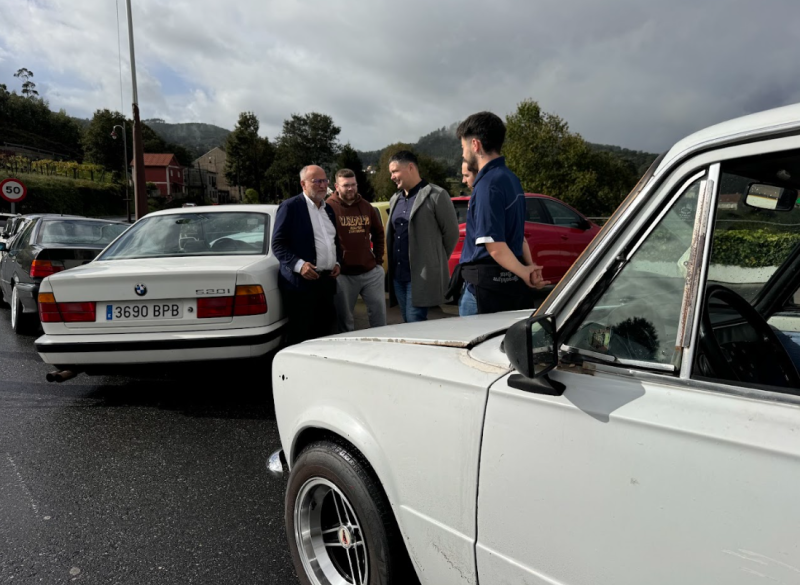
Local authorities now have to adapt their municipal ordinances by establishing formulas to favor the occasional circulation of these vehicles. The government subdelegate stressed that the normative change “was very much expected and is having a magnificent reception both among owners and among clubs or associations.” The new regulation greatly speeds up and reduces the process of declaring a car as a “historic vehicle”.