
“What is the vaccine to end gender-based violence? The education. It is the only way to break with all that normalization, with all that justification, with all that contextualization that leads, when gender violence occurs, instead of producing an absolute rejection, there are those who say, ‘well, something will have done’, ‘well, it is not so serious either’, which are the elements that are playing to distort that cohesion”
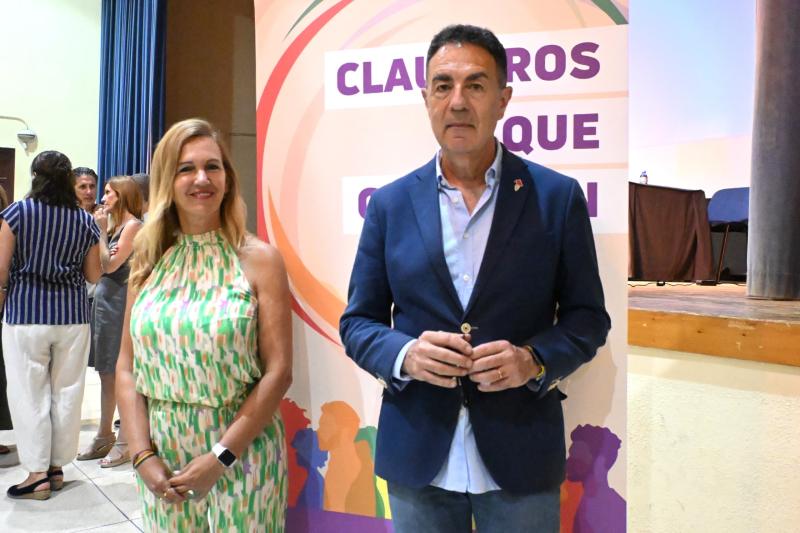
The equality expert and former delegate of the Government for Gender Violence, Miguel Lorente, participated on Tuesday in the second training day within the framework of the activity ‘Claustros que coeducan’, organized by the Provincial Directorate of Education in Melilla.
Lorente, in her speech, made a deep analysis of the causes, consequences and solutions to gender violence, highlighting the importance of education as a fundamental tool for its eradication and stressed that talking about gender violence in the educational context “is a guarantee of the future”. “We have a problem and a present characterized by this violence, even with some data on the most serious results, the homicides,” he said.
In this regard, he recalled that, in the last 23 years, 1,310 women have been killed for gender violence, including the last known victim this morning. In addition, since 2013, 64 minors have been killed in this same context. Lorente has compared these figures with those of the terrorism of ETA, which in 40 years murdered 857 people: “Gender violence in 23 years has killed 1,310 women and, every year, five boys and girls.”
The expert has criticized the “social distancing” from this reality, a reaction that he considers the consequence of a cultural construction that justifies or minimizes violence. “It is thought that it is because of alcohol, drugs or mental disorders, but data from the General Council of the Judiciary reveal that only 1.4% of the aggressors had a mental disorder that influenced their criminal behavior,” he said.
Lorente has also denounced the rise of negationism and the instrumentalization of discourse on gender violence, “fragmenting and contextualizing it” rather than tackling it forcefully. To explain the need for a global response, he has resorted to an analogy with the pandemic: “We did not solve it with hospitals, but with prevention, detection and, finally, vaccination measures. The same thing happens with gender violence.”
In this regard, it has called for an effective detection system, especially from the health field, which is attended by 33% more battered women compared to those who do not suffer violence, according to WHO data. However, he has pointed out that only 25% of victims file a complaint, which shows that the current system does not reach all.
“The vaccine to end gender violence is education,” Lorente insisted, as the only way to break with normalization, justification and the lack of social rejection of violence. “As long as someone says ‘something will have done’, or ‘it’s not that serious either’, we’re not going to build a real solution,” he warned.
Finally, he has appealed to collective responsibility to address this structural problem: “The solution will not start only from a law or an institution. We are all part of that solution. We lack awareness and commitment to break with a culture that confuses, especially men, who often reproduce sexist behavior by social mandate.”
Miguel Lorente has called for reflection, dialogue and active commitment to eradicate gender violence and move towards a truly democratic society based on freedom, dignity and equality.
Training of 400 teachers
Today is the second day of the activity ‘Claustros que coeducan’, organized by the Provincial Directorate of the Ministry of Education, Vocational Training and Sports (MEFPyD) at the IES ‘Leopoldo Queipo’ with the participation of a dozen educational centers in the city.
The Provincial Director of Education in Melilla, Elena Fernández Treviño, thanked the expert Miguel Lorente, who returned to the city to give a training on gender violence aimed at teachers.
Fernández Treviño has very positively valued the participation of the renowned specialist. “Miguel Lorente is a university professor, forensic doctor, doctor of medicine and one of the greatest experts at national and international level in gender violence,” he said, also recalling that he was Government Delegate for Gender Violence in 2008 with the Ministry of Equality.
The Provincial Director has highlighted her informative aspect, mentioning her usual collaboration in media such as El País and her authorship of key books such as ‘The puzzle’, ‘My husband beats the normal’ and her most recent work, ‘The refoundation of machismo’ (2023), in which Lorente “makes an analysis of postculture and identity cultural war, patriarchy, violence and the social situation that leads us to it”.
One of the central axes of Lorente’s intervention, said Fernández Treviño, addresses the analysis of the role of masculinity in the perpetuation of gender violence. “Miguel focuses a lot on that: what role does masculinity play in all this problems, in all this social scourge,” he said.
Fernández Treviño regretted that the sessions took place in parallel with new cases of male violence. “Yesterday and today we have had the latest cases of murdered women. This very morning we received the news that a woman in Valencia has been murdered,” he lamented, insisting that “it is a social reality that we obviously have to deal with with the teachers.”
Finally, he recalled that this training reaches 400 teachers in the city, highlighting the vital role of teachers in the construction of a society free of gender violence. “Doing this analysis in an educational context is a guarantee of the future,” he concluded.