
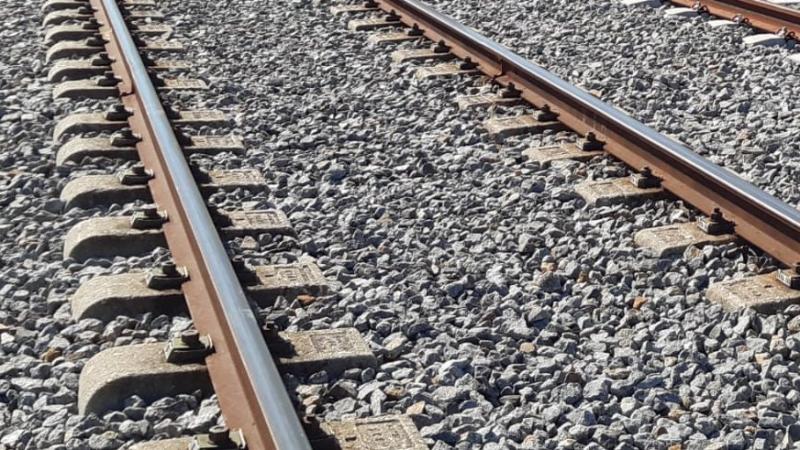
The Ministry of Transport, Mobility and Urban Agenda (Mitma) has submitted to public information the Informative Study the Zaragoza - Castejón section of the Cantabrian - Mediterranean high-speed corridor, through publication in the Official State Gazette of today, as announced by the minister, Raquel Sánchez, on March 17.
The objective of the informative study has been the analysis of alternatives of a high-speed route between Zaragoza and Castejón de Ebro (Navarra), which will connect with the high-speed line Madrid-Barcelona, both in the direction Madrid and in the direction Barcelona and, in the surroundings of Castejón, with the high-speed sections Castejón-Pamplona (currently under construction) and Castejón-Logroño (in environmental assessment).
The new line is proposed as a double track of standard width and electrified mixed traffic at 25 kV, which departs from the high-speed Madrid-Barcelona line in Plasencia de Jalón (Zaragoza) and runs in a north-western direction along the south of the existing conventional Zaragoza–Castejón line to the surroundings of Castejón de Ebro. The length of this performance is approximately 74 km.
Four stages
The scope of the informative study has been divided into four sections, in each of which several routing alternatives have been defined.
In section 1, which covers from Plasencia de Jalón to the municipal term of Boquiñeni, two alternatives are analyzed that present slight variations of layout between them.
In section 2, from the previous section to the municipal term of Tudela, three alternatives are analyzed and two possible locations are proposed for the route of the line and the location of the new station of the Region of Tudela.
In section 3, which extends from the previous section to the connection with the Castejón-Pamplona and Castejón-Logroño sections, two alternatives are proposed with small variations in layout.
Finally, section 4 is located in the area of the arterial network of Zaragoza and two connection alternatives are studied to access the Zaragoza–Delicias station.
In alternative 1 the connection with the high-speed line occurs at the height of the current Plasencia de Jalón width changer and in alternative 2 it is proposed to adapt and implement the standard width in the current Grisén-Casetas section until finally connecting with the high-speed branches that arrive at the station of Zaragoza Delicias.
Likewise, and for the circulation of goods, in the two alternatives of section 4 the new line connects with the conventional Madrid-Barcelona line at the height of the Grisén station, thus allowing access to the facilities of Grisén and Stellantis-Zaragoza. From these terminals it is also proposed to connect with the logistics platform of Zaragoza Plaza on its west side, through a new double track route of approximately 17 km that provides said platform with a through-going functional configuration.
Based on the multi-criteria analysis carried out, the informative study proposes the alternatives that best meet the objectives pursued for sections 1, 2 and 3.
However, it does not opt for any option for the location of the new station of the Comarca of Tudela nor does it propose any alternative in section 4, leaving its selection to the phase after the period of public information and hearing.
Public information and audience of Administrations
The public information process that is initiated is both for the effects foreseen in the Railway Sector Law and for the environmental effects collected in the Environmental Impact Assessment procedure.
This process is open for a period of 30 working days from the working day following the publication of the announcement in the BOE, and aims to enable interested persons, institutions and administrations to comment on the overall design of the route and on the environmental impact.
The documentation can be consulted through the Internet, at the following address:
https://www.mitma.gob.es/ferrocarriles/estudios-en-tramite/estudios-y-proyectos-en-tramite