
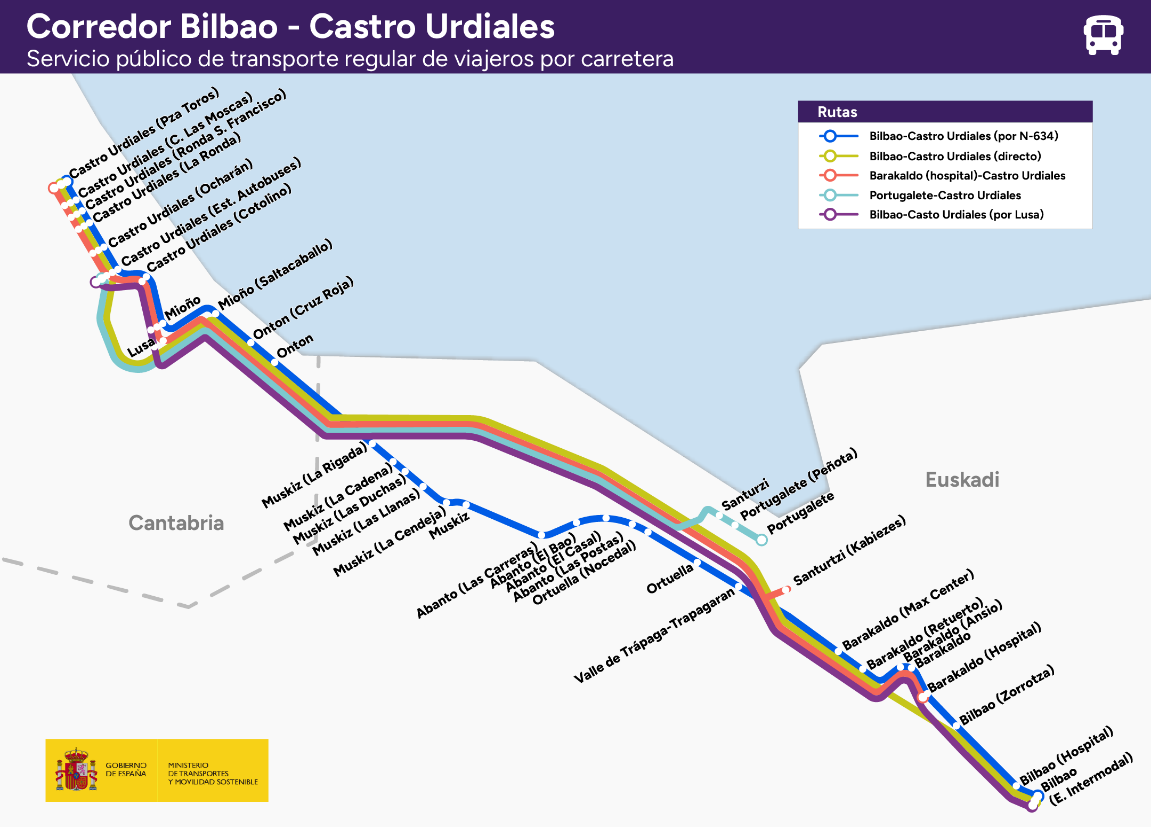
- The Council of Ministers today approved the project of public road transport between Bilbao and Castro Urdiales, maintaining traffic and previous stops, with new direct services passing through Lusa, and between Castro Urdiales and Portugalete.
- This corridor connects municipalities of Bizkaia and Cantabria, among which more than 23 million travelers a year move, of which more than 1 million use the bus.
- Also today the public hearing of the Madrid-Zaragoza corridor begins, with all the current stops, which connects 7.1 million people in 45 municipalities of Barcelona, Guadalajara, Lleida, Madrid, Soria, Tarragona, Huesca and Zaragoza.
- This corridor includes the services Madrid-Malaga-Zaragoza–Barcelona; Madrid-Malaga-cities of Lleida and Tarragona; and a route between Zaragoza and the region of the Lordship of Molina-Alto Tajo.
- In parallel, progress continues to be made in the reorganization of the Concessional Map in which the Ministry will maintain all current stops and routes, with a strategy that will allow the reduction of tariffs, Renew fleets and improve the services.
The Council of Ministers today approved, on the proposal of the Ministry of Transport and Sustainable Mobility, the project to establish the public service of regular passenger transport by road between Bilbao and Castro Urdiales, in what is the beginning of the Concessional Map. In addition, also today, the Ministry has opened the public information procedure for the preliminary project of another corridor of the new Concessional Map, with lines and stops for regular passenger transport services by road between Madrid, Zaragoza and Catalonia.
Bilbao–Castro–Urdiales Corridor
The Bilbao–Castro–Urdiales Corridor is included among the corridors with a metropolitan character, with a distance between both cities of just over 30 km. The service will connect nine municipalities of Bizkaia and Cantabria: Abanto and Ciérvana-Abanto Zierbena, Barakaldo, Bilbao, Atlantic-Urdiales, Muskiz, Ortuella, Portugalete, Santurtzi and Valle de Trapaga-Trapagaran.
In this way, it includes the relations between the populations between Bilbao and Castro Urdiales that have an important functional relationship, whether for work, studies, health or leisure. The main traffic routes along this corridor are the A-8 and N-634 national roads and other provincial roads, such as BI-734.
The passenger transport service that is the subject of the project approved today is divided into 5 routes: Bilbao Casto Urdiales (by N-634); Bilbao Casto Urdiales (direct); Barakaldo (hospital)-Castro Urdiales; Portugalete-Castro Urdiales, being this is one of the novelties of this service; and Bilbao Castro Urdiales (by Lusa).
Taking into account the nature of the public service owned by the General Administration of the State, the need to guarantee territorial cohesion and the entity of the population centers that will connect this corridor, it is considered that there are reasons of public interest that justify the need to continue providing these traffics.
It should be noted that the Ministry has prepared a project to establish this new service that takes into account the contributions made during the consultation and public hearing procedures, accepting 89% of the allegations received.
Madrid-Zaragoza corridor - Catalonia
With regard to the Madrid-Zaragoza–Catalonia corridor, the public information procedure for the preliminary project has been opened today, with the publication of on the website of the Ministry for consideration by potential stakeholders. Thus, from today and for thirty days, the interested parties will be able to formulate the allegations that are deemed appropriate through the Electronic Headquarters of the Ministry of Transport and Sustainable Mobility.
This corridor will connect the provinces of Barcelona, Guadalajara, Lleida, Madrid, Soria, Tarragona, Huesca and Zaragoza, with stops in 45 municipalities that have a population of more than 7.1 million.
It will include the service Madrid – Guadalajara – Zaragoza – Barcelona; Madrid – Zaragoza – municipalities of Lleida and Tarragona; as well as a route between Zaragoza and the region of the Lordship of Molina-Alto Tajo. These traffics are currently served by concessions VAC-099 and VAC-263.
The new arrangement will mean a series of improvements in the offer of services, with connections that have been defined according to the new mobility demands. In addition, a fare improvement is achieved in terms of price per traveler and km travelled, which means a reduction of 25.8% with respect to the previous rates.
The new connections of the Corridor are:
- Calatayud-Guadalajara
- Madrid-Manresa
- Madrid-Sabadell
- Madrid-Tarragona
- Manresa-Zaragoza
- Sabadell-Zaragoza.
In addition, a new stop is established at Barcelona Airport, which means an improvement in intermodality with other public transport services.
Updating and reordering of the Concessional Map
The current concession system serves nearly 2,000 municipalities throughout the country, being an extensive and vital network for inter-urban mobility. This system originated in the 40s of the last century, and over the decades it has proven to be an effective model to guarantee connectivity and accessibility through regular bus services, considered to be of public interest.
The Ministry of Transport and Sustainable Mobility, aware of the current challenges and the delay in the implementation of this new design, has decided to move forward in the reordering of the current concessional map without losing the essence of the system that has worked.
This means that it is the Ministry that maintains all current stops and routes, guaranteeing the continuity of the services that users know and value, but allowing progress to be made in the renewal of state concessions, an issue that has also been marked as a priority within this scheme.
To this end, the necessary tender procedures will be launched that will respect the legal conditions in force and promote fair competition between concessionaire companies. This strategy will allow us to meet several objectives, such as the generalized reduction of tariffs, the empowerment of direct routes while maintaining current coverage, greater legal security for companies, improvement of sustainability through fleet renewal and improvement of services through new channels of communication and ticket marketing and the implementation of intelligent transport systems that provide information to the user.
Further progress will, as noted, require the involvement of CCAAs. Thus, the Ministry will continue to work with them in the spirit of collaboration that it has maintained to date.