
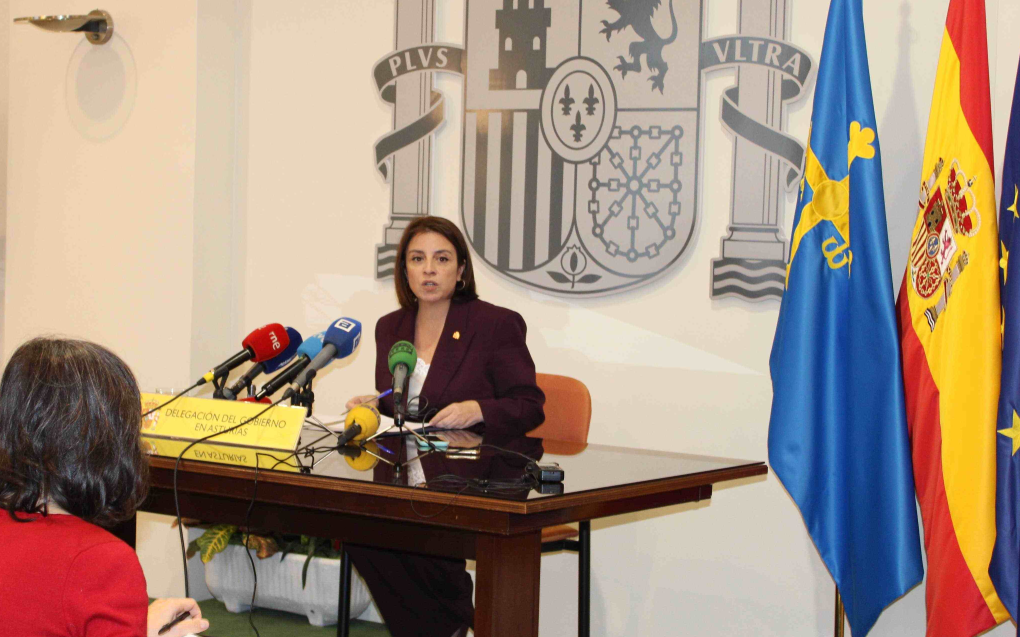
The delegate of the Government of Spain in the Principality of Asturias, Adriana Lastra, pointed out this Friday in an appearance before the media that the impact of the new model of regional financing "will be positive" for Asturias and also to contribute to shielding the Welfare State.
“Our community is, together with Castilla y León, the most benefited by the criteria of adjusted population, which are those that take into account not only the number of inhabitants, but also factors such as aging, territory, dispersion or the higher costs of providing services in rural areas,” he said.
Adriana Lastra has stressed that for the calculation of the new system, the adjusted population of Asturias is 9.6% higher than the real population. “This means that for every 100 Asturians, the model recognizes needs equivalent to serving almost 110 people, because the effort to guarantee quality public services in a territory with our orography and dispersion is objectively greater,” he explained, adding that it is also the second community most benefited by applying the dispersion variable.
The government delegate pointed out that in Asturias the proposed model would mean increasing the resources it would receive with the current model by about 248 million per year. Additional resources that will serve to strengthen public health, improve education, strengthen social services and ensure that no one is left behind. “In short, more means to continue protecting and modernizing our Welfare State,” he said.
Lastra has affirmed that this reform improves resources for all communities, increases solidarity, improves horizontal and vertical leveling mechanisms, and promotes greater autonomy and fiscal co-responsibility.
In addition, he recalled that the previous model has been expired for 13 years and that the new one will be discussed in the Fiscal and Financial Policy Council, where all the autonomous communities are represented, and will be approved in the Congress of Deputies, headquarters of national sovereignty.
Adriana Lastra maintains that the Government of Spain “has done its homework” and “its good work in economic matters” allows more resources to be distributed among the autonomous communities, in such a way that it presents “a serious, solid model designed for the general interest” against a Popular Party that has not been able to propose a reform proposal or articulate a coherent discourse on autonomous financing.
“This new model benefits the autonomous communities as a whole, improves territorial equity and recognizes the specific needs of regions such as Asturias. Thanks to him, we will be able to move towards fairer financing, towards a more cohesive Spain and towards a stronger Welfare State,” he said.
NEW MODEL
The Government delegate in Asturias appeared on the occasion of the presentation of the new model made this Friday by the First Vice-President of the Government and Minister of Finance, María Jesús Montero.
The new model is estimated to bring in 2027, when it is expected to enter into force, 20,975 million more than the communities would obtain if the current model were maintained. The total resources that this model will distribute in 2027 are estimated at 224,507 million. In the last liquidated year, which corresponds to 2023, the autonomous communities received 152,484 million from the financing system.
Montero explained the basis of this new financing model, thus fulfilling the promise of the President of the Government, Pedro Sánchez, to propose a broader and fairer financing for the CCAA while recognizing the singularities of each territory.
This proposal has been sent to all the regional governments for their knowledge, so that it can be debated and analyzed next Wednesday in an extraordinary Fiscal and Financial Policy Council (CPFF).
Bases and principles of the new model
The new model of regional financing incorporates new distribution criteria, methodological improvements and is limited to principles that for the Executive are priorities:
· A new adjusted population proposal is included that contemplates new variables that respond to the challenge of depopulation and incorporates a more precise stratification of population groups.
· Increased tax capacity, which increases fiscal autonomy and co-responsibility and strengthens the principle of sufficiency.
· It expands, strengthens and guarantees interterritorial solidarity through an equitable, objective and transparent horizontal levelling mechanism.
· Vertical levelling is also guaranteed with an additional contribution from the central administration that will increase investment in health and public education and social policies.
· Greater autonomy is also reflected in the possibility for communities to receive the collection of VAT generated by SMEs in their territories.
· The model adapts to the new realities by including a fund to face the challenge of climate change
· Status quo guarantee, whereby no regional CCAA receives less than with the previous model.
· Supplementary financing mechanism.
The improved funding in the case of Asturias is explained because it will be one of the most benefited by the new adjusted population criteria.
New criteria in the adjusted population
Along with the State ' s greater contribution to the system, one of the fundamental elements of the new model is the adjusted population criterion. It determines the number of inhabitants of each autonomous community by weighing variables that influence the cost of services and financing needs.
Thus, the distribution of autonomous resources is defined according to the demographic, socio-economic and geographical characteristics of the autonomous communities. For example, health spending will be higher in a very ageing community, while another community will have greater needs in education if it has a higher proportion of school-age inhabitants.
As María Jesús Montero recalled, last February the Government opened a negotiation process with the communities to update the criteria that determine the adjusted population. Finally, it was not possible to reach a consensus and it was the communities themselves who called on the Executive to submit a proposal, as has happened.
After incorporating the methodological improvements, the main variables that make up the Government’s improved adjusted population proposal are as follows:
- Population Padrón. One of the most relevant variables. It accounts for 30% of the adjusted population weight.
- Equivalent protected population. Pretender representar el gasto sanitario, partida presupuestaria más amplia en el ámbito autonómico. Its weight is 38%. For its calculation, it is divided into 20 age groups, leaving behind the seven of the current model. This allows greater reliability in the delimitation of the resources necessary for the different population groups. In other words, health costs are approximated according to the age of the beneficiaries.
- Education. To determine the educational expenditure, the number of inhabitants between 0 and 17 years old is taken into account, whose weighting reaches 17%. And, in addition, two other new criteria are introduced, such as the number of inhabitants between 18 and 24 years old and the number of university students who move to study in other communities. This recognizes the cost of a community hosting students from other regions in its education system. These variables add up to a weight of 3.5%.
- Social services. The base is the population over 65 years of age, which makes much more use of health-related services or dependency. The novelty is that it is broken down into two sections, between 65 and 79 years old and over 80 years old. The weighting of this variable is 7%. Another novelty is the addition of the number of unemployed without benefits, with a weight of 1.5%, as representative of poverty and social exclusion.
Along with these relevant elements to determine the adjusted population, the model includes others that affect the cost of public services. And they will especially help the autonomies that face the challenge of depopulation.
· Surface. The square kilometers of each community account for 1.6% of the weighting.
· Dispersion. It has a weight of 0.5%. It is determined according to the singular entities of inhabited population.
· Insularity. It is 0.5% in the calculation.
· Fixed costs. This is a new approach advocated by numerous regional CCAAs. It has a weighting of 0.4%, especially benefits communities affected by depopulation and recognizes the difficulty existing in some communities to achieve economies of scale due to their low population.
The funding system that emerged from this new model benefits Asturias through this proposal of the adjusted population criterion. This is due to the fact that its adjusted population is 9.6% higher than the real population. That is, for the financing model, Asturias has more than 96,200 inhabitants more than those that appear in its register. In addition, it is the second community most benefited by applying the dispersion variable when calculating the adjusted population.
Increase in tax capacity
Most of the resources of the autonomous communities come from the taxes ceded and the proposal presented by the Government contemplates increasing the tax capacity of all the communities, which will result in more income and autonomy. Currently, the tax capacity of the communities is determined by the normative collection of the following taxes:
· 50% of IRPF and VAT.
· 58% of special taxes on tobacco, alcohol, beer and hydrocarbons.
· 100% of Taxes such as Inheritance, Property Transfers and Documented Legal Acts, Special on Certain Means of Transport, taxes on gambling and the Electricity Tax.
This new financing model proposes an increase in this tax capacity, making it easier for them to have more income and greater fiscal autonomy. In particular, resources will increase by nearly $16 billion by 2027.
The most significant modification is the increase in the transfer for IRPF and VAT. With the new model, IRPF would yield 55% and VAT would yield 56.5%. In addition, taxes on heritage, bank deposits, gambling activities and on the disposal of waste in landfills will be included in the resources of the financing system.
Horizontal levelling
As Montero has pointed out, the model strengthens and extends interterritorial solidarity. This translates into ensuring that all communities reach 75% of the average adjusted per capita resource determined from their tax capacity.
In this way, communities with below-average per capita funding will receive more resources, while those above the average will contribute to the common good of the system. This serves, on the one hand, to guarantee interterritorial solidarity and, on the other, to reduce the distances in financing per inhabitant.
Vertical levelling
This parameter is the one that most clearly makes visible the commitment of the Government and the State with the autonomous communities and the Welfare State. With a contribution of 19 billion, the initial objective is to reduce by 2/3 the distance of each CCAA from the one with the most resources, which is the Community of Madrid. This calculation will allow those more remote communities to receive more resources compared to those that enjoy a better position.
The resources that the State initially contributes to vertical levelling will come from 5% of the IRPF yield and from an additional transfer until it succeeds in reducing by 2/3 the distance of all communities from which it has greater resources.
Rest of elements
All the above parameters represent 99% of the autonomous resources, which have been allocated after determining the tax capacity and establishing the horizontal and vertical levelling mechanisms. The model contemplates other elements, but with less economic importance.
· VAT Mechanism for SMEs. To move forward with greater fiscal autonomy and co-responsibility, while encouraging economic development, CCAAs will be able to receive a portion of the VAT collection generated by SMEs in their territory. With this measure, which must be requested by the autonomies, the effort of the autonomous communities in promoting and supporting small and medium-sized enterprises is recognized. The amount arises from calculating the difference that exists in the community between the relative weight of VAT paid by SMEs in that territory and the consumption index. If the VAT of SMEs exceeds the consumption rate, the community will receive a positive transfer for the difference. Otherwise, the amount will be negative.
A relevant aspect is that the funds of this phase are not competitive, so an increase in resources in one territory does not involve removing them from another.
· Climate fund. Faced with the challenges of the climate crisis, the financing system will be provided with a climate fund of about 1 billion. 2/3 of it will be distributed among the autonomies of the Mediterranean coast, the most affected by its exposure to the warming of the Mediterranean Sea and its effect on the climate. The remaining third will be received by the other communities. The distribution will be carried out under the criterion of adjusted population.
· Guarantee of status quo. There will be a closing element to guarantee the status quo, so no community, at the beginning of the application of the system, will receive fewer resources than would have been obtained with the previous model. This mechanism will be financed with contributions from the central administration, which will contribute some 400 million to this end, which will especially benefit Cantabria and Extremadura.
The status quo is the last element of the financing model and it acts as a closure. In any case, the First Vice-President of the Government and Minister of Finance has outlined other aspects of the proposal related to tax management and the financing of non-homogeneous competences.
Supplementary funding mechanism
The proposed model establishes that the financing of non-homogeneous competences may come from a higher percentage of VAT ceded. This additional assignment will be fixed in the base year according to which each autonomous community is assigned.
This is an optional mechanism. Therefore, if the communities so wish, they will be able to choose to receive the financing of non-homogeneous competences as before through a transfer evolved by the State Income Index (ITE).
As in the case of VAT for SMEs, the option to choose is again given, which strengthens the autonomy of the communities and reflects the flexibility of the new financing model.