
- Prieto highlights the role of the legislator to develop the text of the Constitution
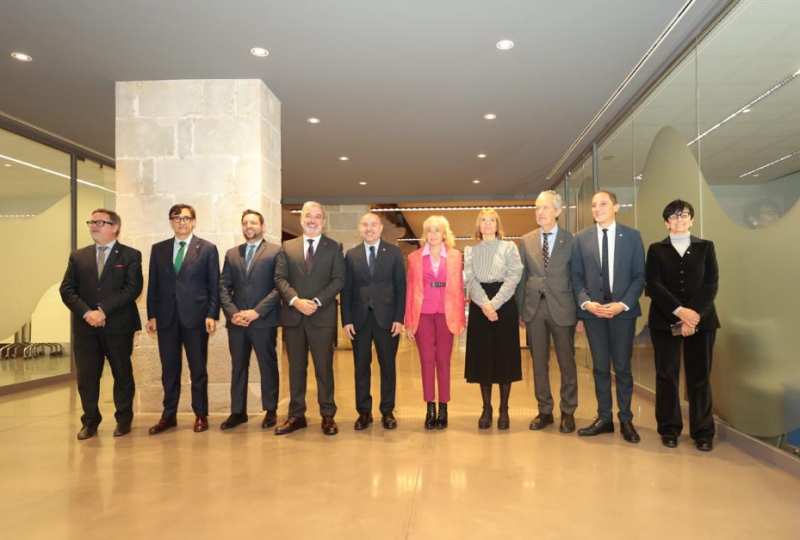
Barcelona, December 4, 2023.- The Permanent Councilor of State, María Teresa Fernández de la Vega, and the Government delegate in Catalonia, Carlos Prieto, have claimed that the Constitution was born of “a pact between diverse people who thought differently”. They said so at the celebration of the 45th anniversary of the Spanish Constitution that was held this Monday in the auditorium of the Maritime Museum of Barcelona. The event was attended by the mayor of Barcelona, Jaume Collboni, and the president of the Provincial Council of Barcelona, Lluïsa Moret.
The permanent councilor of State, María Teresa Fernández de la Vega, said that the Constitution is “one of the greatest collective successes of our transition” because it “made a reality the long aspiration of a model of society with equal rights and opportunities” that has served as “a basis for the progress and well-being of citizens”. De la Vega has assured that the state of the autonomies has been a success because it “responds to the so-called regional problem” and “to decentralization” and because it has led to the “institutional reality” a “settlement between Spanish patriotism and temperate regional nationalisms.” In this sense, he has pointed out that, “although territorial minorities did not participate, it does not mean that they were not taken into account” and has ruled that “in the Constitution there is only one holder of maximum power that is the Spanish people”.
De la Vega also said that, in Catalonia, the Magna Carta responded to basic aspirations: the “political autonomy” that has allowed the Generalitat to acquire more and more competences and the “declaration of Catalan as an official language” that became “compatible with the co-functionality of Spanish”.
The permanent advisor has also defended the importance of the “fourth Industrial Revolution” based on information and communication technologies and artificial intelligence. He considered that they should be addressed by the Constitution because they offer “new challenges that affect the person.” “Taking advantage of technologies, but also preserving the fundamental rights that are sacred” is an issue that must be protected by the Magna Carta, he explained, “to live in a world where we live better and safer.”
For his part, the delegate of the Government in Catalonia, Carlos Prieto, recalled how “45 years ago dialogue and understanding were opened, reason and the will to agree, to live together, to share” were imposed when the Spanish Constitution was approved. Prieto has assured that “the Constitution is the fundamental pillar where the construction of today’s Spain, of modern, diverse, supportive and fair Spain has rested” because “it was born of a pact between diverse people who thought differently”. The delegate explained that with the Magna Carta “a historical debt has been settled with women” and defended “cultural and linguistic pluralism” that “is an indissociable part of being Spanish, a constituent part of the many Spain that make up Spain”.
DEFENSE OF DISSENT
According to Prieto, “the constitutional text accommodates all forms of being, feeling, thinking” and “allows and protects the dissent and criticism that are essential to advance collectively.” The delegate said that “the Constitution gives rights, not fencing them, brings with it progress and not immobility, it is not static, it is dynamic, because that is what society demands of us and that is how we must respond from the institutions”.
“We must honour every day with our actions those who had the courage and courage to renounce, to yield and agree in the name of a common good, of a higher interest: democratic coexistence,” Prieto said in his speech.
THE COUNCIL AND THE LEGISLATOR
The government delegate stressed that “the Constitution is a text with firm covers and flexible sheets” and stressed the open-minded spirit that the parents of the Constitution wanted to give to the Constitution. In this regard, he has highlighted the role they gave the legislator to develop it: “Flexibility was given by the parents of the Constitution, who entrusted the legislator with the development of its content and allowed with its wording that it could always respond to the challenges of the present, as it then responded to the challenges of its time.”
COLLBONI AND MORET
For his part, the mayor of Barcelona, Jaume Collboni, has claimed the “institutional normality” of this act organized between several institutions, a sign of the “firmness of democracy”. For the mayor, the achievement of the Constitution is “to have overcome a deep division in our country, to have overcome a dictatorship”, and “to have normalized a model of coexistence between Spaniards”.
Finally, the president of the Diputación de Barcelona, Lluïsa Moret, defended the Magna Carta for being “a great pact that emerged from dialogue, negotiation and generosity among Spaniards”. “That spirit of equality, justice and freedom must be more valid than ever,” Moret said. The president has assured that the Constitution must be “the framework where progress must be made and the new challenges that must be met as a society and country.” “It’s the point of reference that all Democrats share,” he said.
The event was attended by former government delegates in Catalonia Joan Rangel, Teresa Cunillera, Ferran Cardenal and Montserrat Garcia; the leader of the opposition, Salvador Illa, and the first secretary of the Bureau of the Parliament, Ferran Pedret. Senators Gabriel Colomé and Manuel Cruz; the mayor of Tarragona, Rubén Viñual, and the deputy mayor of the city of Barcelona Maria Eugènia Gay--also ex-delegate of the Government in Constitution--, Albert Batlle and Jordi Valls.
There were also the Superior Prosecutor of Catalonia, Francisco Bañeres; the President of the Superior Court of Justice of Catalonia, Jesús María Barrientos; the Superior Chief of the National Police, Luis Fernando Pascual; the Chief Divisional General of the Civil Guard Area, José Luis Tovar; and the commissariat in Cap de los Mossos d’Esquadra, Eduard Sallent, among others.