
Toledo. Today Monday begins a new special surveillance campaign of the General Directorate of Traffic that will last until next Sunday, July 21 and that, on this occasion, will focus on awareness, surveillance and speed control, especially on conventional roads and urban roads, as one of the key risk factors in road accidents.
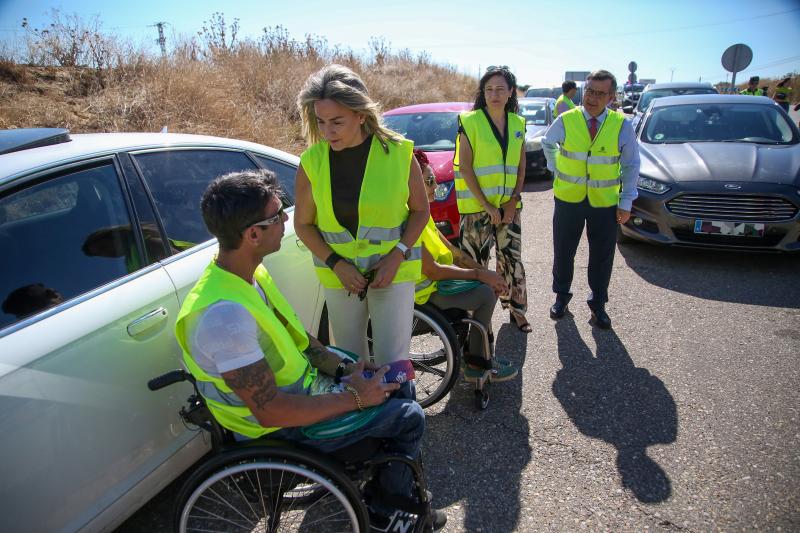
The delegate of the Government of Spain in Castilla-La Mancha, Milagros Tolón, has presented this campaign of the DGT, which is carried out on the ground by the Traffic Group of the Civil Guard and which, as in previous occasions, has been joined by the Association of People with Spinal Cord Injury and Other Physical Disabilities (ASPAYM).
The initiative aims to “make citizens aware of the risk of exceeding speed limits and their incidence of traffic accidents”, said Milagros Tolón, who stressed that respecting speed limits “we avoid risks for ourselves and other road users, improve the response to an accident and reduce the consequences”.
The government delegate pointed out that inadequate speed is the third most common concurrent factor and thanked ASPAYM for its involvement in this campaign, making it “more effective and for drivers to understand very directly the consequences of driving at an inadequate speed”.
This campaign, which is carried out both on urban and interurban roads, is a good example of institutional collaboration between the Civil Guard, the local police that have joined and associations such as ASPAYM, said Milagros Tolón, who stressed that all of us “join in the work of reducing traffic accidents”.
“Don’t step, live more”
In an event in which ASPAYM volunteers have informed drivers of the possible consequences of having an accident associated with inadequate speed, the president of the entity, José Ramón del Pino, has said that this is the eighteenth campaign that the entity carries out on overspeed, this time under the slogan “Do not step foot, live more”.
“Speed causes one in three deaths,” said Del Pino, who explained that excess speed coupled with distractions are avoidable circumstances that together cause significant harm to victims of traffic accidents.
Prevention
For her part, the provincial head of Traffic of Toledo, Eva María Moreno, thanked the collaboration of ASPAYM and explained that the campaign has a preventive character, with the signaling of the controls, and awareness with the participation of people who have suffered the consequences of an accident.
The presentation was also attended by the subdelegate of the Government in Toledo, Carlos Ángel Devia, and the head of the Traffic Subsector of the Civil Guard of Toledo, Andrés Julián Alcaraz.
Awareness and surveillance
With this campaign, the Directorate General of Traffic emphasizes that, although there has been a decrease in the number of drivers reported for overspeed, it is necessary to continue to make the maximum effort of awareness and surveillance, since it has a very important impact on road safety, the environment, fuel consumption and the quality of life of urban areas, endangering the safety of pedestrians and cyclists.
In urban areas, especially in the case of a traffic jam, speed is decisive, since from 80 km/h it is practically impossible for a pedestrian not to die in a traffic jam; while, at a speed of 30 kilometers per hour the risk of death of the pedestrian is reduced to 10%.
During this week, Traffic Agents of the Civil Guard and the local police will intensify surveillance in their respective areas of competence, with the aim of controlling especially sections of risk associated with speed, as well as those points where the circulation exceeds the established limit and there is a high accident rate, all following the recommendations of international and European organizations that urge the agencies in charge of road safety in the different countries to monitor that the established speed limits are met.
Taking into account their preventive nature, drivers will be notified of the existence of controls, either through variable message panels or through circumstantial vertical signage when the road does not have such panels.
It has been proven that speed not only affects the risk of being involved in a traffic accident, but also that, the faster it will be, the more difficult it will be to react in time to prevent the accident and the more serious the injuries produced as a result of it will be.
Intelligent Speed Wizard
On the other hand, the DGT also highlights the importance of new technologies in the field of road safety. In this sense, all vehicles approved since July 6, 2022, as well as new registered vehicles from July 6, 2024, must have a series of advanced safety functions, the so-called ADAS, among which is the Intelligent Speed Assistant (ISA).
This system, made up of the vehicle’s navigator, which shows the speed limit on the road on which it travels, and a signal recognition system that complements digital cartography and detects temporary speed limitations, helps the driver to know and respect the speed limits, thus contributing to the improvement of road safety.