
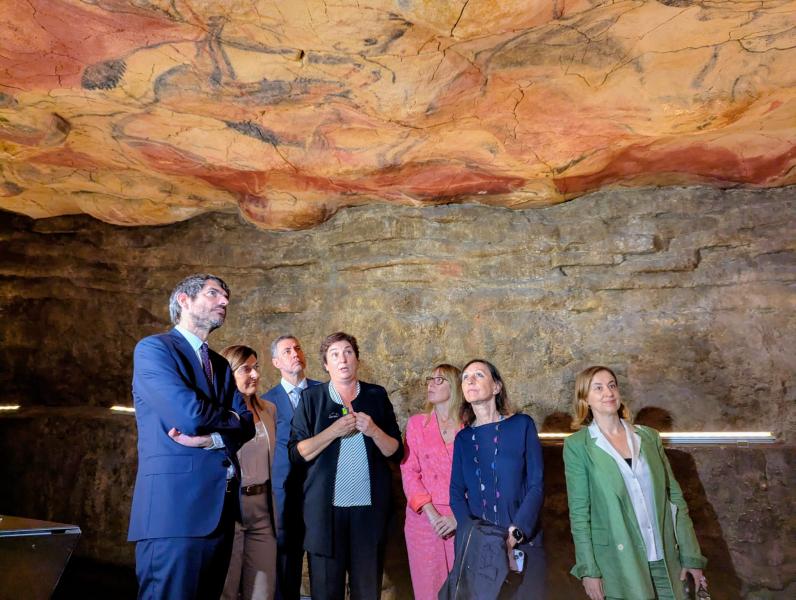
The Minister of Culture, Ernest Urtasun, today chaired the meeting of the Board of Trustees of the National Museum and Research Center of Altamira, which was held in Santillana del Mar. During the meeting, the main lines of action and investments of the institution have been addressed. Thus, the Ministry of Culture has reported that, after investing around 2 million euros in 2024 in the museum, the new investments planned for 2025 will be more than 1.1 million, and will be destined to improve access to the museum, renew the lighting of the Neo-Cave, the digital modeling system BIM of the cave and the purchase of a land to reinforce conservation.
Prior to the meeting of the Board of Trustees, the delegate of the Government in Cantabria, Eugenia Gómez de Diego, accompanied the minister, along with other authorities, on a visit to the Neocueva that was guided by the director of the Museum, Pilar Fatás.
Among the agreements reached at the meeting, it has been unanimously approved that the young people of Santillana del Mar who turn 18 years old can access the original cave of Altamira that year. Thus, of the 250 visits allowed each year for preventive conservation issues, 20 will be reserved for young registered students in Santillana del Mar. The measure seeks to promote the feeling of belonging of the cave of Altamira and reinforce the patrimonial identity of the young people of the municipality. It will begin to be applied with people who turn 18 years old this year 2025, who will be able to visit the cave in 2026. The selection system will be determined by the City of Santillana del Mar, always under the criteria of transparency in the selection.
Regarding the general regime of visits to the original cave, the Board of Trustees has decided to maintain it, to ensure its preventive conservation. Currently, people who visit the cave are cited in chronological order of request from the waiting list, which contains requests from 1999 to June 2002, when the cave was closed to the public visit for conservation issues. After the closure, visits were resumed in 2014 limited to five people per week selected by public draw. This system was modified after the COVID 19 pandemic, at which time the previous waiting list was resumed, from which the first 720 requests have been managed so far.
As the minister said at the end of the meeting, “Altamira is not only a heritage of our country, but of humanity, and that exhorts us to protect it with more dedication, knowing that we preserve the legacy of the world”, for this reason, he added, “from the Ministry of Culture we will continue to protect, investigate and disseminate this unique heritage, so that future generations can continue to admire it as we do today”.
Technology for conservation
The conservation of the cave is subject to a strict monitoring and control system established in the Preventive Conservation Plan. The environmental conditions of the cave are continuously monitored through state-of-the-art technology.
In this sense, the Institute of Cultural Heritage of Spain has presented at the Board of Trustees a new management tool, pioneer in the application of BIM technology to cultural heritage, which will allow to generate a digital twin of the cave. With this system all the agents involved in the conservation of Altamira, as well as the technicians of the museum as researchers of the University of Cantabria and other institutions, who must also work respecting the access protocols, will be able to have all the data available in a more agile and immediate way.
In addition, this collaborative work methodology will be able to make predictions based on the different data of the good and its environment of influence, and thus facilitate decision making in conservation issues.
The works to apply this new technology, developed by the public company INECO and with an investment by the Ministry of Culture of 370,000 euros, began in April of this year and its total implementation is scheduled from May 2026.
A new hosting space
In addition to preventive conservation work, the ministry actively works on updating and improving its facilities. Therefore, in the last year various investments have been made to improve the tightness of the building, and also work has been done on the design of a new reception space whose project has been carried out by the study of Juan Navarro Baldeweg, who was also in charge of designing the headquarters of the museum in 2000 and whose tender is scheduled for next year.
Active work is also being done to improve the sustainable management of the museum. In this regard, the installation of nine charging points for electric vehicles in the car park has been planned and the renovation of the lighting system of the Neocueva is being studied, which will be updated in the coming months. On the other hand, and in relation to accessibility, an alarm system has been installed in the specially conditioned bathrooms for people with motor disabilities.
For its part, the Government of Cantabria has informed the plenary of the Board of Trustees of the cession of two lands near the Museum of Altamira that will allow to increase the protection environment of the cave. For its part, the Ministry of Culture will acquire a piece of land attached to the museum site, under which the last section of the cave runs, and which will ensure the complete conservation of the cave.
The investments planned for 2025 by the Ministry of Culture, worth more than 1.1 million euros, are in addition to those made during 2024, which involved an investment of about 2 million euros. Thus, over the past year, the museum library cover was waterproofed, the interiors affected by humidity were repaired and the accessibility of adapted bathrooms was improved. In addition, in 2024 the design of the new reception space of the museum was carried out, as well as the drafting of the project of improvements in the parking.
Centro Internacional de Arte Rupestre
Between June 4 and 6, the National Museum and Research Center of Altamira is also the venue of the II Ibero-American Meeting of Site Managers with World Heritage Cave Art.
This meeting, which brings together representatives from more than 10 Latin American countries, is organized by the International Center for Cave Art (ICRART), a project created between the Ministry of Culture, through the Museum of Altamira, and the Government of Cantabria. Its objective is to provide technical assistance in the development of research, conservation, training, dissemination and management of rock art at international level, with special attention to those sites included in the UNESCO World Heritage List. This center is a networking platform and facilitator of connections between agents involved in the management of a heritage as fragile as it is exceptional.
Altamira and contemporary art
The line of work of the Altamira Museum is also developed in its commitment to contemporary art both in the exhibition projects and in the new acquisitions of funds.
Among the 13 exhibitions held in the museum from 2023 until today some of those that have developed contemporary artists have been ‘Rockstar’, by Miguel Tornero; ‘Pi©A$$o’, by Rogelio López Cuenca or ‘Ephemeral Cartographies’ by Mendía Echeverría. In addition, these days, you can visit the exhibition ‘A new story’, of the National Photography Award, Isabel Muñoz.
This connection reveals the actuality of a cave that represents creativity at the origin of the human being and that today continues to be a source of inspiration for contemporary creation.