
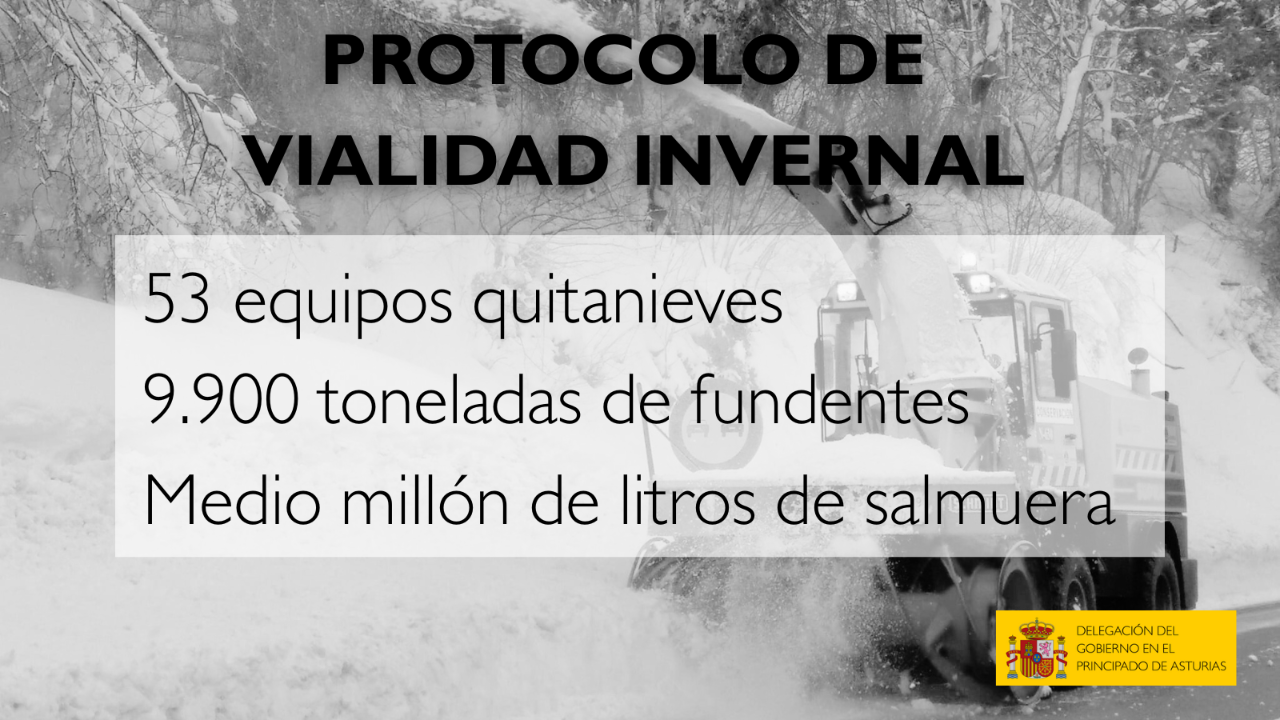
The Government Delegation in the Principality of Asturias and the General Directorate of Traffic (DGT) have updated the Coordination Protocol for Snowfall and other Adverse Weather Phenomena that may affect the State Road Network during the 2025-2026 campaign.
In winter there are frequent weather situations unfavorable to driving, mainly snow and ice, that affect the roads and compromise the road conditions, generating a risk for the safety of the people who circulate through them.
In these situations, the General Directorate of Traffic plays an important role in coordination with the other bodies of the General Administration of the State involved; regulating and managing traffic with the support of the Traffic Group of the Civil Guard and keeping users informed about the incidents on the roads that may condition their circulation.
The Protocol aims to strengthen coordination between the various bodies of the General Administration of the State in the performance of their functions in order to guarantee the road and safety of travel on the State Road Network in the face of possible snowfall or other extreme weather phenomena. Its objective is to minimize the risk of accidents or disturbances in traffic conditions, establish the necessary traffic restrictions until normality is restored and ensure adequate attention to the occupants of the vehicles when circumstances require it.
Permanent coordination device
The Government Delegate directs and coordinates the Executive Committee of the Protocol, in which the heads of the main bodies involved participate (State Road Demarcation, Civil Guard, National Police, Government of the Principality of Asturias, Civil Protection and State Meteorology Agency), setting in motion in case of activation a Coordination Center from which the situation of the roads and the meteorological evolution will be monitored in real time.
The protocol envisages three operational phases according to the evolution of the situation:
- Alert, when AEMET’s red or orange level snowfall warnings are issued.
- Pre-emergency, when the intensity of the snowfall makes it possible to foresee difficulties for the circulation or the falling snow on the road, the ice or any other circumstance effectively hinder the circulation.
- Emergency, when it is necessary to attend to people who are blocked or who cannot continue traveling by their own means.
Available means and areas of action
In Asturias, the State Road Network consists of 400 Km of motorways and 450 Km of conventional roads, having for its winter operation 53 snow removal equipment (snow removers, loaders and turbo milling machines), tanks with 9,900 tons of fluxes and almost half a million liters of brine available at strategic points.
The most sensitive points are located in the Port of Pajares (N-630) and the AP-66 Highway (Campomanes-Leon), where most of the winter roads are concentrated and where there are 8 pocketing areas with capacity for 770 trucks and 885 cars.
In the case of the AP-66, the protocol provides for specific measures due to improvement works in several tunnels, lifting construction restrictions to maintain the fluidity and safety of traffic.
Collaboration and communication
During the snow or ice episodes will be reported continuously through variable message panels on the main roads, official channels of the DGT (www.dgt.es, @DGTes in X, radio bulletins and DGT app) and press office of the Government Delegation, in charge of centralizing the information to the media. In addition, coordination will be maintained with 112 Asturias and transport associations to report on traffic restrictions and pocketing zones.
Indispensable
If it is necessary to travel through areas with orange or yellow warning for snowfall, the conditions of the trip may be affected, so it is necessary to attend to the following indications:
- Extreme caution when travelling through the areas and roads affected by this forecast, as well as having the appropriate means and equipment to travel in safety conditions, including chains or winter tyres.
- Pay attention to the signage in the variable message panels and the indications of the agents of the Traffic Group of the Civil Guard.
- Leave the left lane free and circulate in convoy, that is, one vehicle after another, to allow the passage of road maintenance vehicles and snowploughs.
- Know the colors of the snow and its conditions of circulation. Circulation on the AP-66, due to the large number of existing tunnels, prevents for safety reasons the use of chains to circulate on the track, so that within the red level only vehicles equipped with winter tyres are allowed to pass.
State of the vehicle
In winter, the weather conditions are usually more adverse than in hot months. Rain, wind, ice or snow often occur on many routes, always on a cold asphalt that decreases the adhesion capacity of the tyres.
Another added difficulty during the winter season is the reduction of daylight hours, decreasing visibility. Another added difficulty that occurs in the winter season is the reduction of visibility.
Keeping the tyres and lighting system in good condition is essential to ensure road safety during the winter.
Adverse weather conditions, such as rain, ice or snow, reduce asphalt adhesion and decrease visibility, significantly increasing the risk of accident. The tyres, being the only point of contact between the vehicle and the road, must be in a perfect state of pressure and with a sufficient design to ensure stability and effective braking on cold or sliding surfaces. Likewise, a properly regulated and maintained lighting system is essential to see and be seen, as hours of natural light are shorter and visibility conditions can deteriorate rapidly.
For this reason, the Traffic Group of the Civil Guard in Asturias this week between 17 and 21 November carries out a Special Campaign of control and surveillance of tyres and lights.