
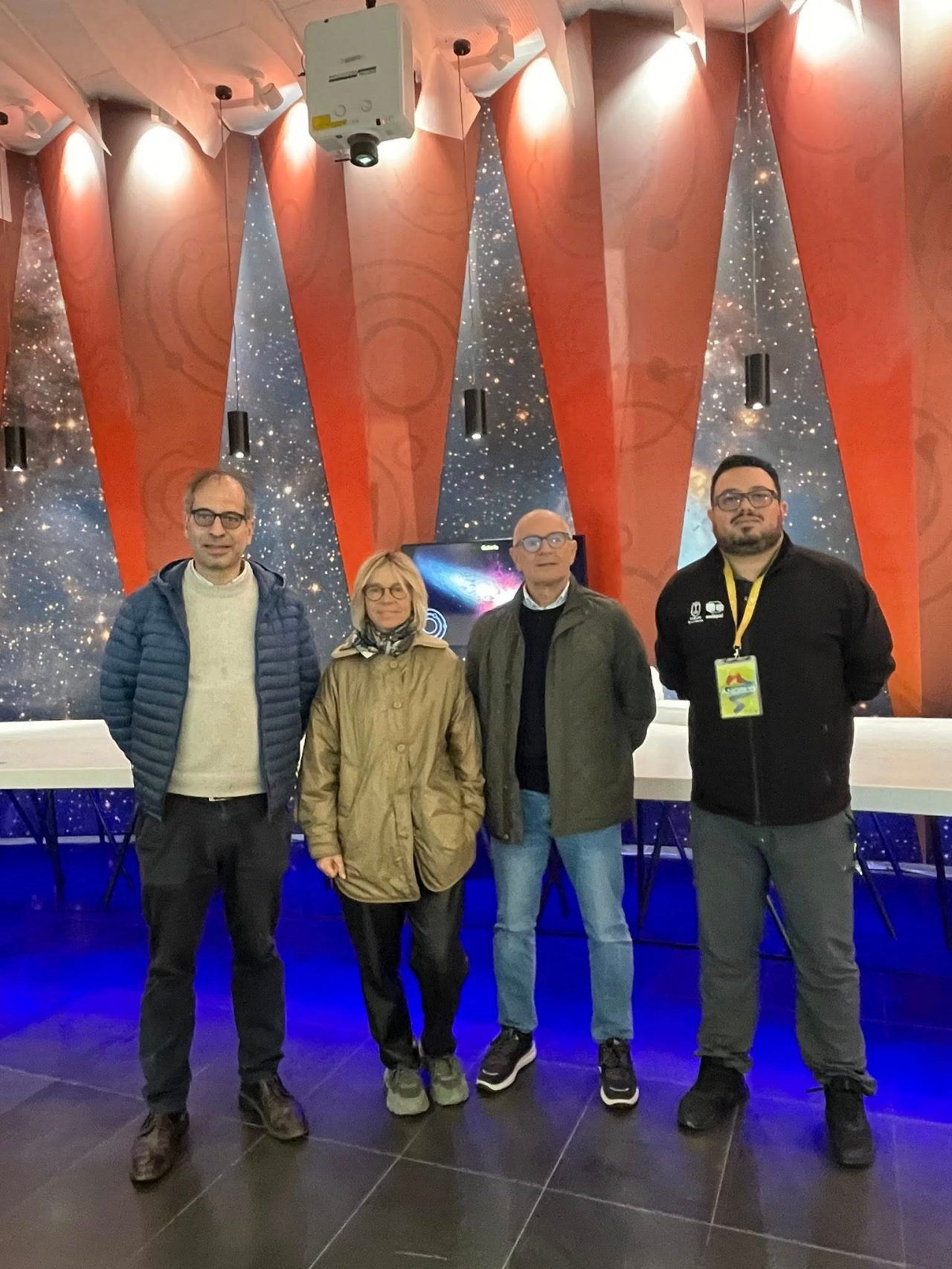
During his stay, the ambassador toured the surroundings of the Granterian and other scientific facilities of the island summit and got to know first-hand the site planned for the construction of the telescope, as well as other high-level infrastructures already in operation. The presence of the Czech ambassador on the island symbolizes strong international support, in line with the firm commitment to science as an engine of socio-economic development for La Palma. In this regard, the Commissioner for Reconstruction stressed that “investment in scientific infrastructures such as EST not only brings research excellence, but also represents a strategic opportunity for economic diversification, following a model of sustainable development, based on innovation, knowledge and the attraction of talent”.
The visit follows the establishment of the Council of Governmental Representatives (BGR) of the EST, a milestone that turns the project into an intergovernmental collaboration, with the institutional participation of Spain, Slovakia and the Czech Republic, which consolidates the transformation of the EST —until now promoted by a pan-European scientific consortium— into a strategic research infrastructure at European level. The ambassador praised the exceptional sky conditions of the observatory and stressed that the EST project in La Palma represents a qualitative leap for solar research in Europe.
The visit of the Czech Ambassador, together with national and international institutional involvement, reinforces the shared commitment to European cooperation in science, innovation and regional development. The EST is not only a scientific challenge, but also a tangible example of how research can generate real opportunities for island territories such as La Palma. “Investing in science here is not just advancing in astronomy, it is boosting qualified employment, training, scientific tourism and a new economic horizon for our island,” said Héctor Izquierdo.
With a 4.2-metre primary mirror, the EST will be the largest solar telescope in the continent and will allow us to study with unprecedented resolution phenomena such as dynamics and magnetism in the solar atmosphere, from the photosphere to the chromosphere, according to the project detail reported by the IAC.