
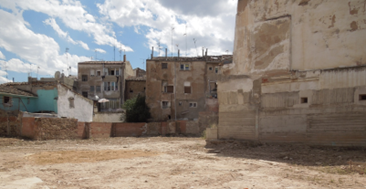
The Ministry of Housing and Urban Agenda, through the General Secretariat of Urban Agenda, Housing and Architecture, has published the tender for the valuation works of the Roman Sewers of Calsalvo, in the amount of 2,621,560.25 euros (VAT included), as well as the contract for optional management services in the amount of 221,507.68 euros (VAT included).
Valuation works of the Roman Sewers of Calahorse
Optional direction of the works of the Roman Sewers of Calsalvo
The updated implementation project incorporates the architectural solution necessary for the inclusion in the environment of a new plot acquired by the City of Calsalvo, which will allow to improve the accessibility conditions of the work and the security conditions of the environment.
The intervention contemplates the consolidation, protection and enhancement of the stretch of the Roman Cloaca, as well as the urbanization and adaptation of the public space included in the scope of action. In this space a new square will be generated and a public equipment will be built.
The term of execution of the works is estimated at 12 months, foreseeing its completion in the year 2027.
Contemplated actions
It is foreseen the development of structural consolidation and conservation actions, both of the sewer and of the vault of the wine cellar.
In addition, the creation of a new public square is planned, formed by a succession of cantilevered porticoes with inclined planes that reproduce the roofs of the environment and evoke the image of a Roman impluvium. This element acts as a shadow element, orders the perimeter and liberates the central space.
In the area of the square there will be a public equipment composed of three volumes intended for access to the sewer, a multipurpose room for cultural activities and a cafeteria. These volumes will be located on the perimeter of the square, behind the perimeter element of shadow, occupying interstitial spaces in order to release the central space as much as possible and allow the continuity of the archaeological campaign.
For this reason, the public space will be paved with cobblestone on the ground, a solution that favors the infiltration of rainwater, avoids runoff problems and allows an eventual disassembly for the continuation of archaeological excavations. In addition, the cutting of the pavement will redraw the winery and the layout of the Roman sewer, preserving the archaeological reading of the complex and maintaining the continuity of the main access to the square from San Andrés Street.
Access to the new square will be made by the north limit of the plot, from San Andrés Street; by the southeast, from Planillo de San Andrés Street; and by the southwest, from Morcillón Street.
The intervention is essential to guarantee the preservation of the archaeological heritage, improve the conditions of use and accessibility of the public space and meet the objectives of regeneration of the historic center, acting as an engine of social and urban revitalization.
Architectural Rehabilitation Program
This action to protect and safeguard the Spanish Cultural Heritage is part of the Architectural Heritage Rehabilitation Program, aimed at the execution of relevant works of restoration and rehabilitation of the national architectural heritage. The program contributes to the creation, improvement and maintenance of equipment, endowments and services of public interest, financed with the Ministry’s own budgets.
In these cases, the Ministry acts as a contracting body for the works, with an investment allocated in the General State Budgets for 2025 close to 24 million euros.
The Architectural Rehabilitation Program has been operating since 1988 and, to date, the accumulated amount invested exceeds 600 million euros. With initiatives of this type, the MIVAU reinforces the commitment of the Government of Spain to the conservation of the world heritage, adding more than 1.5 billion euros invested in the different heritage recovery programs and historic centers.