
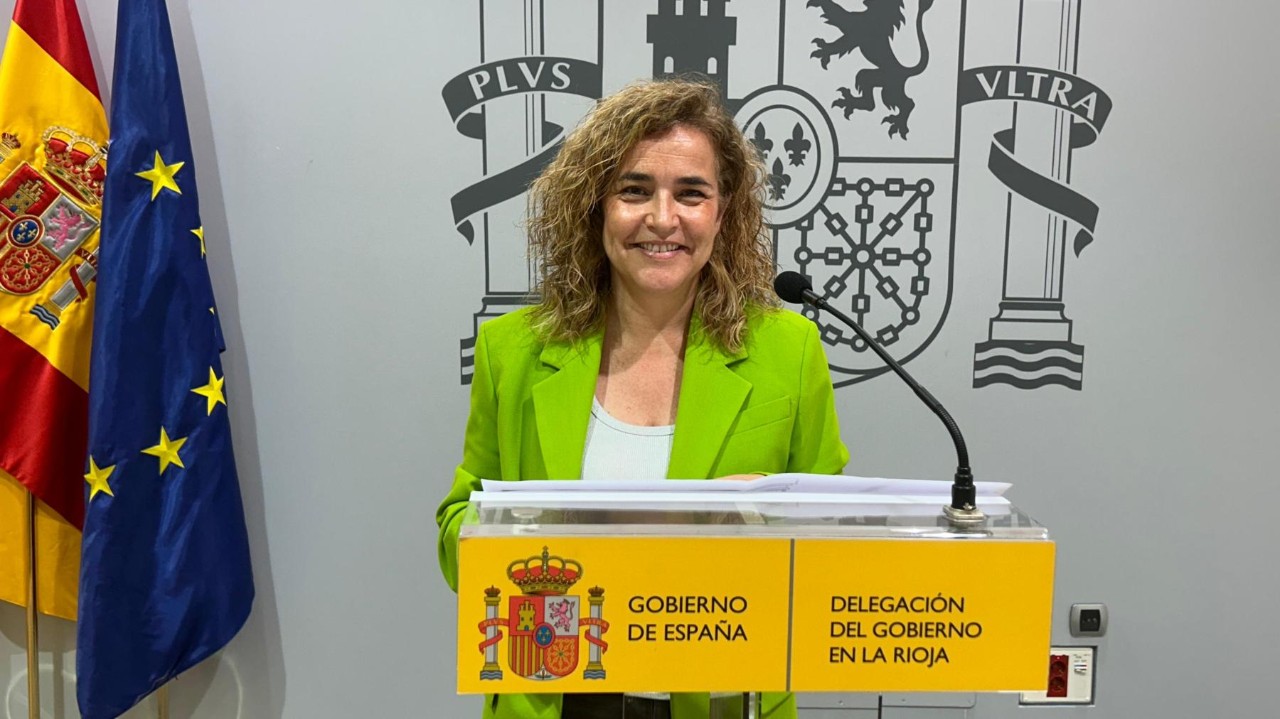
“One of the strongest support of the Government of Spain with the Rioja primary sector is the funds it will receive to finance the aid for the green harvest in this year’s call,” said the Government delegate in La Rioja, Beatriz Arraiz Nalda, during her appearance before the media to concretize the firm involvement and commitment of the Central Executive with this sector.
Arraiz Nalda has pointed out that La Rioja will receive more than 14 million euros for the green harvest, that is, more than double what the Government of Rioja will contribute with 6.8 million euros.”
For the delegate, “the Government of Spain was aware that it must continue to commit itself economically to our region and, once again, it complies with La Rioja because this exceptional measure, of absolute commitment to the Rioja wine sector and, therefore, to the interests of our autonomous community, contributes to regain the balance that had been lost in the supply and demand that this market requires”.
Regarding the impact of this economic item on La Rioja, he commented that these more than 14 million euros contributed by the central executive have been well received by the Rioja countryside, so he has shown his satisfaction because once again it is verified that the Government headed by Pedro Sánchez meets the demands of the primary sector of the region.
In this regard, he insisted that “it shows how the collaboration of the administrations is fundamental to improve and meet the demands of the territory, an attitude that the central government defends”.
In addition, it has highlighted the significant economic amount corresponding to the payment of aid to rain-fed farmlands in La Rioja. From the General State Budgets and to compensate for the difficulties caused by the drought and war in Ukraine, thanks to this line of aid, a total of 1,367 farm owners in La Rioja have benefited, with an amount of aid amounting to 1,693,334 euros.
The delegate also recalled that at the Sectoral Conference on Agriculture held last week, the allocation of 7.3 million euros was approved for programmes to support the wine sector and promote the consumption of milk, fruit and vegetables. Specifically, these more than 7 million euros that are destined to La Rioja are broken down into:
- EUR 3.6 million in the area of Restructuring and Conversion of Vineyards, which seek to improve the competitiveness of the sector, through the adaptation of producers to demand, reduce production costs and facilitate their adaptation to the challenges of environmental improvement, within the framework of the new Common Agricultural Policy (CAP).
- Another 3.67 million euros corresponds to the second call for investment aid of the Wine Sector Intervention 2024-2027, which responds to all requests for eligible aid communicated by the autonomous community of La Rioja. These grants subsidise investments in processing facilities and wine infrastructure, as well as marketing structures and instruments, for wine products.
- The last 95,000 euros correspond to the distribution of Community funds of the School Fruit, Vegetable and Milk Consumption Program corresponding to the 2024-2025 academic year, which contributes to the promotion of healthy habits and the reduction of obesity and other related diseases.
Advancing the 43 measures committed to the primary sector
In addition, Arraiz Nalda explained that it can be seen that “the commitment is full with the primary sector of La Rioja, not only with financial endowments for it, but also with the progress in compliance with the 43 measures committed to farmers and ranchers in mid-April”. At the moment, 11 are already executed and another 6 are in a very advanced phase. Of the rest, 22 are in progress and in another 4 the route has begun.
In this way, at the Council of Ministers held on June 18, the royal decree was approved that makes the conditions for farmers and livestock farmers to have access to the aid of the Common Agricultural Policy (CAP) more flexible. In addition, this Monday, the Ministry of Agriculture began the process of hearing and public information of the project of this royal decree, which will last until July 15.
This new regulation is part of the 43 measures presented by the Government to respond to the main concerns expressed by farmers and ranchers.
This royal decree includes the abolition of penalties for late submissions of the CAP’s single application for the year 2024, in the period between 1 and 15 June retroactively. It also provides for the relaxation of conditions, which include, among other things, that the beneficiaries of aid with holdings equal to or less than 10 hectares are exempt from controls and penalties related to reinforced conditionality, a set of obligations that must be fulfilled by the beneficiaries so that their aid is not reduced.
Likewise, compliance with good agricultural and environmental practices linked to tillage, vegetation cover, crop rotation or non-productive surfaces is made more flexible.
The delegate stressed that “the simplification of the CAP is the most relevant piece at European level to respond to the demands of the Spanish primary sector”, although the Government of Spain is carrying out other actions.
Another of the advances refers to the beginning of the processing of the royal decree so that the digital exploitation notebook is of a voluntary nature. The Ministry of Agriculture, Fisheries and Food began on June 18 the procedure of hearing and public information of the royal decree that modifies this regulation to establish voluntariness. The public hearing ends today Wednesday.
This simplification initiative is also part of the measures committed by the central government to respond to the concerns expressed by farmers and ranchers.
Another of the public consultations that have been initiated, specifically on June 20, is the one regarding the needs of adaptation of the national food quality regulations. This consultation, which will be open until 10 July, has as its main objective to progressively adapt the different existing rules in this area to the current productive and technological reality, as well as to the new demands of consumers, to guarantee the competitiveness of the agri-food sector.
For Arraiz Nalda, “these public consultation processes reflect the commitment of the Government of Spain to transparency and citizen participation in the elaboration of regulations that directly affect the quality of life of citizens and the competitiveness of the agri-food sector.” The contributions received will be evaluated and, where appropriate, will be taken into consideration in the proposal to amend the regulations currently in force.
Among other actions of the Government of Spain for the benefit of the agricultural and livestock sectors are providing human and material resources to the current Food Information and Control Agency, advancing in a dignified remuneration for farmers and ranchers, supporting agricultural insurance or improving the taxation of diesel.
In addition, the Government of Spain wants to include in trade agreements with countries outside the European Union the so-called "mirror clauses", which require that the product imported into a country of the Union comply with the same environmental, health and animal welfare standards imposed on local farmers and ranchers.