
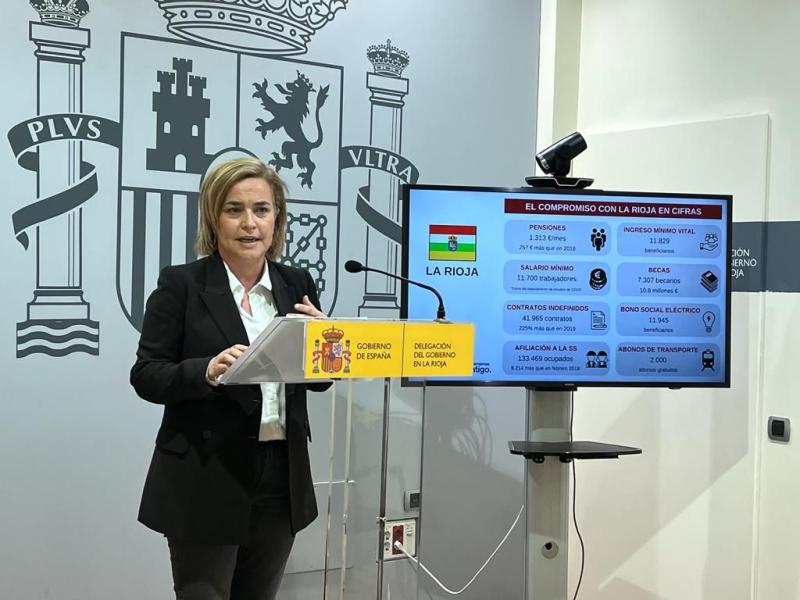
Social cohesion is one of the inalienable principles on which the policies promoted by the Government of Spain throughout this legislature have been based. The government delegate in La Rioja, Beatriz Arraiz Nalda, has highlighted the different measures that have focused on people and the protection of the middle and working class to face the complex situations that have had to be faced in recent years, such as those arising from the health crisis caused by COVID-19 and the war in Ukraine.
In this way, Arraiz Nalda has recalled that “policies of social tendency have been a priority” and has set as an example the advance in the commitment to dignify pensions by guaranteeing by law the maintenance of the purchasing power of pensioners. In La Rioja, more than 72,000 pensioners reside and, among them, almost 49,500 receive a retirement pension, with payrolls that will increase 1,455.58 euros on average per year.
He also mentioned that the Minimum Vital Income has reached 4,130 households in Rioja, in which 11,829 people live. In this regard, he added that this Social Security benefit is having a special impact on the reduction of child poverty, since of the total number of beneficiaries residing in La Rioja, 5,329 are minors. Regarding the number of benefits with the Child Support Supplement, 2,284 have already been recognized in the Autonomous Community.
Other social measures are the electricity bond, with 11,945 recipients, and the aid of 200 euros for households with less income and a reduced patrimony, which has already been requested by 15,856 people from La Rioja.
Scholarships
On the other hand, the Government delegate has focused on the scholarships granted to students in La Rioja. “Scholarships and study grants are one of the instruments that most effectively contribute to making the principle of equal opportunities possible. The Government of Spain has always shown its willingness to guarantee, through the scholarship policy, that no student abandons his studies, for economic reasons, thus ensuring social cohesion,” he stressed.
In total, the Government of Spain allocates 5.34 million euros for scholarships aimed at 3,000 Rioja and Rioja students studying in non-university courses.
Specifically, in the general call for non-university levels, 2,322 scholarships were awarded this course to students from La Rioja. The amount of these amounts to 4.33 million euros.
In addition, 678 Rioja scholarship recipients have benefited from student aid with a specific need for educational support. Thus, from the General State Budget, more than one million euros have been allocated for students in La Rioja who have special educational needs derived from disability, serious behavioural disorder or serious communication and language disorders associated with special educational needs, students with autism spectrum disorder and students with specific need for educational support associated with high intellectual abilities.
As for the students who study at the universities of La Rioja, 5.5 million euros have been allocated for 4,307 scholarship holders.
Employment situation
To analyze the employment situation, Arraiz Nalda has explained that attention must be paid to different indicators, such as affiliation to Social Security. In La Rioja, these data show significant positive growth in the last five years with 8,214 more people employed, going from 125,255 in February 2018 to 133,469 in February 2023.
Regarding indefinite contracts, he pointed out that “the firm commitment of the Government of Spain to quality employment, job stability and the improvement of workers’ rights and conditions is reaffirmed.” Thus, in the period from 2019 to January 2023, the variation in the number of such contracts in the autonomous community was 225.4%, that is 29,070 more, when 12,895 indefinite contracts were registered in 2019 compared to 41,965 January 2023.
Also thinking about the quality of employment of workers, he has specified that the central government has raised the Interprofessional Minimum Wage to 1,080 euros per month by 2023, so it has increased by 47% in the last 5 years. This minimum wage benefits 11,700 workers in La Rioja, 11.4% of the total number of full-time employees in the Autonomous Community.
Support for farmers and ranchers
In this review of the policies promoted by the Government of Spain, the delegate has detailed that the support to the Rioja primary sector has been decisive. He gave as an example the EUR 1.6 million that was allocated in 2022 as exceptional aid to compensate for the economic difficulties arising from the war in Ukraine and charged to the Recovery, Transformation and Resilience Plan (PRTR) and the EUR 2.3 million that La Rioja received last year within the European Union’s Multiannual Financial Framework 2021-2027 within the rural development programmes.
From the Support Program for the Spanish Wine Sector, known as PASVE, La Rioja received 9.6 million euros in 2022, financed with FEAGA funds.
European Recovery Plan Funds
In addition, Arraiz Nalda has referred to the 410 million euros from European funds Next Generation-EU committed to the autonomous community. Of this investment, EUR 65 million comes from the ACTION-EU funds and more than EUR 350 million from the Recovery Plan, of which EUR 240 million has been received through transfers agreed at sectoral conferences, agreements and direct concessions to the Government of La Rioja.
The delegate added that through direct execution actions of the General Administration of the State and with funds of the PRTR, there are already more than 1,820 beneficiary projects of entities in La Rioja with 116 million euros. Therefore, “the mantra that is repeated by some that European funds are not coming is false and the data confirm it, and that is that more than 1,800 Rioja projects are already materializing,” he said.
These funds are allocated, to a large extent, to four irrigation modernization actions (35.7 million euros), competitive concurrence calls for actions for strengthening and the market in Logroño (7 million euros), as well as for the development of an east-west cyclist axis in Logroño (6.5 million euros), among others.
He also highlighted the participation in eight primary projects of the call for the transformation of the industrial value chain of the PERTE of Electric Vehicle with a million euros of support.
Arraiz Nalda has detailed that more than 290 operations have been formalized to re-establish CERSA Guarantees for almost 11 million euros, which have facilitated access to credit for SMEs and self-employed people in Rioja. In addition, about 1,000 SMEs and self-employed people already have the Digital Kit Voucher.
Regarding calls with a special impact in La Rioja, especially in the areas most affected by the phenomenon of depopulation, he recalled that “the Government of Spain is committed to reversing the process of depopulation and the fight against the phenomenon of demographic challenge”. It has therefore been proposed that 100% of the population should have ultra-fast broadband internet access by 2025. In fact, two calls have already been resolved for the Single Broadband program, thanks to which internet connectivity has already been improved in about 25,000 homes and companies in more than 123 municipalities in La Rioja.
In order to boost the country’s green transition, the delegate specified that “it is essential to have workers with green and digital skills to successfully tackle this ambitious process of transformation of our economy.” To this end, the Government of Spain has transferred more than 28.5 million euros from the PRTR to the Government of La Rioja for educational activities and universities. Of these, more than 6.7 million euros have been allocated to the creation of new Vocational Training places, so at the end of this course about 2,800 new VET places will have been created in La Rioja, of the more than 213.00 new places planned in Spain.
On the other hand, thanks to European funds, the innovation of the Rioja health system has been supported through the investment of more than 7.7 million euros for the improvement of high-technology health equipment in three centers in La Rioja.
In the field of infrastructures, ADIF will allocate about 1.6 million euros for the development of the variant of Rincón de Soto.
Valley of the Tongue
Finally, the Government delegate has highlighted the importance of the Language Valley for the launch and strengthening of the PERTE New Language Economy. As early as February 2020, the Government of Spain committed itself to the development of several strategic projects for La Rioja and Spain.
For the Language Valley, the Central Executive will contribute 20.8 million euros and the Riojano 23.87 million euros. In total, 44.67 million euros to develop the new language economy, a project in which we find, among other actions, the creation of an Intelligence Center or Hub of the New Language Economy, which will allow to promote a public-private sector ecosystem of innovation around the New Language Economy.
In addition, the protocol for the creation of the National Center for New Packaging Technologies with 20 million euros of funding from the Government of Spain and another 20 million from the Government of La Rioja was signed in June 2022.