
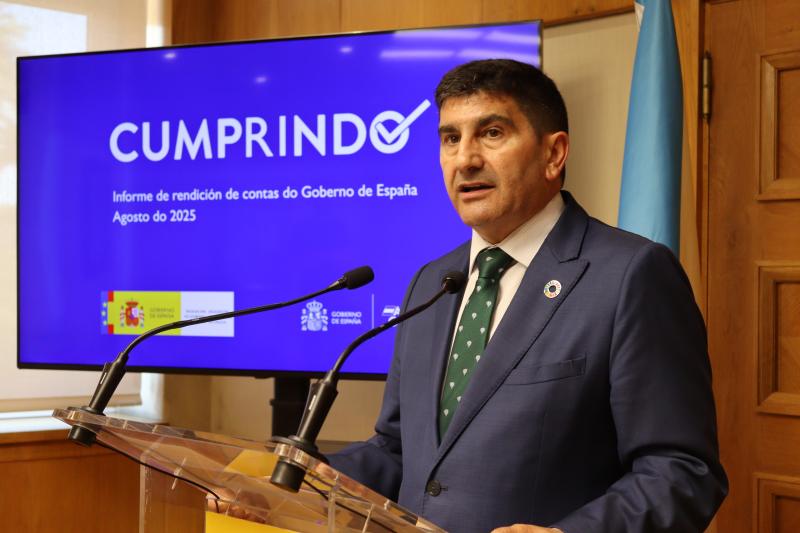
The Government delegate in Galicia, Pedro Blanco, reviewed this morning the advances and improvements that the Government of Pedro Sánchez promoted in this first half of the year in Galicia, “making it a land with more opportunities, with more public investment, with better services and with more rights”. It did so through the data provided in the Spanish Government’s biannual accountability analysis, the Complying report, presented this week by the President of the Government.
Pedro Blanco supported this deep and sustained commitment of the Government to Galicia in figures, stressing that in these seven years of Pedro Sánchez’s government, the community received 18.3 billion euros more than in the previous seven years, corresponding to governments of the Popular Party. “These facts give a good sample of the work of the Government in Galicia, evidencing our firm commitment to the improvement of this land,” said the delegate. In this regard, he indicated that Galicia will receive in 2026, in addition to the funds of the Recovery, Transformation and Resilience Plan (PRTR), “the largest deliveries on account of its history, but for the second consecutive year”, amounting to 10,878 million euros and representing 6.2% more than in 2025, when the milestone of 10,239 million euros in account deliveries had already been achieved. This is in addition to the settlement of 2024, which puts the total amount that Galicia will receive next year at 11,582 million euros.
“But this unprecedented investment of the Government of Spain in our land serves little if the funds destined for the Xunta de Galicia are not executed or take too long to do so,” lamented Pedro Blanco, who asked the regional administration to speed up the processing of the funds of the Recovery Plan: “Galicia cannot afford to have a Xunta with half of the funds of the Government Recovery Plan unexecuted, since we are talking about more than 900 million euros that are not reaching the Galicians and Galicians.” That is why the delegate asked the Galician president “to stop demanding and start executing what he has, with fewer complaints and more management, since it is not admissible to block resources in Santiago and blame Madrid for what happened”.
Therefore, he appealed to the responsibility of the Galician People’s Party so that when the time comes, it supports the accounts prepared by the Government “because the opposite would be to vote against Galicia”. The delegate recalled votes in Congress such as that of the anti-blackouts decree, when the PP voted negatively on measures developed by the Government that would benefit Galicia and its electrointensive industry.
However, he believes that Galicia still has many opportunities to continue transforming its economy and consolidating job creation with the Recovery Plan, which proved to be “an essential tool of the Government to improve Galicia and boost it for the future”. Pedro Blanco stressed that “the Government is taking these funds to each and every one of the Galician municipalities despite the lack of agility of the Xunta”. In this regard, he stressed that there are already more than 60,000 beneficiaries of the Plan, raising their investment in the territory to 4,124 M€. In addition, he stressed the Government’s deep support for the Galician productive fabric, since 42% of those beneficiaries of the PRTR are small and medium-sized enterprises. Among the rest are practically all the other possible entities, from larger companies to foundations or municipalities “guaranteeing an equitable and multipolar distribution of these funds”.
“When there is will, dialogue and responsibility, progress is made,” said Pedro Blanco, referring to these data and the positive impact they have in Galicia. In addition, he stressed following this line that “with the help of this Government, Galicia will continue to transform and improve at least during the next two years of legislature, because politics is to transform people’s lives and not for noise and shouts”.
Dynamisation and economic boost
The delegate reported that, under the Recovery Plan, the strategic projects for recovery and economic transformation (PERTE) of the Government left in Galicia more than 811 million euros in aid to companies in the community.
Tourism and trade play a key role in this commitment to sustainability and digitalization. In Galicia, one in two municipalities are already benefiting from the Government’s more than 200 million euros for the transformation and modernization of the tourism sector, while in the field of trade projects were promoted to make urban and rural markets more sustainable and strengthen commercial activity in tourist areas, with a contribution of 23.29 million euros.
The delegate also stressed the Government’s support for strategic sectors such as the Galician naval sector that resurface with contracts such as the frigates of the F-110 series for the Spanish Navy, with more than 4.3 billion euros for Navantia, to which must be added the 440 million committed for the construction of a Supply Ship in Combat (BAC) also in the public shipyard, which receives 170 million euros within its digital transformation plan for the construction of the block workshop. This adds up to a total investment for Ferrol of more than 5 billion euros.
Another of the key axes of action is the transition towards a more efficient, social and sustainable model. In this area, the Government allocates more than 300 million in Galicia to the development of green energy projects to reindustrialize the Community, supporting initiatives of green hydrogen, thermal production with solar or geothermal energy, or the use of wind or offshore wind energy, among others. 181 M€ of them correspond to PERTE EHRA and 30 to the RENMARINAS program, in Arteixo, through the PRTR. The Autonomous Community received 17.5 M€ in this field, of which 38% was executed. In addition, it received €106.9 million to boost self-consumption and residential storage, of which it executed 65%.
Protection of the welfare state
In addition to promoting the transformation of the productive model, another of the Government’s axes of action is to respond to the needs of the population and improve people’s lives. In this regard, the delegate recalled that the Executive of Pedro Sánchez committed 526 million euros to promote housing policies in Galicia, an investment that will allow the construction of 1,406 public homes and the rehabilitation of more than 18,000 homes in the community. Thus, a total of 92 million has been transferred to the Galician Administration to build and rehabilitate just under 4,000 homes. The novelties in respect of housing are important, since A Coruña has just been declared the first ‘stressed area’ of Galicia, which will benefit the lowering of rental prices by limiting housing for tourist use, bumping rents and promoting tax benefits and aid, since this city can avail itself of the Housing Law developed by the Government, “which delves into guaranteeing that in Spain housing is a right and not a market good”. It is not the only Galician city that pursues this goal, since Santiago de Compostela also aspires to achieve this status.
Thanks to the Government’s commitment to link the increase in pensions to the IPC, the approximately 800,000 retirement pensions of Galicians and Galicians increase more in one year than in all the years together of the PP executives. Thus, the average monthly income of a Galician retiree is 386 euros higher today than at the same time of 2018, currently reaching 1,290 euros compared to 904 at that time.
And just as pensions grew, so did wages. Thus, the delegate pointed out that since the government of Pedro Sánchez, the minimum wage rose almost 400€, more than 54%, compared to the 736 euros left by the PP. Now, the 135,900 Galician workers who receive the legal minimum charge 1.134 euros per month. In Galicia there are almost 90,000 beneficiaries of the Minimum Vital Income, which, like pensions, was revalued this year by 2.8%.
And in terms of dependence, the Government doubled the contribution of funds to Galicia, already covering 40.7% of the total expenditure in this area. In the last year alone, it transferred 221 million euros to the Xunta, said Blanco: 172 million minimum level and 49 million agreed level. “We must not forget, in this regard, that the Government has just allocated a record amount of 52 million euros to Galicia in July to continue strengthening the Galician system,” recalled the delegate.
In the field of education, the delegate stressed the increase in the stock exchanges and their amount, with 132 million euros (an increase of 59% in eight years of government) the scholarships to help the 54,000 boys and girls with their studies. In addition, more than 15,300 18-year-old Galician girls and young people benefited from the Cultural Bonus.
Although it is a regional competence, in 2024 the Government allocated more than 90 million euros to transform and modernize the public health service of Galicia and also transferred 40.1 million euros to the Xunta for the development of co-responsibility policies.
To conclude this block, Pedro Blanco referred to the commitment of the Government in the fight against gender violence, with 84 million destined in Galicia to the prevention and fight against male violence. Of these, 73 M€ were allocated to the Xunta and 11 to the municipalities.
Infrastructure and green and digital transition
The provision and improvement of infrastructures is another of the axes that mark the action of the Government in Galicia, while continuing to advance in the commitment to the railway. The Avril trains were put into service, which since connecting Vigo and A Coruña with the Plateau add more than 1.5 million users. Progress was made in the route between Lugo-Monforte-Ourense, with 550 million to renew the railway line; in the intermodals of the large cities (more than 250 million in investment) and the one of Santiago de Compostela was completed this June, without forgetting the railway accesses to the external ports of Ferrol and A Coruña, which add another 200 million.
In the field of roads, after a prolific 2024 that brought with it an investment of 650 million euros in improvements such as the first stretch of the A-57 in Pontevedra; the Orbital, in Santiago; the link of ‘Sol y Mar’, in the metropolitan area of A Coruña, or the opening in record time of the viaducts of O Castro in the A-6, continues to advance in 2025.
Currently the Government is executing in Galicia 50 km of new roads that represent an investment of 387 million euros, including the remodeling of Alfonso Molina in A Coruña or humanizations such as those of O Milladoiro (Ames) or the finalized this week in As Pías (Ferrol). In addition, he reported that the Ministry of Transport plans to invest 4,561 million by 2030 in the Atlantic Corridor in Galicia. So far this year, the Government has offered 1,789 million euros to develop it in Galicia, representing this milestone “an unprecedented effort”.
At the same time, Pedro Blanco put in value the more than 375 million euros destined for the payment of bonuses in the AP-9. In addition, this aid reaches the AP-53 for the first time, where a total of 14.3 million euros will be invested in 2025, 2026 and 2027. “In this way, the Government ensures benefits for users through useful policies that move towards free-of-charge motorways.”
In addition, in 2025, the entire Galician territory will have a high-speed internet connection thanks to the government investing 275 million euros in the extension of broadband.
In terms of sustainability, the Government granted grants of 51.2 M€ to Galician municipalities with less than 5,000 inhabitants for energy efficiency projects within the DUS-5000 program and has ongoing or committed investments of 138 million euros for sanitation and water supply improvement works, including that of the EDAR of A Silvouta, in the Galician capital, with 48 M€ of investment.