
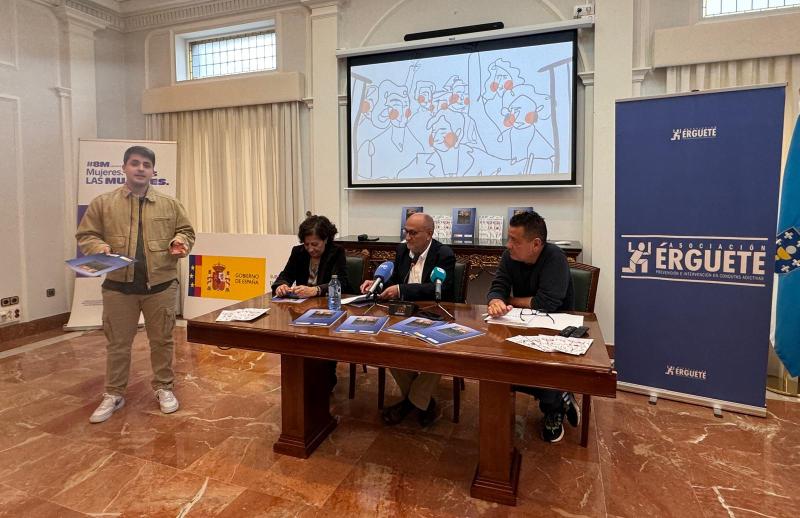
Pontevedra, November 8, 2024.- The subdelegate of the Government in Pontevedra, Abel Losada, presented this morning the new manual on social accompaniment to people with problems of additions in the judicial process developed by the Érguete Association with the support of the Ministry of Health through the National Plan on drugs and the Lakoma Association of Madrid. This tool aims to address, in a very simple way, the judiciary and the different phases of the penitentiary process, as well as the different actions that entities or #social agents can carry out during the penitentiary process to intervene in the legal-penal problem of a person with addiction problems.
Losada opened the event, which was attended by around 30 people, remembering that drug dependency cannot be seen solely as a prison issue, which is why he described as “fundamental” that social entities and public administrations work together to offer the necessary support to those who are immersed in judicial processes related to addictions.
He stressed that custodial sentences, “although necessary in some cases, are not always the solution,” and insisted that “we must look for alternatives that favor the return to society as full citizens of these people.” “This groundbreaking manual aims to do just that,” he said, while congratulating the Érguete for a project “that will greatly facilitate the social accompaniment of people with addictions involved in legal proceedings, helping them not only to face their legal process, but also to receive the emotional, educational and rehabilitative support they need so much.”
Finally, the subdelegate highlighted the commitment of the Government of Spain to social justice and cited several initiatives and policies aimed at coexistence, security and prevention of drug use, including the National Plan on Drugs or the Master Plan for coexistence in schools, thanking the State Security Forces for their work on this issue.
On the part of the Érguete Association, the lawyer and vice-president, Sonia Fernández, indicated that “the judicial process is very complex with these realities, that is why this manual was born in which we gather in a simple way the reality of a system, its resources, its defects and, also, we provide advice to simplify the process”. The pedagogue, David Martínez, added that “this manual is pioneering because it is the first one that explores the entire judicial system in the field of people with addictions in Galicia”