
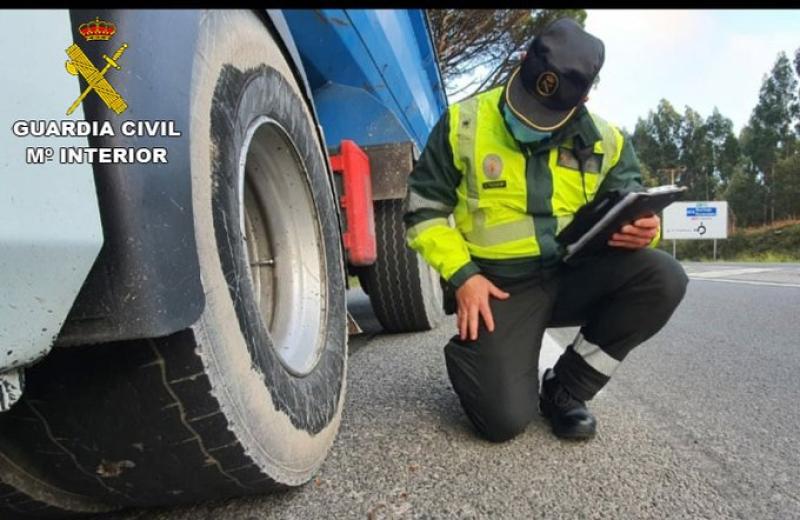
The Government Delegation in Galicia reports that, during the next week, the DGT will develop on the roads of Galicia an intensive surveillance plan that will focus on checking the correct condition of tyres and lights. Between Monday, 23 and Sunday, 29 October, the patrols of the Traffic Group of the Civil Guard in Galicia will pay special attention to the proper maintenance and tuning of these two vehicle security elements.
This intensive surveillance coincides with the arrival of adverse weather, typical of the time of year, and with the imminent change of time and the decrease of hours of light. During the week, the variable signage panels of the roads of Galicia will warn of these specific controls.
Tires
The DGT recalls that tyres are the only and decisive contact with the road. They are responsible for ensuring adherence in pushing, braking and lateral sliding. They also ensure that the direction of the vehicle’s travel is as desired by the user and the cushioning of the pavement imperfections. It is recommended that the depth of the groove should be at least 3 millimeters. The legal limit is 1.6 millimeters.
According to official estimates, approximately more than one million vehicles, or 5%, drive with serious wheel defects, mainly because they have a design depth below the legal minimum of 1.6 mm; have irregular wear due to poor suspension or incorrect alignment and drive with erroneous pressure.
In addition, vehicles related to a more professional use, such as vans, have higher rates of defects in their tyres.
From Traffic, they remind us that we must also regularly check the pressure of the cold tyre and the spare wheel, as well as check possible air leaks through the valves. The cap of the same constitutes a sealing element, so its use is essential.
Lighting
Regarding the lights, the DGT warns that its purpose is not only to see, but also to be seen, since each vehicle in circulation is, in practice, an obstacle for others, so the delimitation of its presence is also significant.
In order to ensure safe driving, it is advisable to pay special attention to the use, maintenance and regulation of headlights, in order to ensure, on the one hand, sufficient light and, on the other, not to dazzle those who drive on the same public roads.
You have to take into account some basic tips:
• The lamps are reducing their intensity with use, so they must be changed every 40,000 km. or 2 years.
• Lamps should be changed from two to two, because their use is symmetrical in most cases.
• It is necessary to always keep the optics clean: headlights and pilots
The compulsory use of lighting is included in article 43 of the Traffic and Road Safety Act:
1.- Vehicles that circulate between sunset and sunrise, or at any time of the day in tunnels, lower passes and sections of track affected by the “tunnel” signal, must carry on the corresponding lighting.
2.- They must also keep the lighting on for the rest of the day:
a. Motorcycles that circulate on any road that is the subject of this law.
b. All vehicles that circulate in a reversible lane or in a direction contrary to that normally used in the road where it is located, either a lane that is exclusively reserved for it or exceptionally open in that direction.
3.- It is mandatory to use the lighting that is established by regulations when there are meteorological or environmental conditions that significantly reduce visibility, such as in case of fog, heavy rain, snowfall, clouds of smoke or dust or any other similar circumstance.
4.- The bicycles will also be equipped with the reflective elements that, duly approved, are determined in the General Regulations of Vehicles. When the use of lighting is obligatory, bicycle drivers will also be wearing a reflective garment if they travel between cities.”
Especially in this season of the year, with fewer hours of light the DGT recommends that vehicles carry the lights on, even during the day: A car with the light on is always visible at a greater distance, without depending on whether it is a black, grey or white vehicle. It has been proven that driving in the daytime with the “short” lights on drastically reduces the risk of an accident, increases the visibility of the vehicles and in addition, pedestrians perceive the vehicle coming on top of them first.