
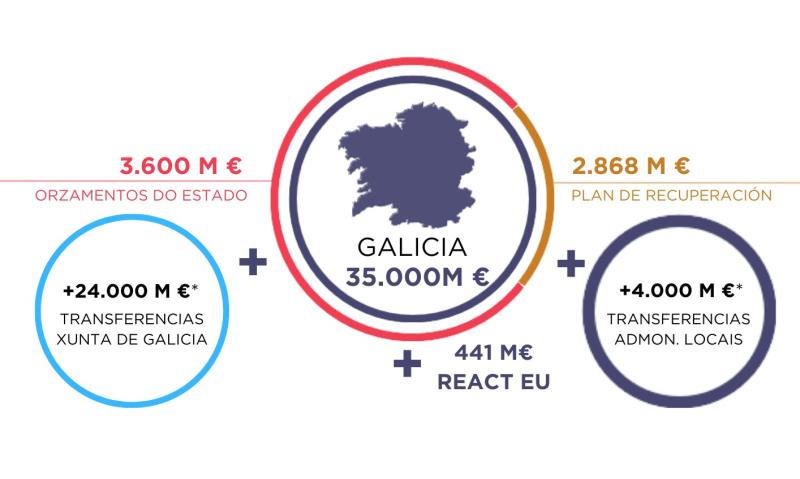
The delegate of the Government, José Ramón Gómez Besteiro, today put in value the 35 billion euros invested by the Government in Galicia in the last three years, a figure that represents a historical record and that seeks to guarantee a social and fair economic recovery. This amount includes the 2,868 million euros of the Recovery, Transformation and Resilience Plan, the more than 3,600 million euros appropriated in the General State Budgets, to which must be added the more than 4,000 million in transfers to local administrations and the more than 24 billion euros to the Xunta de Galicia.
“Only with the budgets, Pedro Sánchez is complying with Galicia as no other president had done, reaching each and every one of the Galician households with an average investment per inhabitant of 400 euros, a figure much higher than the average 284 euros per inhabitant in the state as a whole,” said the delegate, who also pointed out that the funds of the Recovery Plan “are promoting a change of model in the community for an economy based on the creation of quality employment and the sustainability and competitiveness of the Galician industrial and business fabric.”
In this regard, he recalled that the Government of Spain was the first to receive European funds, “which shows that Spain is doing things well.” Those 2,868 million invested in Galicia under the Recovery Plan allowed more than 16,100 actions to be carried out. Of these, 1,276 million (44.5%) are being managed directly by the Xunta de Galicia.
“The Government, with these funds, promotes economic and social recovery while working on the construction of a more modern, green, digital, inclusive, social and territorially cohesive Galicia,” said the delegate. These advances materialize in actions such as the nearly 300 million destined for the rehabilitation of public buildings and housing; the more than 100 million of the UN-Broadband Program, which will provide 100% of the Galician territory with high-speed Internet; the 38 million for pioneering projects to obtain green hydrogen; the 65 million of the Digital Kit, which promotes the digitization of more than 14,000 companies and self-employed; the 95 million for tourism sustainability plans, or the 62 million of the INVEAT plan for the modernization and acquisition of high-technology sanitary equipment, among others.
Infrastructure
In terms of infrastructures, Xosé Ramón Gómez Besteiro celebrated the inclusion of Galicia in the Atlantic Railway Corridor and the advances in intermodality, with the station of Vigo already finished and only pending the South exit, and those of A Coruña, Santiago, Ourense and Lugo in different phases of its constructive process. It marked as a historical milestone the arrival of the High Speed to Galicia and the renewal of the railway infrastructures in the community, with about 100 million euros to conclude the new access to the city of Ourense, 550 million to update and electrify the Ourense–Monforte–Lugo route and with important investments to connect logistics nodes such as the external ports of A Coruña (171 million euros) and Ferrol (76 million euros), and improve the wide metric network between Ferrol and Ribadeo (16 million euros).
“The Recovery Plan and the investments of the Government of Pedro Sánchez are giving an important boost to the infrastructure, retaking and turning into reality projects abandoned by other governments and administrations,” said Gómez Besteiro, who gave as an example the more than 24 million euros of the Recovery Plan for the construction of 499 social housing units in several Galician municipalities or the dredging of the O Burgo estuary (35.5 million euros).
Bonus on tolls
Other actions that the delegate focused on are the toll bonus in the AP-9, a measure in which the Government invested 56.4 million euros in the last year, or the assumption of part of the increase in the CPI of the current year; the nearly 50 million euros destined for the conservation of cultural heritage (to which must be added the 23.5 million for improvements in the network of Paradores); the improvement of the sanitation and purification of numerous villas and cities; the dredging of the O Pontedra estuary (with 35.5 million euros of investment), or the advances and improvements in the A-54
In this line, the government delegate urged the self-employed and companies not to miss the “excellent opportunity” that the Recovery Plan represents for Galicia, “which already reaches each and every one of the Galician households and which is promoting a real change in the productive model,” he said.
F-110 Frigates
To this respect, he cited as an example the region of Ferrol, where the contract for the construction of the F-110 frigates in Navantia and the public company’s commitment to offshore wind are causing a revival of industrial activity in the region, which will be reinforced with the fair transition projects that will be carried out in the environment of the old coal-fired power plants of As Pontes and Meirama. “Galicia also has a lot to say in sectors such as aeronautics, biotechnology, automotive, health, or the primary sector, where all actors cannot miss this unique opportunity,” said the delegate in reference to the funds of the Recovery Plan.
Social spending
One of the chapters that Gómez Besteiro also drew attention to is that of social spending, which already represents one in every six euros of the budgets. With this money, the government seeks a fair recovery for the most vulnerable groups, such as pensioners, young people and the working middle class. “These are budgets designed so that no one is left behind,” said the delegate.
Along with this investment effort, the delegate highlighted the consolidation of new rights, such as the increase of pensions according to the IPC (8.5% in the last year), the Minimum Vital Income, from which about 75,000 people benefit in Galicia and which has been revalued by 15%, or the increase of the minimum wage to 1,068 euros (47% increase since the beginning of the legislature), with more than 100,000 workers benefited in our community.
Gómez Besteiro gave as an example that, thanks to the measures of the Government of Pedro Sánchez, the average retirement pension in Galicia today stands at 1,160 euros per month, which is 233 more than what they received on average in 2018 with the government of the PP, and pointed out that, faced with the predictions of the opposition, which warned of the destruction of jobs due to the increase in the minimum wage and labor reform, “the reality is that today in Galicia there are 270,520 indefinite contracts, almost 200% more than in 2019, and more than one million people affiliated to the Social Security, 57,335 more than in February 2018”.
With regard to young people, the government delegate highlighted the increase in the study grants, from which 52,295 scholarship recipients benefited in the last year, with a total investment of 115.9 million euros in Galicia. In addition, he announced that a new call is already underway, which has a global budget of 2,520 million euros. Other measures aimed at this group are the Bono AlquilerJoven, managed by the Xunta de Galicia, or the Cultural Bonus, which last year were able to enjoy 12,500 young Galicians who turned 18 in 2022.
Exceptional measures
Within the social umbrella, the delegate also mentioned the measures taken to deal with the impact on the economy of the Russian invasion of Ukraine. Thus, he recalled the reduction of 20 cents in fuels, the gratuitousness of rail transport subscriptions of vicinity and distance measure and the discount of 50% in AVANT services, from which more than 65,000 Galicians and Galicians currently benefit, the 68 million euros in direct aid to the fishing sector or the 362 for farmers and farmers, among others.
Along with these, there are other fiscal measures such as the reduction of VAT on certain food products, the reduction in the receipt of electricity (reduction of VAT to 10%, suspension of the tax on electricity generation and reduction to 0.5% of the Special Tax on Electricity), the so-called ‘Iberian Solution’ to limit the price of natural gas, which has been extended by Brussels until the end of the year, or the limitation to 2% in rent updates of housing leases. To these must be added all the actions aimed at guaranteeing the employment and maintenance of the business fabric, such as the temporary employment regulation files (ERTE), which had already proven their effectiveness during the pandemic, as well as a line of guarantees from the Official Credit Institute (ICO) for 10 billion euros aimed at guaranteeing the liquidity of companies and self-employed.
“By combating the rise in inflation, we help protect the most vulnerable families, workers and groups, while advancing towards fairer and more progressive taxation,” said José Ramón Gómez Besteiro.
“There are many challenges and also the opportunities that Galicia has ahead in the coming months. With the impetus of the Government of Pedro Sánchez, which fulfilled like no other with the community, we will take a turn towards a more social economy, focused on people and that has the environment and sustainability as fundamental axes, and always without leaving anyone behind,” he concluded.