
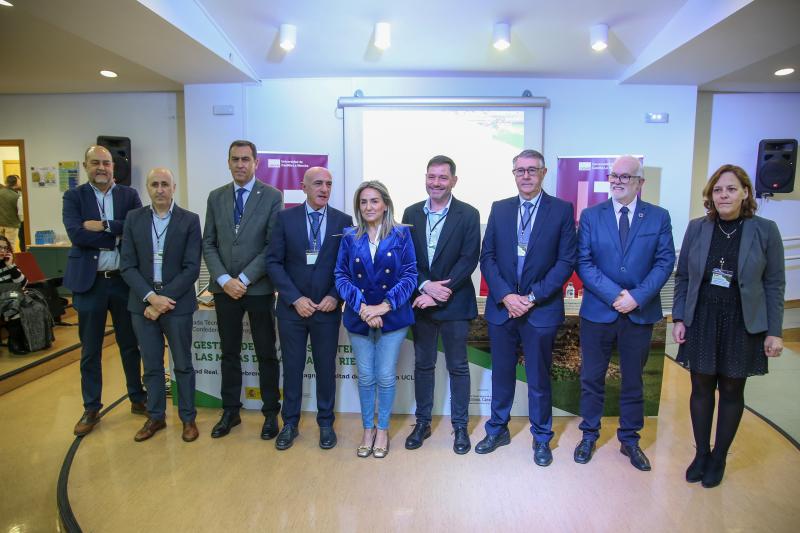
Ciudad Real.- The delegate of the Government of Spain in Castilla-La Mancha, Milagros Tolón, inaugurated this morning the First Legal Technical Conference organized by the Guadiana Hydrographic Confederation (CHG) and entitled “The management of groundwater in the masses declared at risk”, held at the Faculty of Letters of the University of Castilla-La Mancha, in Ciudad Real.
Milagros Tolón has spoken of what, without a doubt, “is such an essential resource for life and for the conservation and development of our societies and environments. Globally, groundwater provides half of the volume of water extracted for domestic use and about 25% of all water extracted for irrigation.”
The day was attended by, among others, the president of the CHG, Samuel Moraleda; the deputy delegate of the Government of Spain in the province of Ciudad Real, David Broceño; the mayor of Ciudad Real, Francisco Cañizares; and the provincial delegate of Sustainable Development, Casto Sánchez.
Groundwater and irrigation
As the government delegate pointed out, “with groundwater, 38% of the world’s irrigated land is irrigated, and, in our country, more than 12 million people drink water from wells, and 30% of irrigated crops are irrigated with groundwater. In Castilla-La Mancha, with much of its territory in so-called dry Spain, we are well aware that groundwater is a very precious commodity.”
Bodies of water “that are the sustenance of rivers, springs and many wetlands and ecosystems of great environmental value in this land. We talk about real biodiversity reserves, such as the National Park of the Tables of Daimiel or the Lagoons of Ruidera in this basin of the Guadiana”.
Milagros Tolón has pointed out that it is “a valuable socio-economic resource. Its surface discharge through springs or wells explains, in large part, the distribution of the population, particularly in territories such as this of La Mancha. Because aquifers are a hidden wealth, an insurance that gives us nature against droughts. They make it possible to guarantee food in arid and semi-arid areas and in times of drought, which is particularly important now in the climate change scenario.”
Climate change resistant
Let us not forget that “groundwater is a system that is very resistant to climate change, seasonal cycles and even the effect of human activity. At the same time, they are, once damaged, much more difficult to recover. Whether due to overexploitation or pollution, the fact is that the aquifers of Spain and Castilla La-Mancha are suffering a significant degradation in recent decades. It is estimated that more than 40% of our groundwater bodies are clearly affected.”
Hence, the delegate of the Government has once again recalled that “we can not dispense with a single drop of water for reasons of overexploitation or improper use because water is a security policy for the country that we cannot lose. It is our duty to give our children a world with sufficient resources for their development and well-being.”
Investment of 500 million euros
Faced with this situation, “the Government of Spain has launched the Groundwater Action Plan 2023-2030 which, with an investment of 500 million euros, seeks to improve the knowledge, management and governance of groundwater with the objective of achieving a good quantitative and chemical status of these bodies of water. Likewise, in a context of climate change and economic and environmental threats, conferences such as the one we celebrate today also contribute to the objectives we share as a society.”
Miracles Toulon insisted that “in the face of current and future risks, nothing beats the certainty born of science and research. In this sense, the program prepared for this day includes the participation of experts who will undoubtedly offer debates and analyses that allow us to improve the management of these resources and, with it, guarantee their quality and quantity. We have to be able to implement anticipation mechanisms to be able to respond to scenarios that we will have to face and that will be more demanding than the current ones.”
Therefore, “a broad scientific and technical knowledge of the functioning and evolution of these bodies of water is necessary in order to design realistic and effective policies. But it also requires the collaboration of users and making human, industrial, agricultural or environmental uses compatible; and that means having a clear regulatory framework.”
“They have the support of the Government of Spain”
In this technical day, topics as relevant as the situation of the groundwater of the Upper Guadiana, the rights over water, the situation of aquifers at risk or the sanctioning regime have been discussed and deliberated.
At the end of his speech, Milagros Tolón wished them “a good day. And I take this opportunity to thank you for the work you do every day so that in this country we have effective legislation and water administration, sustainable and in solidarity with the territories and with future generations. They have the support and the political and moral conviction of the Government of Spain to advance in this task.”