
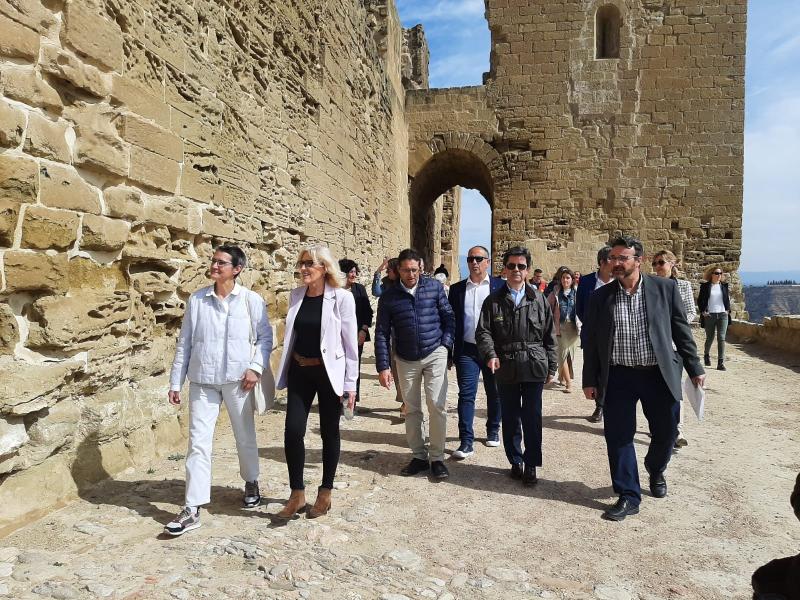
The Ministry of Culture and Sport, through the Institute of Cultural Heritage of Spain (IPCE), has completed the last works of consolidation and restoration of the castle of Montearagón, located in Quicena (Huesca), in which it has also intervened in the church occupied until 1835 by Augustinian monks of Loarre. The works of consolidation and restoration, which are presented today, have involved an investment of 1,726,520.81 euros and have been of great complexity, both for the entity of the castle, and for the numerous interventions made previously.
The presentation of the works was attended by Silvia Salazar, deputy delegate of the government in Huesca; Marta Hernández, deputy director general of the IPCE; Rafael Blasco, mayor of Quicena; Luis Felipe, mayor of Huesca; Olga Roldán, architect of the IPCE; and the architects responsible for the drafting and execution of the works, awarded to Damarin, S.L. ; and the presidents of the Region of La Hoya and the Association of Friends of Montearagón. After the presentation, a tour has been made of the medieval fortress that, after decades of work led by the General Subdirectorate of the IPCE, is already ready to receive visits.
From 1972 to 2011, the Ministry of Culture and Sport has carried out in the castle more than a dozen interventions to clean, consolidate and restore walls, towers, facades and the walls that surround this fortress of the 11th century. These actions include the restoration of the southern façade carried out between 2001 and 2003; the reinforcement of the masonry of the walls developed between 2006 and 2009; and the restoration, cleaning, consolidation and recovery of the environment of the southern wall carried out between 2010 and 2011. In 2015 a geological and archaeological study was carried out; and in 2017 the project was commissioned of the works presented today, executed between 2021 and 2022, in which new works of consolidation and restoration of the fortress and the church of the castle have been undertaken to guarantee the stability of the building and preserve the integrity of the whole.
Latest interventions and findings
The interventions carried out in this last five years have allowed to improve the knowledge of the castle through the analysis of the different historical materials used in its construction, the chronological dating of the different parts that formed it and the study of the geological characteristics of its location.
After a first phase of study and obtaining petrographic and geotechnical reports, structural interventions of micropilotage, studs and stitching of walls were undertaken in order to guarantee the stability of the structures. These were followed by interventions inside the castle: excavation of fillings with archaeological control, consolidation of vans and wall tops, binding of cracks, filling of cracks and implementation of the perimeter drainage system to evacuate the water to the outside of the enclosure reusing the routes of the sanitation network discovered. In the development of the performances inside the fortress, important findings were made such as the original pavement mortified with stone pebbles in steps, pandas of the cloister and in the Casa del Guarda and other original ceramics whose intervention has been especially complex.
The works of this last intervention in the castle of Oscense ended in December last year with the conditioning of its interior and the marking of the slopes that allow to guarantee the safety of the visitors in its opening to the public.