
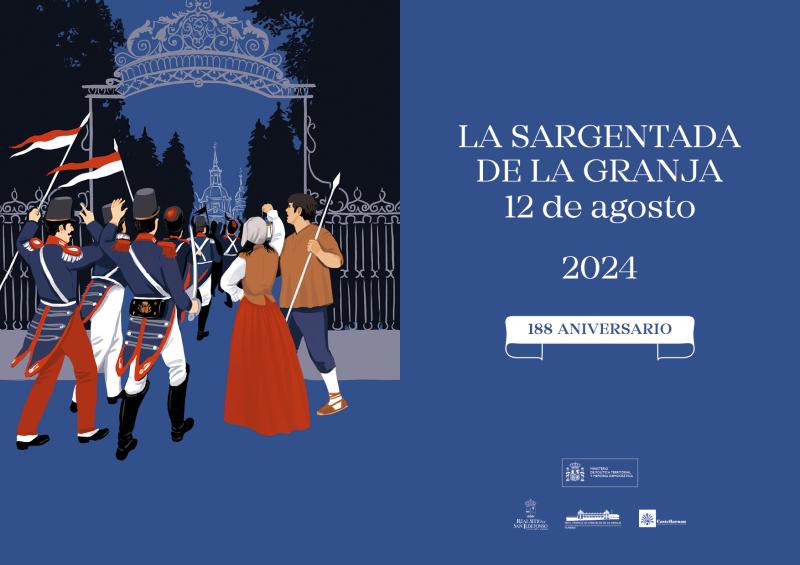
The municipality of the Real Sitio de San Ildefonso (Segovia) has commemorated, for the second year, “La Sargentada” the event in the history of Spain that represented the re-establishment for the third time of the Constitution of 1812 and the constitutional freedoms contained therein. A group of eager sergeants who, without spilling a drop of blood, and overwhelmed by the residents of the municipality supported the restoration of the Constitution under the cry, once again, of "Viva la Pepa! ", they were the protagonists.
The Mutiny of La Granja de San Ildefonso or Mutin of the sergeants of La Granja was an uprising that took place on the night of August 12 to 13, 1836, during the Regency of María Cristina de Borbón. A group of sergeants from the garrison and guard of the Royal Palace of the Farm, where the Regent was with her daughter Isabel, forced María Cristina to re-establish the Constitution of 1812 and to appoint a progressive liberal government, presided over by José María Calatrava.
On this 188th anniversary, the Secretary of State for Democratic Memory, Ministry of Territorial Policy and Democratic Memory, in collaboration with the City Council of the Royal Site of San Ildefonso, Royal Factory of Crystals of La Granja and the Castellarnau Society, has carried out a series of commemorative events. Among them, an institutional act at noon in the City Hall with the reading of the proclamation by Alejandro Triana, Honorary Rector of the UNED, the intervention of the Secretary of State for Democratic Memory, Fernando Martínez, and the Mayo-President, Samuel Alonso, followed by an offering of crowns of laurel in memory of the sergeants accompanied by the liberal anthems (the Marseillaise, the Anthem of Irrigation, and the National Anthem of Spain), and the unveiling of a plaque on the facade of the City Hall in memory of the protagonists of “Sada”.
The tribute also hosted a festive event with the representation of waffles "El sargentillo valiente" in the courtyard of the Royal Crystal Factory of La Granja. A funny comedy that narrates the events that took place in a humorous way, accompanied by the choir of La Granja directed by Javier Lázaro, author of the musical themes.
The most important consequence of the La Granja uprising was the repeal of the Royal Statute and the re-establishment of the Constitution of 1812, with the entry into force of the laws and decrees promulgated under that Constitution during the Liberal Triennium. During this brief stage in the history of Spain, between August 13, 1936 and the promulgation of the constitution of 1937, the definitive abolition of the Old Regime in Spain took place and the process of consolidating liberalism was consolidated.