
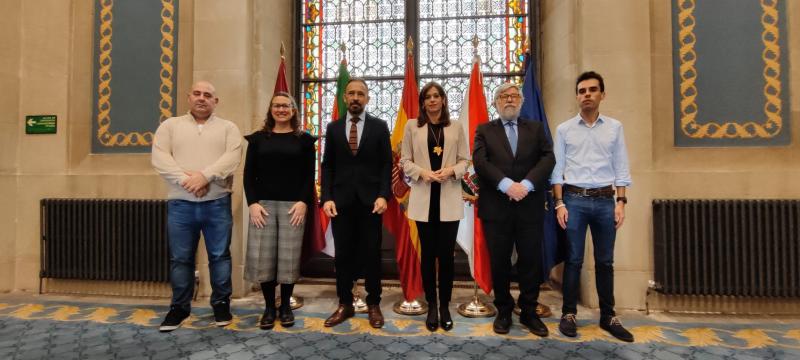
- The Government delegation in the Basque Country and the Memorial of Victims of Terrorism jointly celebrate the Day of Remembrance in the City of Vitoria-Gasteiz
- The event included the interventions of the Civil Guard Koldo San Martín, the student Endika Delgado and the teacher Ianire Lanchas and the projection of a video-survey to analyze the awareness of young people
The Government delegation in the Basque Country and the Memorial Centre for the Victims of Terrorism have celebrated together the Day of Remembrance with an event held in the City of Vitoria-Gasteiz and in which the civil guard Koldo San Martín, the student Endika Delgado and the teacher Ianire Lanchas have participated.
In addition to these speakers, the mayor of Vitoria-Gasteiz, Maider Etxebarria, the director of the Victims of Terrorism Memorial Center, Florencio Domínguez, and the government delegate in the Basque Country, Denis Itxaso, also spoke. Representatives of the political world, the judiciary and the victims have attended the event as a public.
The day was intended to analyze the knowledge that young Basque people have about the terrorism experienced in the Basque Country in recent decades. A video-survey served to draw a scenario in which the need to promote memory was evidenced so that young people know the incidence of terrorism in the recent past and become aware to avoid its repetition. The three guest speakers spoke from the experience acquired in the contact they usually maintain with young people, in the cases of Ianire Lanchas and Koldo San Martín, and, on the part of Endika Salgado, from the concern to deepen the knowledge of our history.
In his speech, Denis Itxaso warned of the danger that some young people who have not lived through the era of ETA “will revive a feeling of hatred not lived, but inherited.” The government delegate cited the recent attacks on the memorial monolith and the tomb of Fernando Buesa as examples that “it will take enormous doses of civic militancy and the commitment of the democrats so that the memory ends up being imposed on the most abject resentment and rancor, still present in some corners of our society.”
Itxaso recalled that “our young people attend a reality in which the values of democracy, peace or freedom are taken for granted”. In his opinion, “perhaps we have not been able to transmit to them the epic of that struggle for freedom” and society has “the responsibility to transmit to the youngest people that commitment, that epic, as an essential part of our DNA as a collective project. This memory must permeate the world of education, culture, family and the social environment. Educate in respect and commitment so that this flow of goodness and sacrifice does not volatilize, like tears in the rain.”