
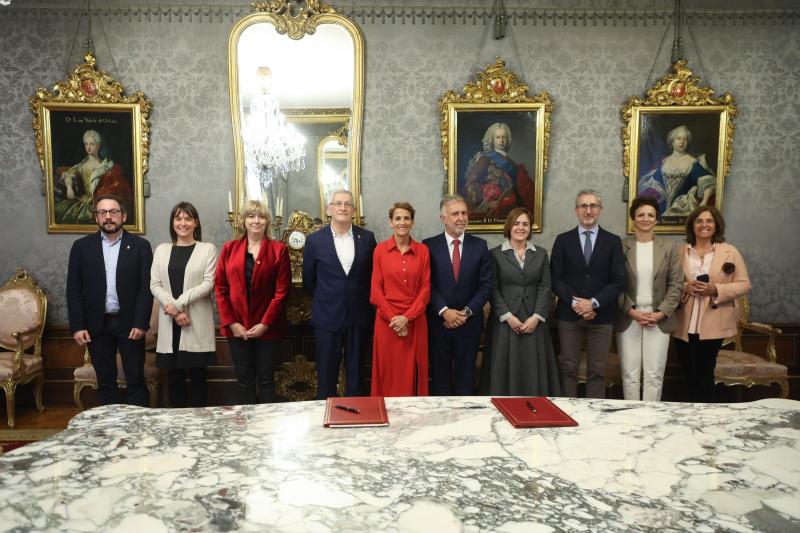
The administrations of the State and the Foral Community of Navarre have agreed in Pamplona to initiate the reform of the Organic Law of Reintegration and Improvement of the Foral Regime of Navarre (LORAFNA).
The agreement was signed after the meeting of the Negotiating Committee held on Tuesday and, subsequently, signed by the Minister of Territorial Policy and Democratic Memory, Ángel Víctor Torres, and the first vice-president and Minister of Presidency and Equality, Félix Taberna.
In the subsequent press appearance, offered in the Palace of Navarre by Minister Torres and the president of the Foral Community, María Chivite, both have highlighted the political will so that the Foral Community can soon regain competence in the field of Traffic.
The minister stressed that the text agreed in the Negotiating Committee “reintegrates into the Foral Community of Navarre the full exercise in traffic, circulation of motor vehicles and road safety, as decided by the two administrations. The amendment of the Law on Reintegration and Improvement of the Jurisdiction has been made in barely 60 days, although the relevant parliamentary steps remain until the reform in the Courts is finalized.”
Torres has appealed to maintain the maximum consensus, in a transfer already decided, with the reform that is now being implemented, to respond to a sentence that we hope to culminate in the shortest possible time and thus continue the path of the State of autonomies, co-governance, the transfer of competences, bilateral commissions and always with the maximum collaboration of the Ministry of Territorial Policy with the Foral Community of Navarra.”
The president of the Foral Community, for her part, has highlighted the support that the governments of Spain and Navarre give to the Amejoramiento, the Constitution and self-government, “which advances since the last legislature more than in the previous twenty years.”
Chivite has stressed the “absolute normality with which this reform process is activated, in an act in which we reaffirm the law from which our self-government emanates, which, in its article 71, provides that the reform must be agreed. And that is what we are doing, with a Spanish Government that has been up to the task.”
It should be recalled that this reform of LORAFNA was launched after the judgments issued on February 15 and 22 by the Supreme Court, in which a part of the transfer agreed by the Transfer Board on March 22, 2023 was annulled and its effectiveness began on July 1, 2023.
Once the agreement has been reached, the proposal will be approved in a government session and must obtain the mandatory opinion of the Council of Navarre. Subsequently, the text will be forwarded to the Parliament of Navarre, for approval by the plenary. The agreed reform will then be submitted to the Government of Spain for processing as an organic law in the Cortes Generales.
Negotiating Commission
The Negotiating Commission that has reached the agreement has been composed of representatives of the Foral Community Administration and the State Administration.
On the part of Navarre, the first vice-president and councilor for Presidency and Equality, Félix Taberna; the second vice-president and councilor for Memory and Coexistence, External Action and Euskera, Ana Ollo; the third vice-president and councilor for Housing, Youth and Migration Policies, Begoña Alfaro; and the general director of Presidency, Open Government and Relations with the Parliament of Navarre, Joseba Asiain, attended.
On the State side, the Minister of Territorial Policy and Democratic Memory, Ángel Víctor Torres, were present; the Secretary of State for Territorial Policy, Arcadi Spain; the Secretary General for Territorial Coordination, Miryam Álvarez; the Government delegate to the Autonomous Community of Navarre, Alicia Echeverría; and the General Director of Regional and Local Cooperation, Alejandra del Río.