
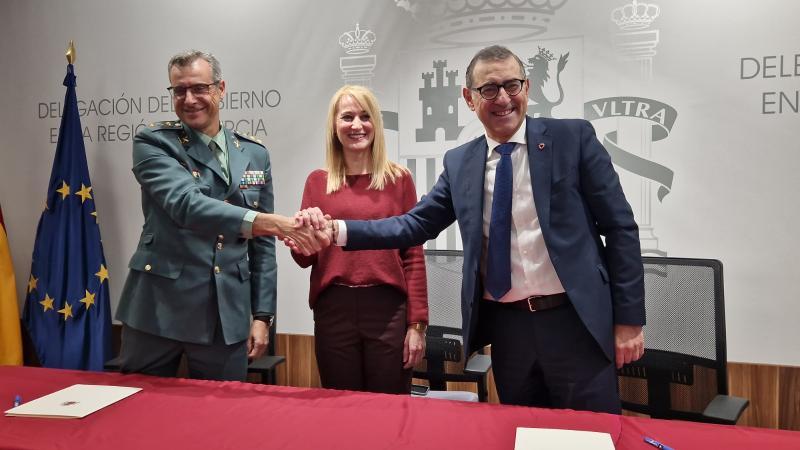
- The Government delegate has presided over the signing of the collaboration protocol signed between the 5th Zone of the Civil Guard and the University of Murcia
- Mariola Guevara highlights that this agreement will allow to carry out training, sensitization and advice on hate crimes and treatment of victims in public administrations, institutions, civil society organizations and security forces and bodies
- “This new space will channel new solutions or strategies to improve care and try to prevent such attitudes from repeating themselves,” said
January 23, 2025. The delegate of the Government, Mariola Guevara, today presided over the signing of the operational procedure of collaboration between the 5th Zone of the Civil Guard and the University of Murcia for the creation of the Regional Observatory against Islamophobia and other hate crimes that have been signed by the Colonel Chief, Francisco Pulido, and the rector of the UMU, José Luján.
“The creation of the Regional Observatory against Islamophobia and Hate Crimes will allow us to monitor the cases of hatred that occur in the Region of Murcia, analyze the response provided to confront this case, attend to the victims and constitute a space to propose new solutions or strategies to improve attention and try to prevent such attitudes from recurring,” said Guevara.
The Government delegate added that this observatory will make it possible to identify, prevent, raise awareness, educate and, above all, raise awareness against acts of discrimination, violence or intolerance motivated by prejudice towards certain groups of people, whether due to their origin, ethnicity or status.
Within these actions, studies will also be carried out to provide precise solutions to certain acts contrary to peace and public order, establishing alliances and collaborations with civil society organizations, government institutions, human rights agencies and other relevant actors to strengthen the work of the observatory.
The Observatory will bring together different social agents to work in a network and directly against these acts from a multidisciplinary approach, with a broad focus that brings together Security Forces, jurists, sociologists, criminologists, public and private entities as well as people from the third sector and/or victims.
“The combination of all these actors is the only solution to eradicate this type of act, contrary to the most elementary rules of public order, and to move towards a society that coexists in peace and harmony, with respect for diversity, free of violence and prejudice,” added Pulido.
For his part, the rector of the University of Murcia, José Luján, has thanked the opportunity to participate in this observatory. “As citizens we share the concern about the manifestation of hate crimes and we understand very well the role played by the Civil Guard taking care of our security. And that is why we thank you for considering that in order to properly develop this function of protection of citizenship, the University of Murcia can be a good ally and offer us the possibility of collaborating in this observatory,” he said.
FUNCTIONS
The observatory's own functions are as follows:
(a) Collecting information related to hate crimes, with the aim of carrying out studies and proposals to improve care and counselling for victims and to improve prevention and response in such cases.
b) Carry out tasks of monitoring and follow-up of cases of hatred, as well as the analysis and evaluation of the response and attention given, and propose solutions or strategies.
(c) Develop and promote studies, research and activities aimed at acquiring new knowledge of hate cases that facilitate the adoption of new strategies and solutions and provide guidance and assistance to all actors involved in such cases.
(d) Carrying out training, awareness-raising and counselling activities on hate crimes and the treatment of victims in public administrations, institutions, civil society organizations, security forces and bodies, etc.
e) Carry out dissemination and publication actions regarding studies and research, or actions, on cases of hatred, as well as the activity of the Observatory itself.
f) Maintain relations and establish alliances and collaborations with other observatories and bodies that carry out their activity in matters of a similar nature, as well as with other public and private agents.
In any case, the functioning, tasks and functions of the Observatory will try to be consistent with the Recommendations of the European Commission against Racism and Intolerance (ECRI).
Information exchange
The Civil Guard will be able to inform the Regional Observatory against Islamophobia and the rest of the Hate Crimes of the problems derived from this type of incidents and provide useful information to prevent this type of crime, improve the attention and advice to the victims and the prevention and response in these cases.
For its part, the University of Murcia may provide the Civil Guard with the information available in the scope and for the purposes of this procedure, for the purposes of police and/or judicial use, and must at all times preserve the anonymity or confidentiality of the sources of knowledge of the information.
Training
The formation of both administrations will be promoted in an interdisciplinary way.
The University of Murcia will collaborate in the training in matters of interest to the components of the Civil Guard of the Murcia Command through ad hoc courses or reservation of places in already existing courses.
The Murcia Command will provide training to the University of Murcia, or its students, of the subjects it considers relevant.
Background
At the beginning of 2022 the CISDO project starts: “Inter-police and Social Cooperation against Hate Crimes”, presenting the candidacy to participate and be financed by the Europera Commission “Citizens, Equality, Rights and Values Programme” (CERV-2022-EQUAL).
This project is led by the Spanish Monitoring Centre on Racism and Xenophobia (OBERAXE) of the Ministry of Inclusion, Social Security and Migration, together with the University of Salamanca (USAL) and the National Office against Hate Crimes (ONDOD) of the State Secretariat for Security, representing the Ministry of the Interior.
The overall objective of the CISDO project is to improve the capabilities of police forces at national and local levels, in cooperation with civil society organizations, to prevent, identify and respond to racist and xenophobic incidents, as well as hate crimes, by improving mutual understanding and building bonds of trust, to prevent hate crimes from being reported, and to provide better assistance to victims of hate crimes.
During the year 2022, work continued on giving impetus and form to the project, designating the Contact Points and facilitators who should receive specific training to properly develop their functions as facilitators of the Community of Practices (COPRA) that they should constitute in their province.
In February 2023, the official launch of the European project CISDO took place, in which, in addition to the presentation and launch of the project, the first lines of action of the COPRA were specified, as well as the scheduling of the project.
In the case of the COPRA of Murcia it was decided to bring the members of the Security Forces and Corps closer to the Muslim community to fight and improve the problem of the under-denunciation in the field of Islamophobia, with the final commitment to establish a tangible and lasting product over time, in relation to the challenge posed, validated by the direction of the project.
Recognitions
On December 18, the delegate of the Government and the colonel of the 5th Area of the Civil Guard of Murcia recognized the work of security forces and entities of the Third Sector in the fight against hate crimes by handing them the diplomas accrediting their participation in the aforementioned European project CISDO.
In that event, diplomas were given to about twenty civil guards, two national police officers and three local police officers of Murcia, in addition to the recognitions to members of entities participating in the project, such as Columbares, Murcia Welcomes, Cepaim, Red Cross, Accem, Asociación Rumiñahui, Convivir Sin Racism and Young People for a Change.