
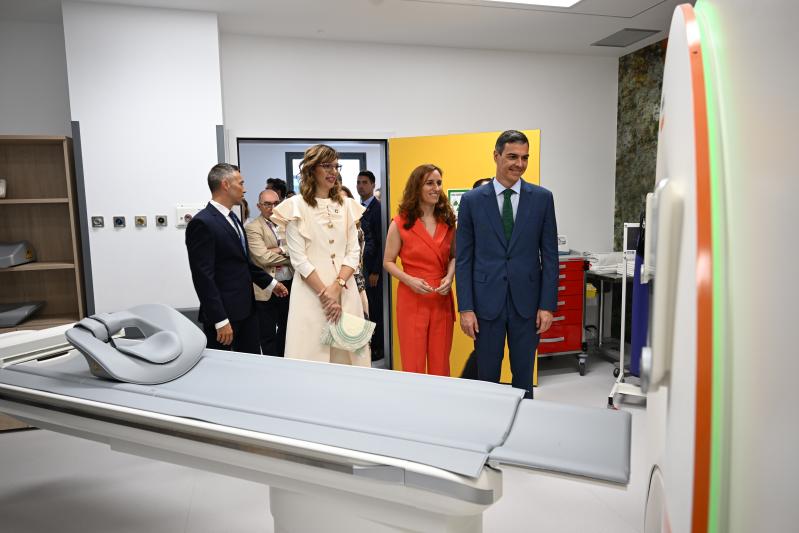
The President of the Government, Pedro Sánchez, has inaugurated today the new University Hospital of Melilla (HUME). Accompanied by the Minister of Health, Mónica García, the President of the Government has visited the hospital complex and experienced first-hand the functional organization and technological equipment of the center, stopping in particular, in the areas of Laboratory and Radiology.
Both the President of the Government and the Minister have been able to see first-hand the excellence of the center and its professionals in the hands of the director of the INGESA, Isabel Muñoz, and the Manager of the center, Alberto Romero, with whom they have toured various facilities of the HUME together with the Government delegate in Melilla, Sabrina Moh, and the territorial director of the INGESA in Melilla, Omar Haouri. The president had already visited the hospital works in 2022.
Pedro Sánchez has highlighted that this new infrastructure demonstrates, with facts, the commitment of the Government of Spain with the city of Melilla, with the improvement of the living conditions of its citizens, as well as with public health as a basic pillar of the welfare state.
Today, seven years after the constitution of the current Government of Progress, Pedro Sánchez recalled how, on January 31, 2006, President José Luis Rodríguez Zapatero visited Melilla and then announced the construction of a new hospital for the city, and how, now, finally, fifteen years after its first stone was laid, it has been the current progressive Government that, overcome the images of cranes stopped as a result of the cuts and the dismantling of public services suffered between 2012 and 2016, retook with absolute decision and definitively promoted the project of this new University Hospital that has been officially inaugurated today.
As the President of the Government pointed out, “where there was freezing and cuts, citizens today enjoy more and better services; where there was freezing and loss of purchasing power, today we witness the revaluation of the public” as a result of “a government action that is leader in investments and territorial cohesion”. In this regard, Pedro Sánchez recalled that Spain is the driving country for job creation in the European Union because four out of ten new jobs in Europe are created in our country.
The President of the Government wanted to remember that “the treasury of public health” is assured and developed through infrastructures such as the HUME, with its 256 beds and 45,000 m2 of assistance area, its new services such as the pediatric ICU, the Hemodynamics Room or a hyperbaric chamber, as well as state-of-the-art technological equipment such as robotic surgery. Pedro Sánchez, at the head of a government that invests 20% more in health, has stressed that “opening the doors of the HUME repairs an injustice, it means paying a historical debt to the Melillense population”. Not in vain, the new HUME, with an investment of more than 150 million euros, becomes the largest service infrastructure, in decades, for the city of Melilla.
On the other hand, the president continued, in a context in which the Ministry of Health has offered more training places through residency than ever in our history -11,943, in the last convocation - and covers 100% of them, the new University Hospital of Melilla will be located as a reference center in training within our National Health System.
Pedro Sánchez concluded his speech by dedicating a special mention to “those who give the soul to these facilities, to their more than 1,100 professionals”, as well as to the professionals of the hospitals destroyed in the Gaza Strip, whose courage continues to save lives and whose memory the president wanted to honor “on the shores of this same sea” that bathes the city of Melilla, a “land full of history and, above all, of opportunities and future”.
A before and an after
The Minister of Health, Mónica García, has stressed that “as a doctor, I know very well how important it is that those who care can do it with a quality infrastructure”, although it is within its walls that “the best values of our National Health System are found, those that make our public health great: equity, cohesion, solidarity and social justice”.
Mónica García expressed her sincere thanks to all the people and institutions that have made this milestone possible: to the professionals who have worked tirelessly in its design, construction, equipment and implementation, to the National Institute of Health Management and its director, Isabel Muñoz, and, in a very special way, to the European Union, for its decisive support through European funds.
Finally, the minister stressed that this new hospital is also an example of how we are moving towards a fairer and more cohesive public health. Thanks to the INGESA framework agreements, we have brought cutting-edge technology not only to Ceuta and Melilla, but to the whole country, plans such as INVEAT, AMAT-I (High Technology Framework Agreement) have allowed to reduce obsolescence, shorten the technological gap between territories and strengthen diagnostic capacity throughout the National Health System. And that has a very concrete consequence in people’s lives: they are cared for earlier and they are cared for better.
“Today the new University Hospital of Melilla is starting. But above all, it sets in motion a better future for the health of this city and the country as a whole,” concluded the Health Minister.
Effective entry into service
On Monday, May 26, immediately after receiving from the Autonomous City the administrative licenses of first occupation and use as a health center, the people of Melilla saw how this new center opened its doors to the public health service of the city, a service that in Melilla is directly managed by the government of Spain.
The opening of the University Hospital of Melilla (HUME) represents an unprecedented milestone: from the structural point of view, the building has been built based on the most modern standards of efficiency, sustainability and accessibility; from the healthcare perspective, the HUME places the specialized care in Melilla at the forefront of the National Health System.
The technological innovations incorporated in the new HUME will not only allow more diagnostic tests and care processes to be carried out in the center itself, avoiding trips to the peninsula, but also extend its organizational and therapeutic influence to the entire Health Area of the city, as has already been seen with the sample collection system that has also been implemented in Primary Care: the INDEXOR system is a technological tool that transforms the collection and management of laboratory samples. Automation, total traceability and faster results. Everything, thanks to the new University Hospital. The system already works in the Health Centers Zona Este (Polavieja) and in the Health Center Alfonso XIII (Zona Oeste) and will soon reach the other centers. Technology at the service of patients and professionals.
The opening is being carried out without stopping the care activity, that is, the patients will not be affected by their attention. In this first phase, all external queries are being moved. At the moment, they are already treating patients of the specialties of Diabetes Education, Rheumatology, Allergology, Neurology, Pneumology, Internal Medicine and Oncology. The Rehabilitation Service and several radiological tests are also installed and functioning: magnetic resonance imaging, computerized axial tomography (CAT) and bone densitometry. The new Clinical Analysis Laboratory of the HUME is also already operating and represents an absolute revolution that places the hospital of Melilla among the most advanced in Spain in this service. This only in the first week since its opening.
This commitment not to stop the attention to the citizens hinders an already complex process, so the change from the Regional Hospital to the University is divided into multiple phases so that both patients and health professionals are cared for and work with all the guarantees of safety that health care requires.
A quantitative and qualitative leap
As highlighted in today’s inaugural event, the HUME represents a quantitative and qualitative leap for the health service of Melilla. Firstly, the space is larger, so it can serve more patients at once: it is a building with 45,000 m2 of healthcare space and a total of 63,000 m2 of built space. This allows an increase in the number of almost one hundred beds from 170 to 265. The investment made amounts to 150 million euros for the development of this state-of-the-art hospital equipped with the most modern technology.
The HUME endowment is the most advanced in current healthcare, with the most cutting-edge technology in the sector: thanks to the European Funds, managed by the National Institute of Health Management (INGESA), Melilla will have at its service a new hospital that will have state-of-the-art equipment such as Magnetic Resonance Imaging, the pediatric ICU, the Hemodynamics Room, or the Robotic Surgery team, placing itself at the forefront of the country at the healthcare level.
This provision of new equipment, services, and facilities will allow us to expand the portfolio of services that will be provided in it. For example, the aforementioned Magnetic Resonance equipment is the latest generation and totally pioneering, so the population will no longer have to travel to the peninsula for this type of tests. The new Hemodynamics Room will allow cardiac catheterizations to be carried out, for which, until now, it was also necessary to travel to hospitals on the peninsula, so it is another important advance for citizens.
This operation is considered an operation of strategic importance in the Multiregional Program of Spain FEDER 2021-2027.
The largest number of staff in its history.
The beginning of the activity in the University Hospital of Melilla has associated the largest staffing in the history of the public health service of Melilla. About 1,100 professionals in the Health Area of Melilla serve a population that is approaching 74,000 health cards. The increase in staffing carried out in recent years has made it possible to have 27% more professionals in the last decade (2014-2024), 229 more people to serve a population that remains stable and with an assistance pressure that has been reduced by 34% with the closure of borders. The retributive conditions of the specialist doctors, the highest in the entire National Health System, and the care pressure, significantly lower than in the rest of the country, have made it possible to attract 30% more doctors in the last ten years, assuming 52 more specialist doctors to care for the Melillenses.
The increase in the teaching capacity of health professionals is already available from this same year for Family and Community Medicine with an increase in the places offered in this specialty. This increase, possible thanks to the new facilities of the University Hospital of Melilla, will be an important incentive to guarantee the generational replacement and the incorporation of young professionals with a very high qualification and motivation for teaching and research.
Next-generation technological innovation at the service of health
The new HUME is another real example of the action of the Government of Spain for technological innovation applied to health. Since 2021, the Ministry of Health through INGESA has launched its centralized purchasing mechanism to renew the technological park of all health services in our country. The first was the INVEAT Plan (High-Tech Equipment Investment Plan), made up of 8 framework agreements for the acquisition of 774 high-tech healthcare equipment to be financed from the PRTR (Component 18 Investment 1). The investment of this Plan amounted to 865 million euros and the savings for the SNS through the CCAA adhered to the different framework agreements reached approximately 80 million euros.
During 2024, the Ministry of Health has continued on this path of reducing obsolescence, increasing the diagnostic capabilities of the SNS centers, expanding the technological park, reducing the technological gap between regions and achieving maximum efficiency, through the formalization of 6 framework agreements that make up the so-called AMATI-2024 Plan (Plan of Agreements Framework of High Technology Sanitary Equipment of the INGESA) focused on diagnostic imaging technologies.
The estimated saving for the SNS is 40 million euros in the purchase of more than 2,500 new equipment that are improving the diagnostic capacity of the SNS with an investment amounting to more than 250 million euros. To this must be added the savings of non-acceded regional CCAAs that have been able to negotiate better prices thanks to those established in the INGESA framework agreements.