
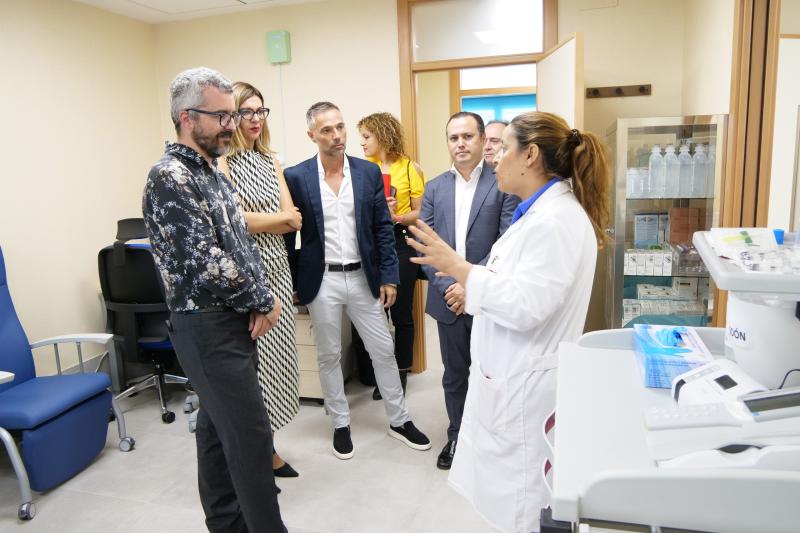
Thanks to the commitment and investment of almost one million euros by the Ministry of Health and INGESA, Melilla now has a modern, functional and equipped primary emergency service to address any emergency. This is the renewed Primary Care Emergency Service (SUAP) in the facilities of Álvaro de Bazán (behind the Polavieja Health Center) and that today has been known at first hand by the Secretary of State for Health, Javier Padilla. This service opened its doors on Saturday and has already served 196 people in its first weekend with great satisfaction of users and professionals.
Accompanied by the delegate of the Government in Melilla, Sabrina Moh; the general director of INGESA (National Institute of Health Management), Isabel Muñoz; and the advisor of the Secretary of State for INGESA, Alda Recas, Padilla has been able to see in first person that this integral reform not only modernizes the original facilities in terms of structure and technology, but also makes significant progress in the quality of care and comfort for patients and professionals.
Before this visit, the Secretary of State met with the Minister of Social Policy and Public Health, Randa Mohamed, with whom he reviewed the main issues related to the health area of Melilla and where he valued the figure of the Sectoral Table of INGESA as the only forum for negotiating human resources issues of this body according to current legislation.
Faced with questions from journalists about the transfer of competences to the Government of the Autonomous City, the Secretary of State recalled that the distribution of competences provided for in Spanish regulations makes this transfer impossible. In addition, he has assured that the Government of Melilla is not prepared to carry out this competence in the light of the current situation, for example, with the screening of different cancers, a competence of Melilla that it is not carrying out. The Ministry is working on an agreement for INGESA to take charge of these screenings, fundamental for the early detection of cancers such as breast, cervix, colon and metabolopathies, he announced.
“The best way to guarantee proper health care coverage and the right to health protection of the population of Melilla is for the current competences to work and function well. We are very aware that there are areas for improvement and that is why we are here. We are not satisfied, but we are also aware that great improvements have been made, especially in the last six years,” he said.
The secretary wanted to highlight some data that show that the health managed by INGESA is progressing at a good pace. Melilla and Ceuta in 2023 had much better data than the SNS average: only 8.59 people out of every thousand expected an intervention, while the national average was 17.55 patients and only 7.5% of patients had been waiting for more than 6 months (data as of June 30, 2023) when in the SNS that figure stood at 17.4%. In Melilla and Ceuta, the maximum waiting time on that date was 86 days, almost one month less than the national average (112 days).
Regarding the attraction of talent, the secretary recalled that the Ministry does comply with all its competences: “In Melilla, we have hired the three MIR who have completed their specialized training and, in Ceuta, four of the six who have finished. This results in a retention rate of 77%, the highest among all employers in Spain as a whole.” For the ministerial director, “this is a sign that improvements have been made in the working conditions, which make the professionals stay”. “However, we continue to work on salary improvements through the definition of difficult to cover posts and the increase in the unit price of the on-call time, which we are working with Public Service and Finance and within the Sectorial Table.” In this line, one more sample of the good conditions of the professionals is that the balance is positive in retention of talent if we observe the service commissions: only 5 professionals have left Melilla per service commission to go to another health system, while we have 17 service commissions of professionals who worked in other health services and have wanted to come here.
Padilla has also met with the professional associations of Nursing, Psychology, Dentistry, Pharmacy and Speech Therapy to learn about the concerns of its members. The College of Doctors of Melilla has not attended this meeting, as the secretary has informed questions from the media.
The secretary thanked the Melillense public health workers for their work and explained that October is going to be a particularly intense month for this health area for the opening of the new SUAP and the University Hospital, a staggered, planned and flexible process to be able to face the many unforeseen events that may arise in a process as complex as the one being developed. He also recalled that this opening will be accompanied by an increase in 252 professionals who will join INGESA to continue advancing the line already begun and that has meant the increase of 34 doctors in the last decade.
Padilla stressed that the Ministry is very familiar with the health of Melilla and believes that we must begin to talk about it in positive terms: “There has been great progress in the last decade and more specifically, in the last six years. We have reversed the rate of decline of professionals in which we had immersed ourselves with the governments of the PP and we are already recovering in the number of nurses and doctors in the field of Primary Care and we have increased the rate of growth in the hospital field.” In addition, “we want to continue working in an area where Melilla is better than the average in Spain, such as waiting lists”, he stressed.
The secretary wanted to place the emphasis on the first level of assistance: “This is the legislature in which we have to work more and better in Primary Care throughout the State and also push for services that have been already being promoted such as Oral Health and Mental Health.”
The MINAP Plan: Infrastructure and Equipment Renovated
After these meetings, the Secretary of State for Health has had the opportunity to get to know the facilities of the SUAP with the help of the highly qualified team, with many years of experience in emergencies that is at the front: first quality care is guaranteed. During this meeting, the facet that the center will play in the training for future professionals of Medicine and Nursing who will rotate through the SUAP to obtain a training of excellence has been highlighted.
The home care service has also been highlighted, with an official vehicle equipped to bring medical and nursing care to the homes of patients who cannot go to the center: essential for people in palliative care, elderly or people with reduced mobility. During weekends and holidays, the home service is available 24 hours a day.
This new SUAP is the result of the Primary Care Infrastructure Improvement Plan (MINAP), an ambitious project promoted by the Ministry of Health of the Government of Spain and INGESA. It has allowed the renovation of the facilities and the acquisition of state-of-the-art technological equipment that guarantees greater comfort and quality, both for patients and professionals.
One of the major advances of the new SUAP is the use of cutting-edge technology. They highlight:
• EcoFAST: system that allows ultrasound in situ, fundamental to rule out serious pathologies without the need for referrals to the hospital. This considerably improves the response and treatment time.
• Rapid blood analyzer: provides results in minutes, essential for critical situations such as serious infections or severe dehydration. Thanks to this equipment, the treatment can be adjusted immediately, improving the patient's prognosis.
• Electrocardiograph: allows electrocardiograms to be performed immediately, vital for the evaluation of heart problems, and share the results digitally with specialists.
UNIVERSITY HOSPITAL OF MELILLA
The Secretary of State also wanted to know first-hand the University Hospital of Melilla, a modern building of 45,000 square meters that incorporates the latest advances in sustainability and the most avant-garde health technology. It should be noted that INGESA has already presented today all the necessary documentation together with the application for the first occupation license to the Government of the Autonomous City.
Padilla has toured the facilities with the INGESA management team that has also accompanied him throughout the morning to inform him of all the details, including the territorial director of INGESA in Melilla, Omar Haouari; the new manager of the health area of Melilla, Alberto Romero; and the rest of the management team. All this team and more INGESA managers are working hard to start the transfer of the first services in a few weeks.
INGESA received in June the work that has involved an investment of more than 100 million euros from the Multiregional Program of Spain FEDER 2021-2027. Thanks to the European Funds, Melilla will have in this 2024 a new Hospital that will have state-of-the-art services such as Magnetic Resonance Imaging, the pediatric ICU, the Hemodynamics Room, or the Robotic Surgery team, placing the University Hospital of Melilla at the forefront of the country in terms of assistance.
The equipment of the Hospital is financed with PRTR funds in the amount of € 28,546,226.70, of which a total of € 5,816,051.69 have been executed in previous annuities and it is planned to execute € 22,730,175.01 in 2024.
Its gradual implementation will begin in October 2024, as confirmed by the Secretary of State, who explained that the priority is to begin the transfer and that the inauguration, on a date to be determined, will be done at the highest level: “We want it to be a day of celebration and pride for the whole city.”