
“The National Police is an indispensable institution in our society. Your work is crucial to maintaining peace and protecting the rights and freedoms of citizens.”
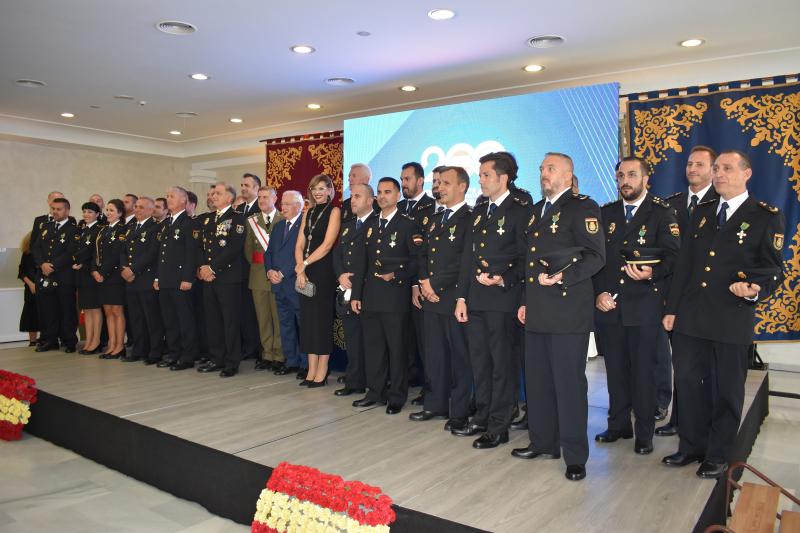
The Delegate of the Government, Sabrina Moh, on the occasion of the commemorative event of the Holy Angels Custodians, Patrons of the National Police Force, which was held this lunchtime at the Melilla Puerto Hotel, has recognized and thanked the work and dedication of the women and men of the National Police.
“Thanks to your work you have made the Police become an indispensable institution for Spanish democracy,” he stressed, and defined them as a body of officials “highly qualified and with solid principles that make you continue to earn the trust of the citizens and that every year more people are willing to wear your uniform.”
The Delegate has valued the work of the professionals of the National Police. A work, he said, “that has as its main axis the security in which a society such as ours must be sustained and sustained and that thanks to this we can live and enjoy with the tranquility that you bring us, since your presence gives us that confidence necessary to feel protected”.
200 years history
The highest representative of the Government of Spain in our city recalled that, almost two centuries ago, in 1824 and by the Real Cédula de Fernando VII, the General Police of the Kingdom of Spain was born, the first police force with competence throughout the territory and formed by professionals with exclusive dedication.
“Today, with almost 200 years of history and thanks to your ability to adapt, you have become the institution responsible for guaranteeing security and public order throughout the national territory, and you have proven to be a fundamental pillar in the protection of citizens and in the fight against crime,” he added.
But in addition, the Delegate has referred to the constant changes and advances of today’s society in which “public security management is required that adapts to the new realities”, so she has highlighted the work that the Police has carried out in terms of digital transformation “that has allowed to enhance cybersecurity capabilities”.
Something, he said, “essential, not only to have a greater capacity to respond to this type of crime, but to raise awareness among citizens of the responsible use of new technologies.”
Just as relevant, Moh added, is the institutional and citizen collaboration. An issue that in our city “is evidenced every day, not only by the work of protection that you carry out make the most vulnerable groups, towards our elders or the citizenry in general, but by the actions that you carry out to bring institutions closer to society”.
At this point, the Delegate has mentioned the solidarity races that the Superior Police Headquarters is carrying out, which this year celebrates its third edition, and whose funds will go to the Autism Melilla association. “For performances like these, once again, I thank you,” he said.
Rigorous training
In her speech, the Government Delegate stressed the pride of being part of the National Police, given that the commitment to protect and serve society “is a vocation that encourages the police to give the best of themselves in each intervention.”
“You, the men and women who are part of this great family, are always ready to help and protect those who need it, ensuring the safety and well-being of society, from the commitment and dedication with which the police carry out their work daily,” he said, addressing the professionals of the body.
However, the Delegate wanted to highlight the rigorous training of these professionals and that comes to be perfected with the creation of the Police University Center, “which places us as a national and international reference in police training and which tries to find the necessary balance between excellence and training that benefits both the internal professional career and the acquisition of talent, thus promoting the incorporation of new agents.”
A professionalism, he pointed out that, together with the effort they carry out, “it makes you fulfill the mission entrusted to you by our Constitution from the dedication and determination that characterizes you and with fidelity to the values that this body represents.”
Acknowledgements
In her speech, the head of the Government Delegation in Melilla also had words of thanks and support to the relatives and loved ones of the police officers for being an important support and providing support and understanding.
A gratitude that has also extended to the institutions, entities and body that offer their collaboration and accompany the Police in their daily work.
Continuing with the chapter of thanks and congratulations, he has had words for all the decorated of this year, “a distinction that is granted to you as deserved and just recognition of your work”, as well as for the people who have retired, “after many years of dedication, loyalty and unconditional dedication to this Body”, to whom he has thanked them for their time of service and has transferred their best wishes for this new stage of their life.
Finally, Sabrina Moh has had a few words of remembrance for all those policemen who have left us during this year. “May all our affection and affection reach their relatives and loved ones,” he said.
A safe country
The Superior Chief of Police, José Antonio Togores, for his part has referred to the fact that the body has been, during these almost two centuries at the service of the citizenry, “demonstrating every day our capacity and dedication to society, striving to ensure that we Spaniards enjoy a safe country.” “One of the safest in the world, facing the great challenges facing public security,” he said.
Thus, he has referred to the Strategic Plan of the National Police, scheduled for the period 2021-2024, which promotes aspects such as the fight against cybercrime, international cooperation and equality, among others, as well as the empowerment of digital transformation and training with the creation of the University Center of the National Police, which since this year will benefit many police in their professional development. “This is an ambitious reality that consolidates the Police as a reference both nationally and internationally,” he stressed.
In his speech, the Superior Chief pointed out that, according to data from the General Directorate of Police, criminal offences in Melilla have decreased by 3.73%.
Thus, as he has reported, the rate of effectiveness, which indicates the result of the investigations with the clarification of the crimes and, where appropriate, the detention of the perpetrators and participants, has increased to 61.35%, being at the national level 38.17%. The number of detainees increased by 10.82% and at the national level by 7.59%. “It’s good data that tells us we’re on the right track,” he said.
In the field of investigation, he added that during the last year, the units of the Provincial Judicial Police Brigade have worked on more than 50 cases, with the dismantling of seven Organized Criminal Groups. “Most of these organizations were involved in drug trafficking and the total number of detainees is 684,” he said.
Togores has highlighted operations such as the so-called ‘Trastero-Ramo’, in collaboration with the Civil Guard, in which 2.5 kg of heroin and 22.5 kg of cocaine of great purity have been intervened, as well as effects valued all in almost one million euros of a criminal organization dedicated to international drug trafficking that transported heroin and cocaine from the Netherlands to Morocco through Melilla through aground vehicles.
He also reported on Operation Tomelloso 2, which allowed the dismantling of another international criminal organization dedicated to cocaine trafficking operating throughout Europe, which prepared the vehicles in Germany and loaded them in the Netherlands, thanks to which 11.5 kg and the second 8 kg of the aforementioned substance have been intervened in a first phase. Or Operation Tarsis, which succeeded in dismantling a criminal group dedicated to the introduction of synthetic drugs by seizing 25,000 psychotropics with the detention of two people in Melilla and another 6 in Morocco.
Another activity that the Superior Chief has also highlighted has been that carried out by the members of the UFAM in relation to the crimes of Gender Violence and in the family, who “permanently investigate and protect the victims” with 248 attested for gender violence and 57 for domestic violence, with 249 detainees and 34 investigated.
And on the Protection of Victims of Gender Violence, it has pointed out that 1,100 risk assessments have been carried out, 728 removal orders have been executed, in addition 248 victim care actions, 375 accompaniments and more than 268 contacts with shelters of different NGOs. “Very important figures that require a lot of effort,” he said.
For its part, the Economic and Fiscal Crime Unit (UDEF), in its work against laundering and corruption, “has participated in 14 investigations that remain active.” And, with regard to common crimes, which is carried out by the Urban Crime Group, 1,125 cases have been processed with 966 Attestations and trades, in addition to 377 clarified cases that have allowed 395 people to be detained, which is 9% more than the previous year.
Togores has also addressed the work of the Group of Minors (GRUME), with Operation Macan, related to the corruption of minors and sexual assaults, thanks to which four people have been arrested.
In the area of Foreigners and Borders, the UCRIF has developed during this year 50 operations of trafficking in human beings for the purposes of sexual and labor exploitation, irregular immigration, prostitution and documentary falsehood, with the result of the dismantling of 8 criminal organizations and groups settled in Melilla, 132 detainees and 29 involved in the situation of investigated.
Among them was Operation Cupid, which dismantled a criminal group based in Melilla that in exchange for amounts exceeding 10,000 euros facilitated the irregular immigration of citizens of Moroccan origin to Schengen territory, through the fraudulent formalization of marriages and de facto unions, with the participation of false witnesses, resulting in the arrest of 65 people involved and 25 arrest warrants for investigators involved in the events described.
Entry Exit System
In his speech, the head of the Superior Police Headquarters of Melilla also explained “the intense and effective work in the control of border flows, irregular immigration and cross-border crime” of the Border Unit, “managing the exhaustive inspection of more than 4 million people and 805,746 vehicles, with the practice of 160 detainees and the detection of 10,561 on which police and judicial signs and orders weighed, including Operation Strait Pass”.
For its part, the Foreigners Documentation Unit “has effectively developed its competences in the control and documentation of those who are in Melilla”, while highlighting the intense and constant collaboration with the Labour Inspectorate in the fight against irregular employment and labour exploitation, with the development of 114 inspections and 463 workers identified in companies and businesses in different areas of activity.
Likewise, Togores has highlighted the important work of planning and management of resources for the correct and prompt implementation of the smart border, “which will allow to increase the security and agility of flows through an intensive use of elements of registration and technological control.”
An improvement in the border that involves “the connection with the other European border posts through the Entry Exit System program and the development of a local system called Agile Crossing System so that Moroccan citizens residing in Nador can enjoy the visa exemption, and also for cross-border workers and people residing in Melilla who are going to carry out a frequent border crossing”.
Scientific and street work
In the words of Togores, the Scientific Police Brigade “continues its important support to the different investigation units and in response to the requests of the courts in the different technical and laboratory areas”, such as the DNA-biological, lofoscopy and documentoscopy, which has allowed to identify perpetrators of serious crimes related to drug trafficking, robbery with violence and intimidation and others, as well as establish the falsity of multiple identity documents and intervened effects. In fact, so far this year he has assured that 43 perpetrators of different crimes have been identified through the revealed fingerprints and vestiges.
In the field of citizen security, he has placed the accent on the “silent and sacrificed work” carried out daily by the radio stations, known as ZETAS, and the Prevention and Reaction Unit, “responding to citizens’ requirements and ensuring the safety of all people both on the streets and in their own homes.”
Both units, he reported, “have recently been empowered for this purpose.” In addition, the numerous special devices and services in which the members of the Provincial Brigade participate “represent an extra effort of great responsibility,” he said.
At this point, he referred to the extensive device that had to be established “on the occasion of the attacks on the Post collective” during the days prior to the electoral day of May 28, providing dynamic protection to the workers of this entity in collaboration with the Civil Guard and the Local Police, while highlighting the work of coordination with the Private Security companies, “supporting this important sector that collaborates invaluable in public security”.
Continuing with his speech, he explained that, on the part of the Citizen Participation Unit, there have been continuous meetings with citizen groups incardinated in the different plans of the National Police to protect vulnerable groups, and especially in the fight against bullying and hate crimes.
This Unit, he said, has a special impact on the protection of Melillense school students, having given a total of 144 talks in schools and institutes related to the development of the Master Plan in the prevention of bullying and protection against new technologies. In addition, 139 meetings have been held with associations of neighbours, entrepreneurs and other entities.
In the area of the fight against terrorism, the Provincial Information Brigade “carries out constant work to combat violent radicalism and also responds to the plan to combat hate crimes of the Secretary of State and Security, with the creation at the territorial and functional level of the Teams of Violent Extremism and Hatred (EVO), maintaining permanent contact with those groups and communities that may be, at a given time, the target of racist or xenophobic behavior,” he said.
Words of gratitude
In his speech, the Superior Chief referred to the joint work and collaboration with public and private institutions, such as the Civil Guard, the Armed Forces, Penitentiary Institutions, Local Police, Private Security, Judges and Prosecutors… “Thank you all because they are essential to achieve the goal of improving security in our city,” he acknowledged.
Continuing with the chapter of thanks, Togores has conveyed his congratulations to the people who have received the Cross to Police Merit, to the various agencies, institutions and people who have received plaques in recognition of their support for the National Police Force and their congratulations to the police who have today entered the Order to Police Merit, of which he has pointed out that they are heirs “of an almost bicentennial institution, whose main capital is its members who are relieving themselves generation after generation without losing their essence”.
The Superior Chief in reference to the retired comrades who have received a diploma of distinction of Honorary National Police, has asked them to feel “proud to be part of our body” and has recalled that, to be creditor of this distinction, you must have exceeded 35 years of effective service with unblemished personal and professional conduct and have entered the Order of Police Merit.
Finally, the Head of the National Police in our city has had words of remembrance for the comrades who gave their lives in the exercise of duty and for those who have died in an accident or illness. “An emotional memory for all of them,” he said.