
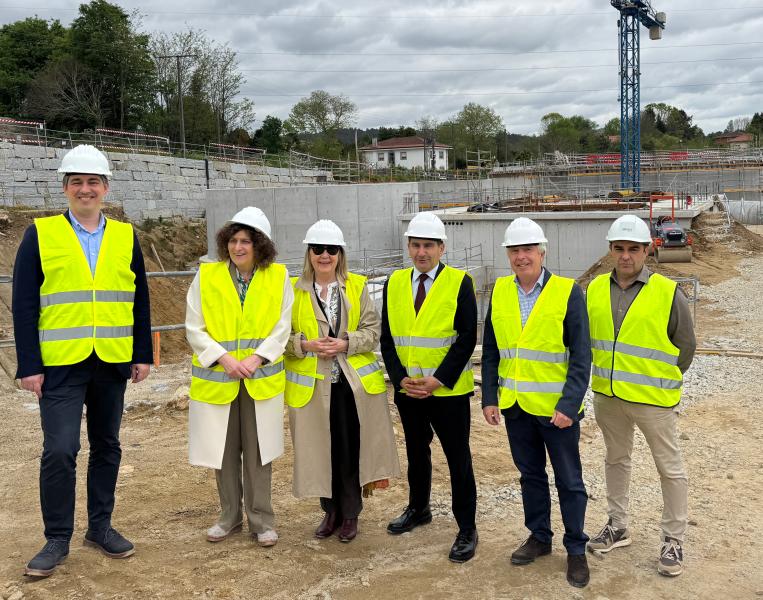
The government delegate in Galicia, Pedro Blanco, exemplified in the new treatment plant of A Silvouta, in Santiago de Compostela, the government’s commitment through ACUAES to correct historical deficits of sanitation in different localities of Galicia thanks to an investment of 130 million euros. This was the opinion of the press conference held this morning in the City of Santiago after the meeting of the Commission to follow up the agreement for the construction of this new treatment plant.
Pedro Blanco framed the A Silvouta treatment plant in the Government’s commitment to the “transformation of our cities and with the advance in strategic infrastructures”, and, in particular, with the modernization of Santiago de Compostela, “where we work on all fronts”, among which he pointed out the new train station, the reform of the airport runway, the new Orbital, the completion of the motorway to Lugo and the feasibility study to promote the improvement of the railway connection with Lugo.
After congratulating the Mercantile Society for the good progress of the works, which already reach 20%, Pedro Blanco stressed the importance of cooperation between administrations to carry out this type of projects for the benefit of the citizens, as happens in A Silvouta. In this case, the Government, through ACUAES, finances 80% of the works (about 50 million euros).
The delegate recalled that the WWTP of Santiago is the most important but not the only one of the actions carried out by ACUAES (dependent on the Ministry for the Ecological Transition and the Demographic Challenge) to improve sanitation in different parts of Galicia. It is joined by the actions that are executed in Sanxenxo, Ponteareas and A Illa de Arousa and also those of Ribeira, which are already in operation. The total state investment in these projects reaches 130 million euros.
After the meeting at the City Council, the government delegate, the executive president of ACUAES, Mª Rosa Cobo; the mayor of Santiago, Goretti Sanmartín, and the director of Augas de Galicia, Roi Fernández supervised the execution of the works.
Follow-up Commission
The Convention’s Follow-up Commission and its addendum to the works of the new A Silvouta debugger certified today that the works reached a degree of execution of 20 percent. The work, despite the delays due to adverse weather episodes, is progressing at a good pace, which will allow the completion of the work scheduled for summer 2026, so that the six-month start-up phase will then begin.
The works, which began on February 14, 2024 with the signing of the replanting act, consist of the construction of a new treatment plant that will treat a current average flow rate of 52,000 m³/day with a future forecast of 64,800 m³/day for a population of 205,000 current equivalent inhabitants and a growth to 277,000 futures, the connection to the network of existing collectors and the execution of a new electrical undertaking.
Currently, the work is focused on the construction of the pre-treatment and de-sanding building, as well as the primary decanting enclosure and the two gravity thickeners, which are at a very advanced level of execution of civil works, foreseeing the start of the assembly of equipment and coppersmithing in the month of May.
In this first phase of execution, the sludge thickening building, the three galleries that will house the pipelines, as well as the large diameter collectors, the header relief pipe and the final pipeline of the spill to the Sar River will also be executed. It is planned that this phase can be put into operation this summer, so that the demolition of the old treatment plant will then begin in order to accommodate the rest of the elements of the new WWTP, including the new biological reactor, the membrane building and the digesters.
With regard to the electrical connection, the pipeline was started parallel to the high-voltage power line (Santiago – San Caetano) in the rural area, with the trench, the placement and protection of the plastic pipes and the filling, remaining only pending the placement of the splice and the extension of the cable.
The expected investment in the action reaches 60 million euros (excluding VAT) which, thanks to the signing, on June 19, 2024, of the addendum to the agreement signed in 2021, will be cofinanced by 80% by the Government of Spain, within the framework of the Recovery, Transformation and Resilience Plan. The Xunta de Galicia provides 10.8 million euros.