
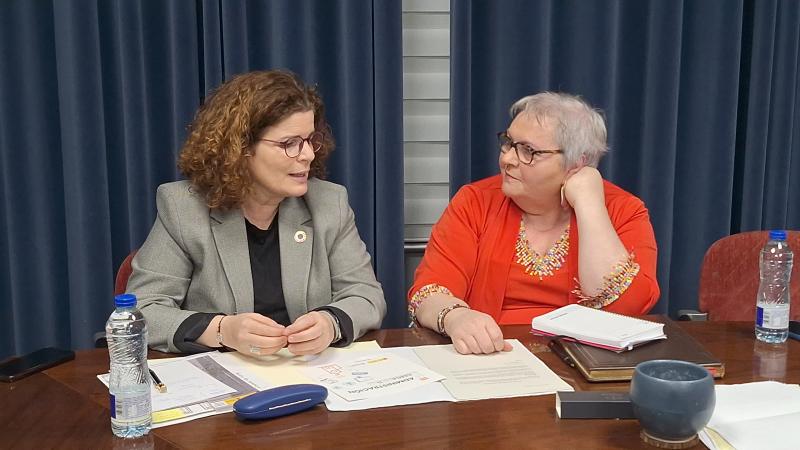
The subdelegate of the Government in A Coruña, María Rivas, highlighted in Lousame the Government’s commitment to provide the Galician rural with more and better services that help fix population. She did so during a visit to the City Hall, where she was received by the mayor, Teresa Villaverde, with whom she reviewed the investments of the Government in the locality, which exceed half a million euros, and in which she also took advantage to sign in the Book of Honor of the municipality.
María Rivas indicated that these investments, among which are the more than 212,000 euros of the DUS5000 program for the reduction of light pollution and the improvement of the efficiency of public lighting, the 137,000 of the IDAE for energy efficiency or the 168,000 euros for digital musealization and the adaptation of the historic building of the mines of Sano Finx, are intended to improve the life of the neighbors of Lousame. This money must be added to the more than 14,000 euros that the city council received since 2018 within the framework of the State Pact against Gender Violence.
The deputy delegate took advantage of the visit to announce that Lousame is one of 51 municipalities with fewer than 10,000 inhabitants of the province that will benefit from the program to expand 5G connectivity in rural areas, a program that has an investment of 9.3 million euros and that will benefit 13,000 inhabitants in the province.
“We want a living rural; that the people of the rural can live in it and attract new population,” said Rivas, who pointed out that this requires decisive measures such as those being taken by the Government, which by the end of this year has provided the entire territory with high-speed internet connection. “The demographic challenge is a country challenge and digital transformation plays a crucial role. Making this technology available to everyone is a way to build a fairer society that is adapted to progress,” he said.
In this line, the subdelegate also highlighted ‘The Administration Near You’, a program that simplifies relations with the Administration thanks to obtaining the digital certificate, “which is the key that allows to carry out telematically more than 90% of the procedures and communications with the General Administration of the State”, from basic procedures such as benefits, payment of taxes, driving licences, #public fee payment, requests for study aid or work life certificates, to the request for subsidies, which in many cases can only be managed telematically.
“The improvement of connectivity and digital skills are two actions that go hand in hand to provide citizens with the tools to be able to develop their lives without the need to travel,” said Rivas, who stressed the importance of the program, which “strengthens the presence of the State in the territory, in particular, in the less populated municipalities.”