
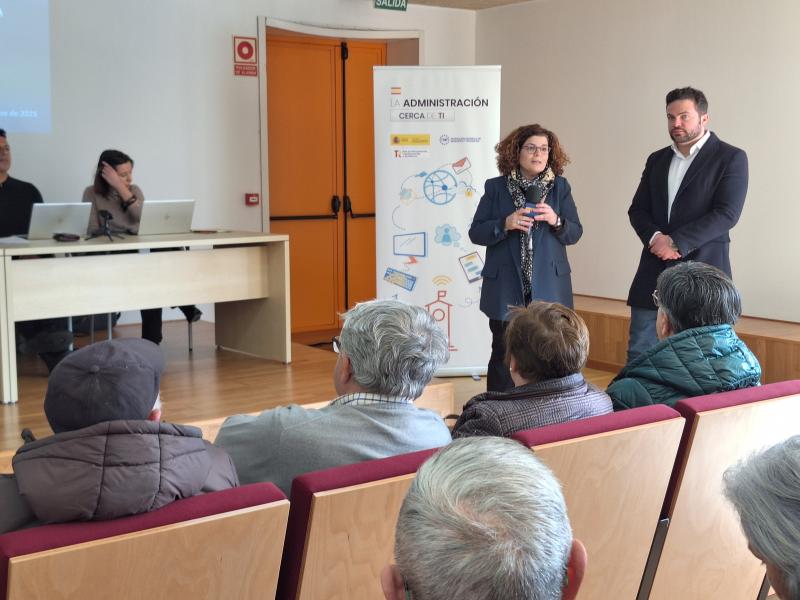
The subdelegate of the Government in A Coruña, María Rivas, announced today in Cerceda an investment of 9.3 million euros to expand 5G connectivity in 51 municipalities of less than 10,000 inhabitants of the province. He did so during a visit to the Concello, where he was received by the mayor, Juan Manuel Rodríguez, with whom he reviewed the Government’s investments in the town, which exceed 25 million euros, and in which he also took the opportunity to sign in the Concello’s Book of Honor.
As explained by the subdelegate, the aid of the UNICO 5G program will reach more than 35,000 Galicians and Galicians, 13,000 of them in the province of A Coruña, and the city of Cerceda is one of the beneficiaries. “It is a measure aimed at municipalities with less than 10,000 inhabitants, which are at the heart of many of the policies developed by this Government, with the aim of providing rural people with infrastructures fundamental to their daily lives,” argued Rivas, who put Cerceda as an example of the Government’s commitment to provide rural people “with more and better services, but also new opportunities to establish a population.”
“We want a living rural; that the people of the rural can live in it and attract new population,” said the deputy delegate, who pointed out that this requires decisive measures such as those being taken by the Government, which by the end of this year counts on providing the entire territory with high-speed internet connection. “The demographic challenge is a country challenge and digital transformation plays a crucial role. Making this technology available to everyone is a way to build a fairer society that is adapted to progress,” he said.
The deputy delegate and the mayor were also in charge of welcoming the Council to ‘La Administración Cerca de Ti’, a program that consists of practical informative sessions given by staff of the Government Subdelegation, previously trained, and, as a novelty in this edition, also of other units of the SEPE, the General Directorate of Traffic and Social Security.
Its objective, said Rivas, “is to simplify relations with the Administration thanks to obtaining the digital certificate, which is the key that allows more than 90% of the procedures and communications with the General Administration of the State to be carried out telematically”, from basic procedures such as benefits, payment of taxes, driving licences, payment of public taxes, applications for study grants or work life certificates, to the application for subsidies, which in many cases can only be managed telematically.
“The improvement of connectivity and digital skills are two actions that go hand in hand to provide citizens with the tools to develop their lives without the need to move,” said Rivas, who took the opportunity to highlight projects linked to the decarbonization of the economy in the municipality, such as the construction of a green hydrogen plant on the land of the old plant or aid for recycling companies or biofuels. “They are money called to boost the economy of these regions and also to improve the lives of Cerceda’s neighbors,” he added.
Second edition
Maria Rivas recalled that, in its first edition, 'The Administration Near You' covered 8,728 kilometers and reached 63 of the 67 municipalities with less than 8,000 inhabitants of the province, in which 981 digital certificates were issued.
In this second phase, the program has already reached localities such as Miño, Vimianzo or Carnota. To date, 41 of the 67 small concellos of the province are registered, who collaborate with the Subdelegation of the Government in A Coruña ceding the spaces in which this initiative is developed.
María Rivas stressed the importance of the program, which “strengthens the presence of the State in the territory, in particular, in the least populated municipalities”. That is why he called on the municipalities of the province of less than 8,000 inhabitants “not to miss this opportunity to improve the attention to their neighbors and to adhere to the protocol signed between the Spanish Federation of Municipalities and Provinces (FEMP) and the Ministry of Territorial Policy and Democratic Memory that allows the development of this program.