
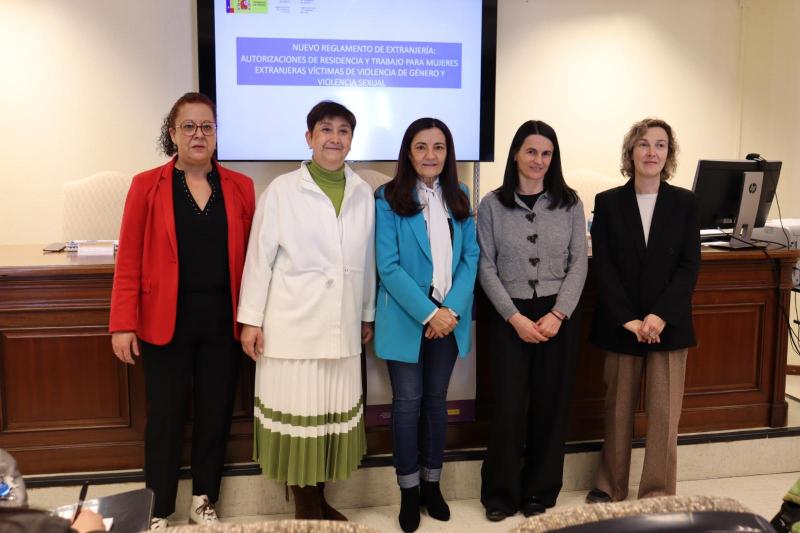
The subdelegate of the Government in Lugo, Isabel Rodríguez, inaugurated today an information day on the normative changes in the regulation of foreigners that reinforce the rights of migrant women victims of gender violence and sexual violence to obtain temporary residence and work permits. The session, organized by the Government Subdelegation, is part of the activities scheduled for March 8, International Women’s Day.
In her speech, Isabel Rodríguez stressed the need to guarantee effective protection for foreign women who suffer male violence, ensuring that “the Government’s commitment to equality and against gender violence is firm, so we move forward to ensure that all women, regardless of their administrative situation, have the greatest coverage and protection,” she said.
The day was attended by Elba Rivas López, Head of the Provincial Labor and Immigration Unit, and Montserrat #Vidal Expsito, Head of the Office of Foreigners of Lugo, who explained the changes in the regulations and the new ways of residence and work for victims of gender violence, sexual violence or human trafficking. Thus, they pointed out some of the main developments regarding the application for family reunification, the validity of the reports of the social services of the municipalities to determine the status of victim, or the non-immediate requirement of complaint to grant the provisional authorization of residence and work.
Rodríguez also highlighted the increase in investment in policies against male violence in Galicia, which since 2018 exceeded 80 million euros, financing prevention programs, comprehensive assistance to victims and reinforcement of the protection network. “The last four years saw a threefold increase in available resources. In 2024 alone, municipalities in the province of Lugo received more than 240,000 euros for prevention and victim support actions,” he said.
The subdelegate concluded her speech by appealing to the importance of all actors involved in the fight against gender violence applying a feminist and intersectional perspective. “The only way to reduce casualty figures is by increasing resources and prevention. We must redouble our efforts to ensure effective protection and emphatically point out who is violating human rights,” he said.