
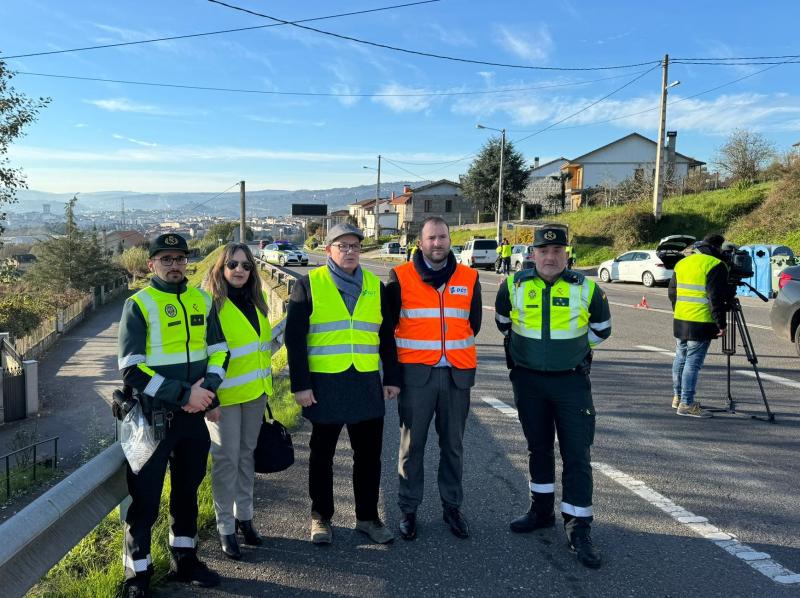
The subdelegate of the Government in Ourense, Eladio Santos, accompanied this morning the provincial head of Traffic, David Llorente, and the captain of the Civil Guard, Juan Carlos Nogales, in the presentation of a new campaign of control of alcohol and drug consumption launched by the DGT, which took place at O Viso Service Station, in the N-525 direction Santiago de Compostela.
These days, there is an increase in business lunches and dinners, as well as road trips to visit family and friends or make purchases. In addition, as a result of these first Christmas celebrations, the consumption of alcohol and drugs, incompatible with safe driving, also increases. For this reason, the DGT today launches a new campaign to control the consumption of substances by drivers throughout the territory. The Civil Traffic Guard, together with several Local Police of the province, will monitor the roads of Ourense carrying out numerous checks.
During 2024, in the province 14 fatalities were recorded as a result of traffic accidents, as well as 72 people seriously injured. Figures better than those recorded in 2023, but still far from the objective: zero deaths on the Ourense roads. “We would like it to be closed this year without any more deaths, hence the beginning of this campaign of controls,” explained the provincial head of Traffic, David Llorente.
For his part, the subdelegate of the Government, Eladio Santos, recalled that “approximately one third of accidents involve alcohol and drug consumption. It is a problem, in fact, in the similar campaign carried out last year, 85 drivers were positive, very high values. Alcohol consumption decreases the sense of danger, prolongs reaction times and alters the driver’s perception of reality. You have to think that when you drive after consuming alcohol or drugs you are endangering your life and that of other people who are on the road. Therefore, the subdelegate insisted that we must choose other means after our Christmas meals and dinners. “In these days that we have many celebrations we must look for alternatives, use means of public transport and other services, but give up driving. Alcohol and the steering wheel are not compatible,” he concluded.