
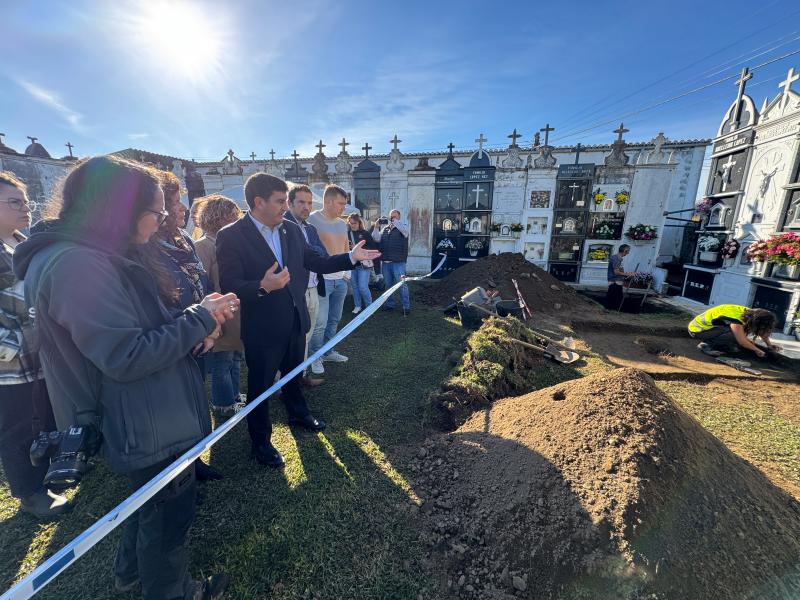
The government delegate in Galicia, Pedro Blanco, celebrated the designation of the Group of Agrarian History and Politics of the Rural World (Histagra) of the University of Santiago de Compostela as the entity responsible for preparing the state census of victims of the Civil War and the Dictatorship. He did so during a visit to the exhumation work that this entity, together with the Institute of Legal Medicine of Galicia (Imelga) and with the collaboration of the Association Democratic Historical Memory, is carrying out these days in the cemetery of the Val, in Narón, which was also attended by the subdelegate of the Government in A Coruña, María Rivas; the mayor of Narón, Marián Ferreiro; project managers and relatives of the victims.
These works, which put an end to the First Quadrennial Plan of Democratic Memory (2021-2024) and which seek to bring to light one of the greatest graves of Franco’s regime, represent, in the words of the delegate, “a true act of restitution of the memory of the victims of Franco’s regime; a necessary act so that families can bury their loved ones as they deserve.”
In this regard, Pedro Blanco highlighted the Government’s commitment, through the Ministry of Territorial Policy and Democratic Memory, to repairing the justice and dignity of all victims of Franco’s regime as well as their families, “a symbol of the freedom and democratic values that we defend.”
With this respect, the delegate recalled that the Government financed in Galicia activities such as research, publications and exhumations, among others, for an amount that exceeds half a million euros in recent years.
Specifically, the State Secretariat for Democratic Memory financed activities for more than 435,000 euros, almost 50% through the Xunta in the Sectoral Conferences, “which means an average of 103,000 euros a year for research, publications and exhumations,” said the delegate. This amount must be added to the approximately 80,000 euros in aid for activities related to the recovery of democratic memory directed to associations, foundations and non-profit entities, as well as to universities and public research bodies that have among their objectives those related to the recovery of Democratic Memory and the recognition of the victims of the Civil War and the Dictatorship.
Pedro Blanco insisted on the importance of fighting historical oblivion. “Only by learning from our past can we avoid repeating it,” he concluded.