
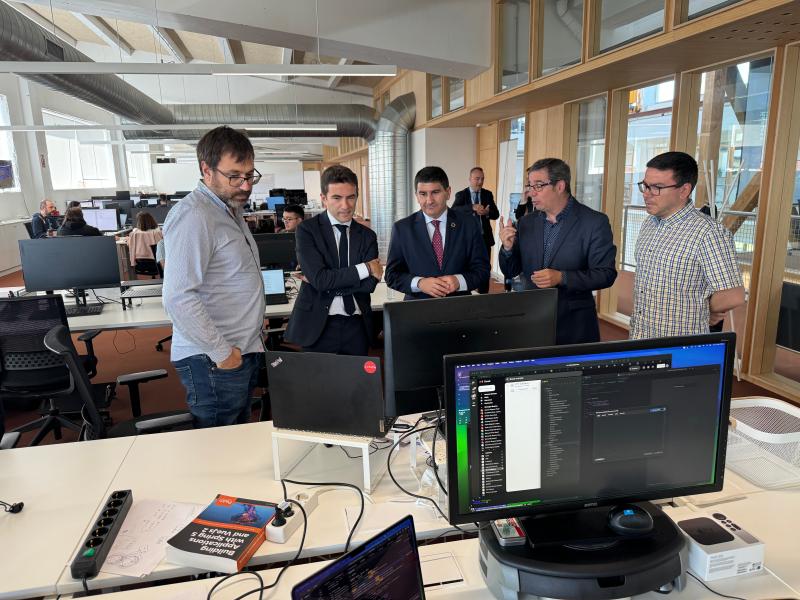
The government delegate in Galicia, Pedro Blanco, and the deputy and spokesman for Economy in Congress, Pedro Casares, said that the government is going to invest 53.1 million euros in Galicia to bring 5G mobile coverage to concellos of less than 10,000 inhabitants. They did so within the framework of a working day in which they visited the facilities of the company Cinfo, in the ICT City of A Coruña accompanied by its president and president of the ICT Cluster, Antonio Rodríguez del Corral.
There, Pedro Blanco announced that yesterday, Thursday, the Ministry for Digital Transformation and Public Service, through its Secretary of State for Telecommunications and Digital Infrastructures, published the provisional resolution of this aid, framed in the UNICO Active Networks program. This resolution mobilizes 508 million euros throughout the country to bring the necessary infrastructure that provides 5G coverage to more than 1.8 million inhabitants of small municipalities, in addition to providing coverage to 30,000 kilometers of the road network. “In the case of Galicia, it will allow to bring 5G to hundreds of villas and villages that this technology would probably not reach in years, since it is not economically profitable for private initiative,” said the delegate. 5G coverage will be given to 146,000 inhabitants and more than 4,600 kilometers of roads.
For his part, the deputy Pedro Casares indicated that the Government “is decisively betting on a greener and more digital Galicia”, ensuring that at the end of 2025 the entire Galician territory has a high-speed Internet connection, either by fiber or by satellite, and that 5G coverage is accessible to the entire population.
The actions, financed from the funds of the Government’s Recovery, Transformation and Resilience Plan, were awarded in the four Galician provinces to the companies Orange and Telefónica and, as Pedro Blanco pointed out, “are going to allow to do social technological justice, close the digital divide and provide citizens with all the possibilities that 5G offers to apply them in agricultural activities, tourism or in the improvement of their day to day”.
5G sectrorial
During the visit to the facilities of the City of ICT and the headquarters of Cinfo, the Government delegate in Galicia had the opportunity to know another of the initiatives that are developed within the framework of the UNICO Program. This is the Terpe&Talia project, developed by the company Coruñesa and which promotes the creation of a system based on Artificial Intelligence to automate the audiovisual production of live artistic activities.
For this initiative, Cinfo comes from receiving an aid of 1,220,344.99 euros in the framework of the UNICO 5G Sectorial program, financed from the funds of the Recovery Plan. The end result will be a system that is capable of producing how a human would do it. That is, through artificial intelligence, it will be able to detect the stage, the decoration and cloths, actors, who is the vocalist and who the musicians, the instruments, will take into account the games of lights to adjust the cameras and will be especially detailing with the synchronization of audio.
In this regard, the delegate stressed the importance that Artificial Intelligence will have in the coming years and celebrated that the city of A Coruña, with initiatives such as those that can leave the City of ICT and with the implementation of the State Agency for Supervision of Artificial Intelligence (AESIA), “will be a reference in this matter at the Galician, national and international level”.
Digital Kit
The delegate also visited the hotel establishment ‘Hemingway’, one of the many beneficiaries of the Digital Kit program in the city of A Coruña, where he had breakfast from its manager, Luis Diz. Pedro Blanco valued the usefulness of this initiative for companies, “evidencing the commitment of the Government to the digital transformation of the Galician productive fabric and promoting all the economic growth of the community.” He valued the key role that SMEs and self-employed people play within the business ecosystem and called on these companies to take advantage of the new expansion of the Digital Kit, announced by the Government this May.
The main novelty of this extension is that, for the first time, it will be accessible to companies with between 50 and less than 100 employees and to those with between 100 and 250, which will benefit from aid of up to 25,000 and 29,000 euros, respectively. In addition, self-employed people and companies with less than 3 employees will be able to access a maximum of 3,000 euros of subsidy instead of up to 2,000, as so far. For them, the ‘Secure Workplace’ solution is also opened, which amounts to 1,000 euros per beneficiary and is designed to finance the purchase of computers for workers, so as to guarantee their safety and privacy within the workplace.