
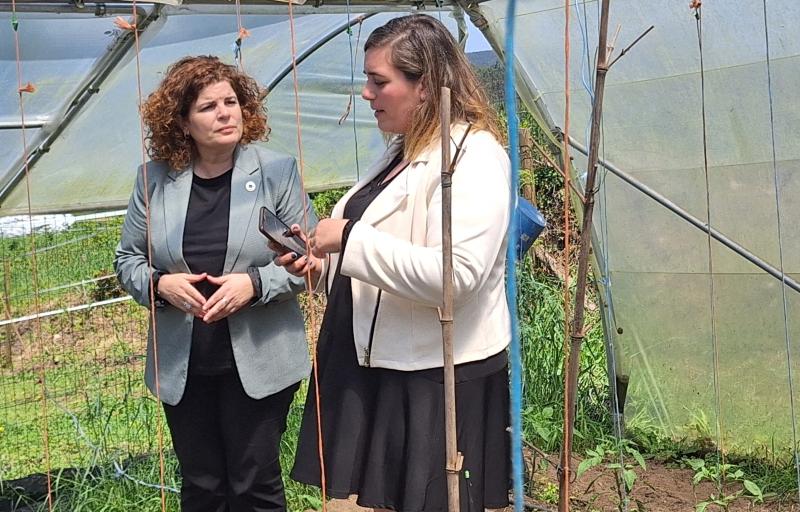
The subdelegate of the Government in A Coruña, María Rivas, visited this morning the greenhouse and the facilities that the technology company Azura Tech has in Zas, and with the help of its creator, Cristina Gil, she was able to know first-hand the activity of this consultancy Agrotech that puts technology at the service of agricultural production.
The subdelegate informed during the visit that the Ministry for Digital Transformation and Public Service, through the agency Red.es, has expanded the potential beneficiaries of the ‘Digital Kit’ program to companies that have between 50 and up to 250 people employed. All of them, the subdelegate encouraged them to apply for this aid, which already mobilized more than 107 million euros in Galicia through 25,800 bonds, 9,700 of them in the province of A Coruña, where the investment exceeds 41 million euros
Thus, he reported that one of the novelties of the last call for the program, is that in addition to the creation of two new sections (for companies with 50 to less than 100 employees and for those with between 100 and 250 employees), with grants of up to 25,000 and 29,000 euros respectively that can be requested in the last quarter of the year, he also pointed out that companies with less than three employees - as is the case with Azura Tech - will see the amount of the aid increased to 3,000 euros.
In this respect, he pointed out that, in the case of those who already had the aid of 2,000 euros, they will be able to extend it in those thousand euros through a specific button that will be enabled in their file. The concession will be automatic and the form will be available next June.
In addition, within this segment is created the “safe workplace” solution, with a maximum eligible amount of 1,000 euros to finance the purchase of laptops or dessert computers with a series of requirements that guarantee the security and privacy of the data stored in it.
Azura Tech, has a greenhouse of 50 square meters, in which this small technology-based company develops studies on the water consumption of indigenous species of peppers and tomatoes, as well as resistance to pests or virosis. In addition, this work is developed through artificial intelligence tools that monitor the growth of species at all times and facilitate the study of them. The final objective is to promote organic farming, making the information gathered available to producers or other consulting companies for the implementation of solutions for vegetable crops.
María Rivas stressed the importance of seeing “in situ” the practical application of Artificial Intelligence for the development of the small entrepreneurship initiatives of our rural, in this case also applied to the primary sector; “we can see how AI becomes an ally of rural development, ecological production and that will undoubtedly help the fixation of the population through the dynamization of the local economy and the generation of employment.”
Cristina Gil, also explained the social and community nature of this small technology company, as they carry out workshops to transfer the knowledge acquired to the entire agrarian community, but also specific activities are carried out with people at risk of social exclusion, or entities that promote the inclusion of people with disabilities.
María Rivas stressed that it is this type of company that helps to value our products, our rural, in addition to contributing to make visible both women in rural areas, and women in science and technology so that “they are small initiatives with a very high value” that must be supported.