
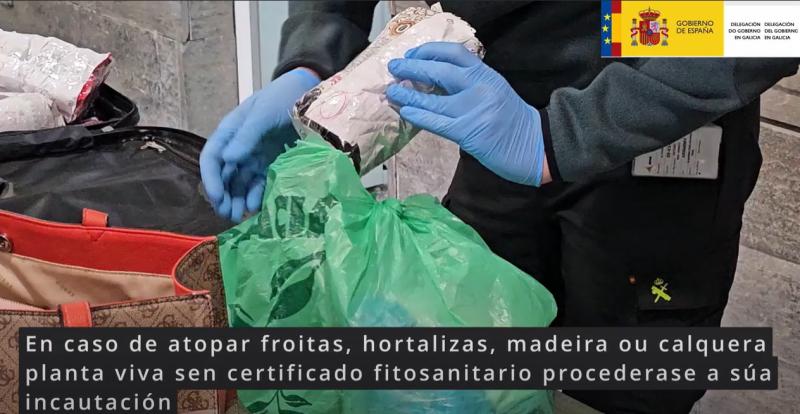
The deputy delegate of the Government, María Rivas, on the occasion of the commemoration of the International Day of Plant Health, highlights the value of the work done by customs personnel and the State Security Forces and Bodies in the inspection of plant health at the border, both in the ports and airports of the province.
The subdelegate stressed that these actions seek both to prevent the introduction and spread of harmful organisms whose presence is not known in the European Union, to control those already present in order to prevent their dissemination to new free areas, as well as to prevent the entry of invasive alien species. The aim is to protect biodiversity and the environment, ensuring the quality of vegetables and plant products.
For this reason, a subdelegada calls on the population to be aware of its actions and the impact it can entail. To contribute to public awareness on this issue, an informative video was prepared that can be consulted through the channel of the Government Delegation in Galicia, at the following address https://run.gob.es/aqn0aaa6
The plant health inspection at the border, is an action that is carried out daily at the Border Inspection Posts (PCF) located in the Port of A Coruña, in the External Port of Ferrol and at the Santiago Airport; and also the Passenger Entry Points at the cruise terminal of Puerto de Ferrol, in Puerto de A Coruña and at the passenger terminals of the airports of A Coruña and Santiago.
Of all these spaces, efforts are currently being focused more on the airports of Alvedro and Rosalía de Castro, given the relevance of the movement of people in both facilities; thus the airport of A Coruña closed 2023 with 1,252,022 passengers, 29.9% more than in 2022, and the airport of Santiago-Rosalía de Castro reached a new passenger record in 2023, closing the year with a total traffic of 3,537,445 passengers, 9.2% more than in 2022.
María Rivas pointed out that with figures close to five million passengers in the province’s airports, and with a trend that continues to rise, the controls carried out are a crucial element to guarantee plant health.
As for the data that reflect the result of the actions, materialized in the number of minutes raised during 2023, they amount to 229 between the two airports, confiscating 1,052.5 kilos of prohibited products, and in which from 2024 there are 126 minutes already raised with 468 kilos seized.
The International Day of Plant Health was established by the United Nations for its celebration on May 12; it is part of the 2030 Agenda that frames the Sustainable Development Goals, and they invite to celebrate it through activities aimed at raising awareness about the importance of plant health and its economic, social and environmental impact on food security, nutrition and the functions of ecosystems, as well as the exchange of best practices.