
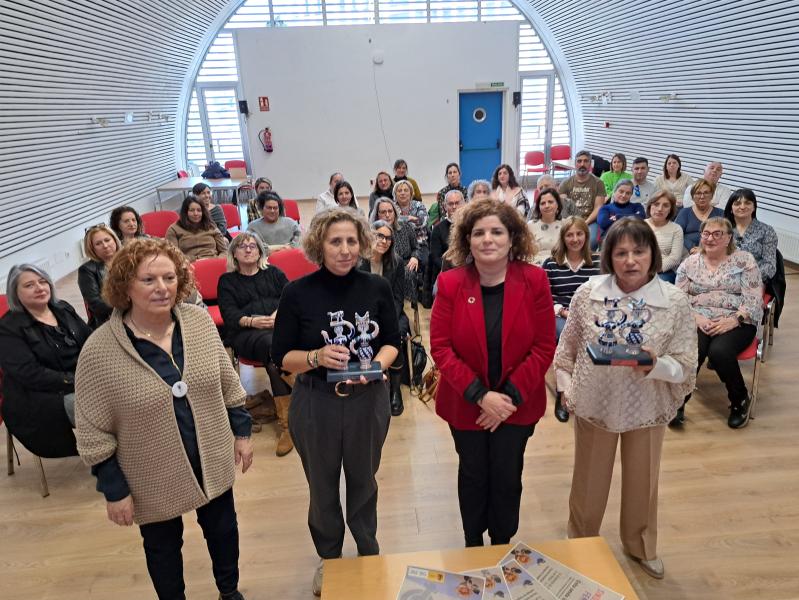
The deputy delegate of the Government in A Coruña, María Rivas, presided on Tuesday in Santiago de Compostela the event ‘Unionism and Feminism: an indissoluble path’ with which the subdelegation intends to recognize the historical work of the UGT and CCOO unions in the fight for equality and women’s rights.
“With this act, we want to restore the merits of all those people and institutions that rallied in this direction and that were key in the fight for equality; a goal that, although there is still a way to go, is closer than ever today and in which the Government, which I am proud to represent, has a lot to do,” said Rivas.
The deputy delegate indicated that the Government’s commitment to equality is transversal to all its policies. “We are talking about a feminist government that opted to integrate the perspective of equality as the axis of its political agenda. We did so and we will continue to do so,” he said.
In this line, he stressed that “the fight for equality is a struggle of the whole society, in which we all go hand in hand”. A struggle, she said, in which the role of the unions remains fundamental, since “without their contributions Spain would not be the international reference in feminist public policies”.
“The minimum living income or the increase in pensions have a woman’s face,” recalled the deputy delegate, who explained that these measures benefit women the most because of the precarious situation in which many of them still find themselves.
The event, the first that the Subdelegation organizes outside A Coruña, was held at the House of Cornes Associations, in Santiago de Compostela, and is part of the programming on the occasion of the 8M, International Women's Day.
In the course of it, the trade unionist and retired professor Carmen Díaz Simón, made a narrative on trade unionism and feminism in which she reviewed the achievements of this movement and gave way to a colloquium in which the attendees participated.
Subsequently, the deputy delegate of the Government in A Coruña gave her respective recognition to the unions. In the case of UGT, the person in charge of collecting it on behalf of the union was Inmaculada Sieiro Asorey, a trade unionist and militant of UGT since the times of clandestine during the Franco dictatorship. In the CCOO was Amelia Pérez Álvarez, the union’s first general secretary in Galicia.
“They are women, like many others, referents in different times that remind us, now that we celebrate 8M, that this is not a one-day struggle, because every morning we must continue to defend the rights that we already enjoy before those people who insist on denying the need to continue advancing in new conquests. And in this sense, trade unionism is decisive. It was always and it will remain so,” concluded Rivas.