
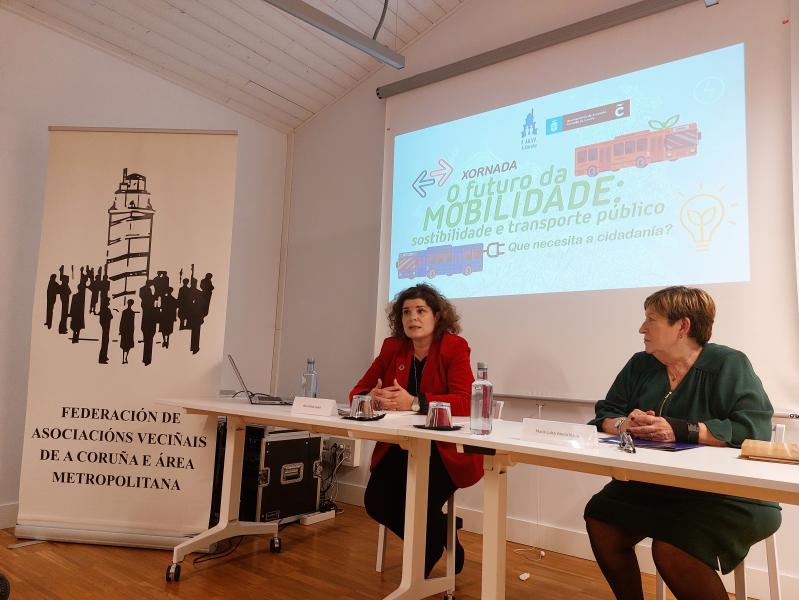
The subdelegate of the Government in A Coruña, María Rivas, closed today the conference ‘The future of Mobility: sustainability and public transport. What does citizenship need?’ organized in the Civic Center of the Old City by the Federation of Neighborhood Associations of A Coruña and Metropolitan Area in collaboration with the City Council of A Coruña.
In her speech, the subdelegate wanted to highlight the Government’s commitment to the sustainable development of public transport and the well-being of the neighborhood, which translates into the 20 million euros granted by the Ministry of Transport to the city of A Coruña for the promotion of sustainable mobility.
This investment focuses on the development of different actions that contemplate the acceleration of the implementation of the Low Emissions Zone, the purchase of electric bicycles to improve and expand the service of BiciCoruña, improvements in traffic management and in different streets of the city and the accessibility of the neighborhoods.
On the other hand, the Government transferred 11,609,205.37 euros in the last three years to finance urban public transport services.
In this same vein, María Rivas recalled that the preliminary draft of the ‘Sustainable Mobility Law’, framed within the objectives of the Transformation and Resilience Recovery Plan, is in the process of being processed.
The ‘Sustainable Mobility Law’ was born from the hand of the Ministry of Transport with the aim of promoting a faster and more effective response to the needs of citizens by administrations and in this way, “to face the challenges of society in this 21st century: sustainability, digitalization and social and territorial cohesion”.
Thus, this law is built on four basic pillars: the consideration of mobility and free movement as essential for the vital development of people; adaptation to cleaner and sustainable mobility to reduce the impact of climate change; the development of an innovative and regulated digital transport system and the realization of investments in improving mobility that generate social value.
“In short, it is about seeing mobility as a social right; that it is clean, healthy; modern, innovative and digitalized; and that it results in a better service for citizens improving their quality of life,” said Rivas.
María Rivas pointed out that in order to achieve these objectives it is “fundamental” both the institutional collaboration between the municipalities and the regional and state administration, and that of the citizens, who have to “modify the customs so that among all of us we can build those new models of cities in which we aspire to live”.
In this regard, the subdelegate affirmed that A Coruña “is an example of the transformation” of cities, which are evolving to improve mobility and win in spaces for people “to make them more friendly, more accessible, more friendly”.
The day was also attended by the mayor of the city of A Coruña, Inés Rey, the president of the Federation of Neighborhood Associations of A Coruña and Metropolitan Area, Luísa Varela, and the Councilor for Innovation, Mobility and Infrastructure of the City of A Coruña, Nereida Canosa.