
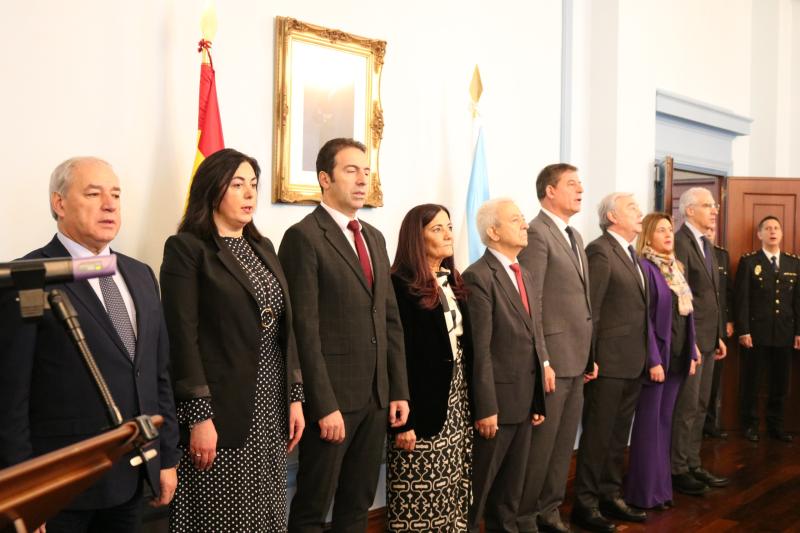
The subdelegate of the Government in Lugo, Isabel Rodríguez, today stressed that the constitutional framework is based on an agreement of consolidated democratic coexistence. There are more than four decades through fundamental values such as consensus and dialogue between different parties. He expressed this during the institutional act of the 45th anniversary of the Spanish Constitution, which took place in the meeting room of the government subdelegation in Lugo.
Isabel Rodríguez pointed out that the Spanish Constitution approved in 1978 includes “in legal and political terms the protection of public freedoms and citizen rights, the settlement of the institutions of our democracy and the crystallization of the territories as subjects of political autonomy,” which is why “this celebration is justified every December 6.”
“On this same date of 45 years ago, the Spanish people put dialogue, harmony, consensus, forgiveness and social peace before drawing the path to follow without leaving anyone on the margins, creating this Magna Carta as a common heritage of all.” He also defended that the only way out of social problems and political disagreement is “understanding, because we are heirs of a firm commitment to coexistence and respect”, alluding to the spirit of the Transition “that ended with one of the darkest times in our history”. He pointed out at this point that “45 years ago the Constitution was written on a blank page, a lesson that we must never forget”, because agreements between positions that are difficult to reconcile “are sometimes the ones that add the most value”.
Social transformations
Isabel Rodríguez said that there were “many and very profound social transformations since that December 1978”, highlighting the development of “laws that placed our country at the forefront of civil rights, such as equality between the sexes, rights for discriminated groups, recognition and protection of disability or consolidation of state pacts such as violence against women”.
However, he remarked that “although we should be proud of the route, it would be a mistake to consider that the Constitution has already fulfilled its historical task, since the democratic system established under this Fundamental Law must evolve along with social values and the change of needs and problems of the citizenry.”
Comply with the Constitution
A subdelegada said that compliance with the Constitution currently occupies part of the public conversation of the country, emphasizing that a good way to celebrate this day “is to promote institutional loyalty between administrations, because no social progress is achieved with stagnation or incendiary rhetoric away from consensus.”
Not delivering his speech, he said that “complying with the Constitution means moving forward and progressing, taking into account new challenges that are already included in the text and that must be urgently transferred to reality, such as the protection of the environment due to the climate emergency, the right to decent housing, the linguistic and cultural recognition of peoples, the strengthening and quality of public education and health systems, among others.” He said that “to defend all this is to defend the constitution.”
Gender Perspective
Isabel Rodríguez wanted to bring a fact closer to those present: “The Magna Carta had seven parents and no mothers, although in Article 14 it guaranteed the equality of all people regardless of their sex.” She explained that “thanks to the evolution of society, the normative development and the feminist struggle, women like me, today, we develop positions of institutional representation and normally occupy the public sphere that for so long was denied to us.”
He concluded that “there is no democracy without the active participation of half the population, and that is the best gift we can give to the younger generations.”
Institutional act
A subdelegation of the Government celebrated today the commemoration of the 45th anniversary of the Constitution with an act that brought together more than a hundred authorities and invited people, among which were the Conselleiro del Mar, Alfonso Villares; the deputy in the Congress, José Ramón Gómez Besteiro; the president of the Diputación, José Tomé; the 1st vice-president of the Galician Parliament, Elena Candia; the president of the Hydrographic Confederation, José Antonio Quiroga; among others.