
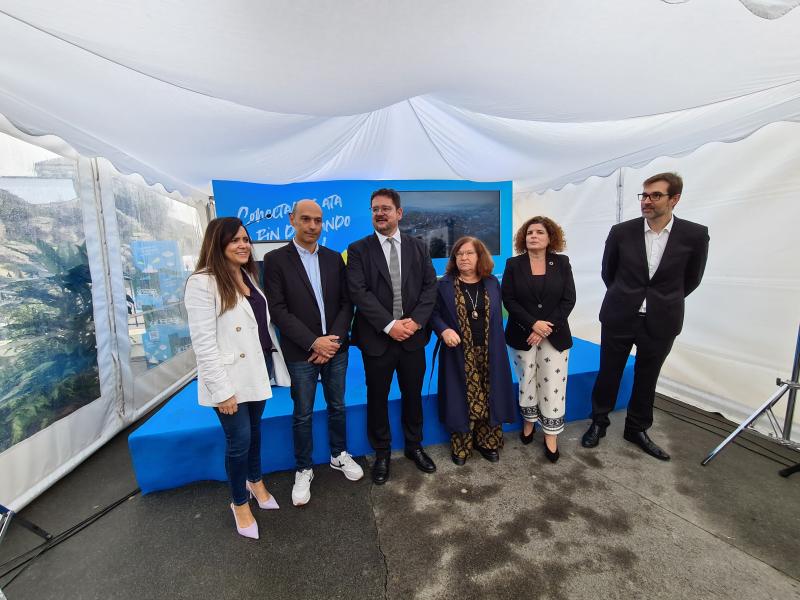
The subdelegate of the Government in Coruña, María Rivas, highlighted today in the Fisterra Lighthouse the impulse that the Government is giving to the extension of broadband, with more than 24 million euros invested in recent years to bring high-speed internet to all municipalities in the province of A Coruña.
“Today the government is bringing fiber optics to the end of the world,” said the deputy delegate, who called the extension of high-speed internet to rural areas “an urgent need to avoid population loss and achieve new inhabitants.” In addition, he celebrated the election of the Lighthouse, a symbolic reference for thousands of travelers, sailors and pilgrims, as an example of the policies of the Government of Pedro Sánchez “reaching to the last corner of the territory.”
María Rivas, took advantage of the event to thank her for the Open Network, the company that awarded the second call for the UNICO Broadband Program in the province, its contribution to the deployment of the network and the commitment to the incorporation of new technologies. Precisely, the Galician company announced in it the start of the deployment of the fiber optic network in the municipality and also the implementation of 50G-PON technology, which allows an internet speed of 50 Gbps, pioneer in Europe, in the first months of 2024.
For that date, the company’s forecast is to bring high-speed internet to 155,000 homes in the province that until now did not have this service, with an investment of 26.6 million of which 13.3 million correspond to funds from the Government Recovery Plan.
Total coverage in the territory
María Rivas recalled that the Government’s commitment is that in 2023 95% of the Galician population will have access to high-speed internet and that in 2025 coverage will reach 100% of the territory. To this end, the Single Digital Infrastructure Universalization Program, promoted by the Ministry of Economic Affairs and Digital Transformation and financed from the funds of the Recovery Plan, is mobilizing an unprecedented investment that, in the case of rural municipalities such as Fisterra “contributes to building more equitable communities and the fulfillment of the Sustainable Development Goals.”
In this same vein, the subdelegate stressed that having a high-performance Internet connection service at a competitive cost “is a basic element to stop rural depopulation and break with the gap that separates the rural and urban world. We won’t stop until we get it,” he said.
“Those who live in rural areas do not have the same opportunities as those who live in a city. Our duty as a government is to offer the same possibilities to everyone,” said María Rivas, who recalled the progress made in the field of digitalization in recent years thanks to the implementation of the National Digital Skills Plan, “one of the essential pillars of our digitalization strategy, which has as its final objective that 80% of the population reach those basic digital capabilities.”
“Digital precariousness, like absolutely all precariousness that may exist in our country, is something that this government wants to combat and it does so. We don’t want to leave anyone behind, we don’t want anyone to feel excluded from a world that increasingly speaks a digital language,” he concluded.