
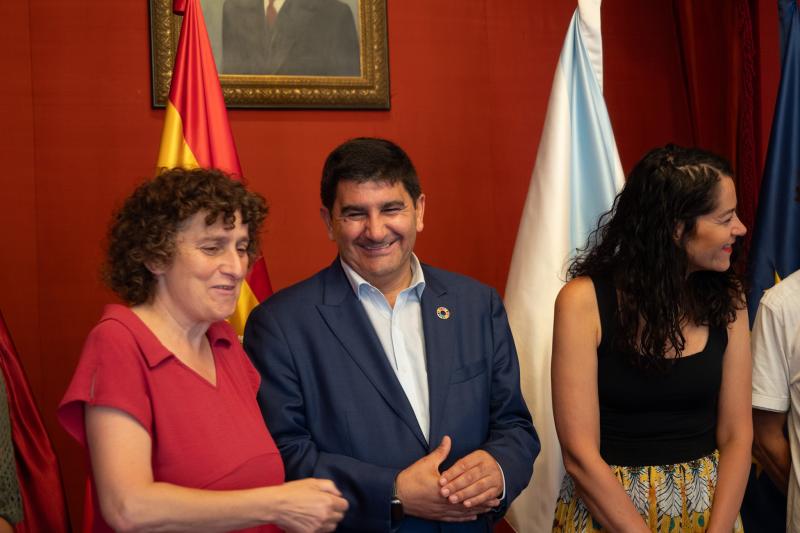
The government delegate, Pedro Blanco, held a working meeting today with the mayor of Santiago, Goretti Sanmartín, in which he highlighted the more than 200 million euros invested by the government in the city and which are allowing to unlock key actions in the Galician capital that had been stopped for a long time, such as the Orbital and Orbitaliño links, with a joint investment that exceeds 50 million euros; the Intermodal station, with 30 million, or the A Silvouta debugger, which the government finances with 40 million euros.
Pedro Blanco, who congratulated the mayor on her appointment and signed in the city’s Honor Book, indicated that “each and every ministry leaves its mark on Compostela,” while highlighting the impact that the funds of the Government’s Recovery, Transformation and Resilience Plan are having in terms of heritage conservation, tourism or sustainable mobility.
Improved communications
In the infrastructure chapter, in addition to the links of the Orbital and Orbitaliño, which will improve road mobility and make its polygons and its airport more accessible to all citizens, which will undoubtedly have a significant impact on the economic activity of the city and on improving the quality of life of its neighborhood, the Government also works for the improvement of rail communications.
In this regard, the government delegate in Galicia pointed out the implementation of the ERTMS system on the Atlantic Axis, which is currently under test, and which will result in greater safety on the routes. He also celebrated that, soon, Compostela will have a train station of the 21st century. A new passenger building that will adapt to the new functional reality of the station: intermodality and connection with the high-speed network. In addition, new public spaces are going to be created in its surroundings for the enjoyment of citizenship, such as the new elevated square that acts as the lobby of the station.
These transformations in urban mobility also have a lot to do with one of the axes of the action of the Government of Spain, as is the commitment to a greener future that does not compromise the future of the next generations.
In this line are measures such as the implementation of the Low Emissions Zone that, from the funds of the Recovery Plan, will restrict the access of combustion vehicles to the historic center of Compostela and will allow the creation of a last-mile distribution and logistics center with electric vehicles of zero emissions.
Housing and digitization
“For the first time, this Government is making public money reach each and every one of the Galician municipalities,” said Pedro Blanco, who pointed out that, in the case of Compostela, this financing is materialized in actions such as the more than 4.5 million euros that the Ministry of Transport allocates to the rehabilitation of buildings in the old town and public promotions of the Ministry of Housing of the 20th century, or the 7.2 million euros of the PIREP, with projects such as the reform of the sports complex of Santa Isabel, the sports center of Vite or the rehabilitations of the CEIP Master Rodriguez.
Digitisation projects are also being funded, with support from the Ministry of Territorial Policy for the digitisation of the Local Government and the Ministry of Economic Affairs with the UNICO broadband programme, which benefits more than 800 Compostela families and companies, or the Digital Kit.
Bet on tourism
Tourism is another of the axes of the Government’s action in Santiago. In this regard, the delegate clarified that this commitment to the tourist attraction of Compostela is being made without neglecting the approximately 100,000 Compostelans who reside in the city. Regarding investments, Pedro Blanco recalled the million euros from the Ministry of Industry for the execution of his Tourist Sustainability Plan in Destination, to which must be added two other plans that receive funds from the Recovery Plan, such as the Tourist Sustainability Plan Terras de Compostela, with 1.3 million euros, and the plan of the Green Way Compostela-Tambre-Tabelle, promoted by the Provincial Council of A Coruña and which, with another 1.3 million euros of investment, allowed to recover the old route of the train between Cerda and Santiago for the use and enjoyment of citizenship.
He also stressed the care of the Government of Spain in the conservation of the extensive heritage of Compostela, with actions such as the financing of the works of cleaning and relief of roofs of the Pazo de Raxoi, or in the neighboring Hostal dos Reis Católica, which is undergoing a thorough rehabilitation that entails an investment of 13.5 million euros, within the recovery program of the BIC of the Paradores network.
Medium Care
Regarding the care of the privileged natural environment of Compostela, the government delegate celebrated that the WWTP of A Silvouta will soon be a reality thanks to the financing of the Government, to which must be added the contributions of Xunta and Town Hall to complete the 68 million necessary for its construction. This infrastructure will improve the quality of the water courses that cross the municipality, as will the river ecosystem restoration projects promoted by the Biodiversity Foundation in the Sar and Sarela rivers, and the creation of a Health Forest in the Sar as it passes through the Conxo Banquet, with more than 4 million euros contributed by the Ministry of Ecological Transition.
World Capital of the Economy
Finally, the government delegate announced that, in a matter of weeks, Santiago de Compostela will become the world capital of the economy thanks to the Spanish presidency of the European Union. It will be on September 15 and 16 on the occasion of the meeting of the ECOFIN Council at the Cidade da Cultura, a meeting in which, for the first time, the 27 ministers of economy and finance of the European Union will be accompanied by the representatives of 33 countries that are part of the Community of Latin American and Caribbean States (CELAC), and which will mark the future of relations between both sides of the Atlantic.
In short, said Pedro Blanco, “this government, despite facing an adverse scenario as it is not remembered, with a pandemic and the crisis derived from the Russian invasion of Ukraine, turned to the city of Compostela, recovered the time lost with previous governments and gave the citizens the response they deserve.”
“The objective remains to protect and advance without leaving anyone behind, reaching every street and every house in Galicia with the action of the Government,” added the delegate, who stressed that “today we can say that all the great projects that will transform Compostela are on track. Now we just need to continue counting on the involvement of the City Council, as so far, and also demand the commitment of the Xunta so that sooner rather than later they are all a reality,” he concluded.