
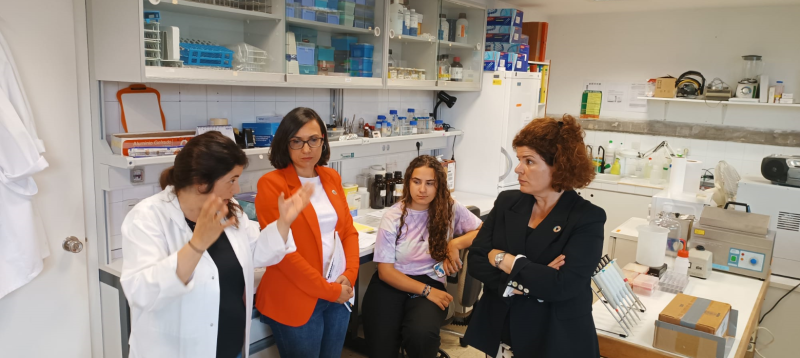
The subdelegate of the Government in A Coruña, María Rivas, today presented the day of open doors that the Oceanographic Center of A Coruña will celebrate next Saturday, June 10, on the occasion of the Day of the Oceans that is celebrated today throughout the world.
María Rivas encouraged all citizens to take this opportunity to know “a reference center in scientific research” and stressed “the privilege of having access to the center’s staff, both technical and scientific, to be able to ask questions related to the work they do every day not only in the center but also in different oceanographic campaigns in which they participate.”
Precisely, as explained by the Government’s deputy delegate, one of the objectives of this day of open doors is to bring science and the oceanographic center closer to society and “make it more accessible to all Coruñeses, who can see closely how researchers work in a center of these characteristics.”
Among the activities that will take place this Saturday, the dissection of fish is planned in which it will be shown how to know the age of a fish by the photoliths. The different types of nets used in fishing will also be taught depending on the size of the fish.
As the subdelegate said, there will be a workshop to learn about the functioning of ocean currents, with experiments related to physical oceanography and the characteristics of sea water such as temperature, density or salinity.
In the presentation of the conference, the subdelegate was accompanied by the director of the Oceanographic Center, Luz García and two of the researchers working in it, Isabel González and Marta Varela.
The day of open doors will have a schedule of 11.00h. at 2:00 p.m. and from 16h. The 18.00h and it is not necessary to register previously.
The Oceanographic Center of A Coruña
The headquarters of the Spanish Institute of Oceanography in Cordoba has the longest time series of multidisciplinary marine data in Spain since 1989. It has crucial data to understand how the ecosystem works. It also collects fishing data, analyzes the information and defines the state of the populations, which allows it to give scientific advice to national and international administrations.
The center of A Coruña participates in numerous European and international projects and has a presence in multiple committees with an “enviable degree of internationalization” as pointed out by María Rivas who stressed the “usefulness of all the data that is managed here because it serves both our fishing fleet and the people who are experts in climate change”.