
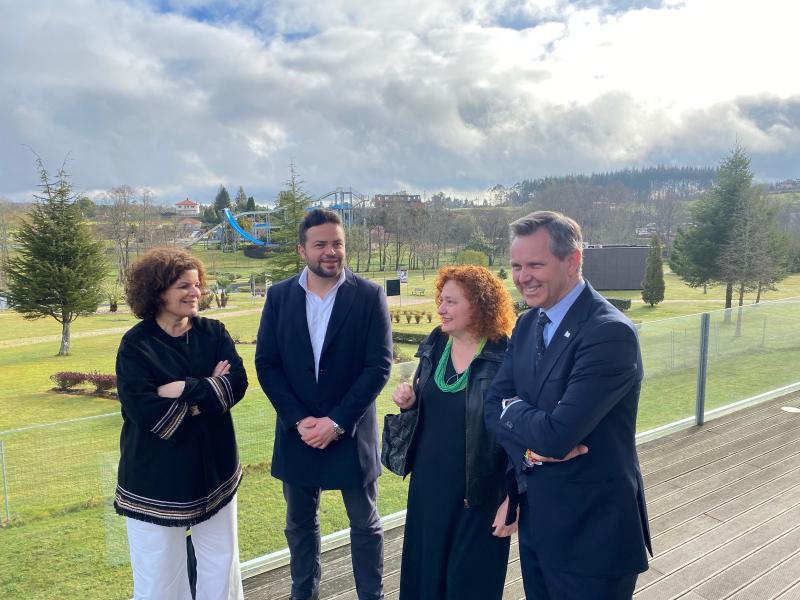
The Ministry for the Ecological Transition and the Demographic Challenge (MITECO) has included a new Galician project in the provisional resolution of aid to boost the production of renewable hydrogen. It is the renewable hydrogen plant that Naturgy, Repsol and Reganosa project in Meirama, for which the Government grants funding of 15 million euros. This was announced by the director of the Institute for the Fair Transition (ITJ), Laura Martín, at the opening of the Conference on the Fair Transition Agreement in Cerceda, in which the government delegate in Galicia, José Miñones, also spoke, who stressed that “a great opportunity is opening for Galicia, for municipalities and also for companies and entrepreneurs”. The event was also attended by the subdelegate in A Coruña, María Rivas.
The Institute for the Fair Transition (ITJ), an autonomous body of the Ministry for the Ecological Transition and the Demographic Challenge (MITECO), in collaboration with the Xunta de Galicia and the Association of Municipalities in Fair Transition - Association of Mining Comarcas (ACOM of the FEMP) have held today, in the Business Incubator of Cerceda (A Coruña), an information day on the evolution of the works of the Fair Transition Agreement that are being developed for the area affected by the cessation of the thermal activity of the Meirama.
The meeting was attended by representatives of the municipalities included in this Convention, business and trade union organizations as well as companies, associations and other local actors.
The opening ceremony was attended by Laura Martín, director of the Institute for the Just Transition; the government delegate, José Manuel Miñones; Pablo Fernández, general director of Energy Planning and Natural Resources of the Xunta de Galicia; Carolina Morilla, general secretary of ACOM and Juan Manuel Rodríguez, mayor of Cerceda.
According to the director of the ITJ, “the work carried out in the Fair Transition Agreement of Meirama is yielding good results, since only the industrial projects of circular economy and renewable hydrogen production that are under way, represent an increase in employment compared to that which existed when the plant was in operation. In addition, we support municipal projects that will improve socio-health care services, the availability of social housing and boost tourism development in the area. We have recently opened support lines for SMEs that can be the seed of new projects.”
The Fair Transition Agreement of Meirama covers the 5 municipalities of the province of A Coruña that have suffered the impacts on income and employment as a result of the closure of the Thermal Power Plant of Meirama, located in the municipality of Cerceda. It is about Carral, Cerceda, A Laracha, Ordes and Tordoia. It is one of the 15 agreements that are being carried out in Spain to address the effects of the closure of coal mines, coal-fired power stations and nuclear power plants.
SUPPORT FOR MUNICIPAL INFRASTRUCTURE PROJECTS
During the course of the day, the ITJ reported on the results of the provisional resolution of the aid to municipal projects for digital, environmental and social infrastructures destined to the 197 municipalities of Just Transition and which are financed with 91 million through the Recovery Plan.
This call highlights the success of participation, since the five municipalities included in the Meirama Convention have presented a total of 17 projects. Following the evaluation process, the ITJ has approved the provisional concession of more than 5 million to finance 5 infrastructure projects to be developed in Cerceda, Ordes and Tordoia. At the end of the period of allegation, it is expected that the final resolution will be published in the coming weeks.
The grants will allow the rehabilitation and transformation of public property, spaces and lands for new uses that strengthen their digital, environmental and social component or help to create new spaces.
New call with 25 million
The high rate of participation and the quality of the projects presented have prompted the ITJ to work on a new call for grants with identical objectives with 25 million euros that will be launched soon. Thus, the municipalities have a new opportunity to materialize their proposals.
NEW ENERGY AND INDUSTRIAL PROJECTS
This day is the area where the projects supported by the ITJ in the area are presented and the projects promoted by the 'Agreement for a fair energy transition for closing thermal power plants: employment, industry and territories' signed in March 2021 between the Government, the trade unions and the companies holding the thermal power plants are monitored. Its focus of priority action is the maintenance of employment in the territories and its economic and industrial dynamization through the search for new investments.
Two industrial projects and a strong tractor component for the local economy and job creation promoted by Naturgy, Reganosa and Repsol are under development at the Meirama plant.
The first is a project for the efficient management of slurry in Galicia and the production of biomethane. The objective is to promote the circular economy in the management of livestock dejections, urban waste and industrial organic waste through a network of treatment centers distributed throughout Galicia, which could valorise around one million tons of multi-waste with the installation of the first plant in Meirama. The associated production of biomethane will contribute to the decarbonization of industrial processes and mobility through renewable gases. The planned investment for the digestion plant is almost 120 million and 25 million for the pretreatment plants. The creation of jobs for the exploitation of the plants, as well as in the logistics necessary for it is estimated at 300 direct jobs.
The second project includes the development of a renewable hydrogen production hub, with a 30MW electrolyser in its first phase, for the supply of energy and thermal uses for local industries, as well as mobility fuel and grid injection. The planned investment is 46.4 million, with more than 400 direct, indirect and induced jobs created during the construction and operation phase.
In addition, thanks to the plan to give priority to energy innovation projects located in areas of fair transition applicable to the aid lines managed by MITECO and its associated agencies, the Institute for Diversification and Energy Saving (IDAE), under this Ministry, has granted this green hydrogen project, jointly promoted by the companies Naturgy, Reganosa and Repsol, 15 million in aid.
This prioritization formula will continue to be deployed from MITECO and IDAE for green hydrogen projects, storage, recycling of wind turbines, energy communities, biogas, heat and cold networks, marine renewables, etc.
GRANTS FOR BUSINESSES IN JUST TRANSITION MUNICIPALITIES
The conference presented the new aid to companies with the objective of promoting the generation of new activity, economic diversification, the generation of employment, as well as contributing to maintain the jobs of local companies.
Today the BOE has published a call for small investment projects. It is endowed with 10 million and oriented to small investment projects that require at least 30,000 euros and that commit to maintaining employment or creating a new job in the case of new activities. It complements the call published on March 7, the BOE provided with 40 million destined for job-creating business projects that require an investment of 100 thousand euros and generate at least 3 jobs.
For the allocation of aid, the environmental and social benefits of the projects, their employability, their tractive effect on the territory, their innovation and their location in municipalities affected by depopulation, the demographic challenge and the closure of coal mines and power plants will be assessed. Small and medium-sized enterprises will also have an additional score.
JUST TRANSITION BACKGROUND
In the course of the Conference, the representative of the Xunta de Galicia has presented his next lines of aid financed through the Fair Transition Fund (FTJ) of the European Union.
The FTJ Plan for Galicia is structured in six main areas of intervention: decarbonization and industrial renewal of tractor industries; promotion of the value chain of renewable energies, self-consumption, energy storage and renewable hydrogen; promotion of SMEs and tractor business projects for the economic diversification of the territories; promotion of digital centers of systems development, monitoring, control of operations; and finally the promotion of training and qualification initiatives for the labor insertion of affected unemployed and training in digital and green transition.
EFFECTS OF PARTICIPATORY PROCESS
The public participation process initiated in July 2020 that aimed to capture and identify initiatives to generate a new productive fabric in the area, allowed to gather 73 ideas and proposals from 46 actors: public administrations, business and trade union organizations, companies, associations, local development groups, etc.
Of this percentage, around 42% would be able to access ITJ help lines already in place such as those intended for companies. They can also benefit from other centrally managed economic support channels from the Ministry for the Ecological Transition and the Demographic Challenge, such as the Strategic Project for the Economic Recovery and Transformation of Renewable Energies, Renewable Hydrogen and Storage (PERTE ERHA) -foreseen in the Recovery, Transformation and Resilience Plan- which especially scores the contribution to areas of fair transition or demographic challenge.