
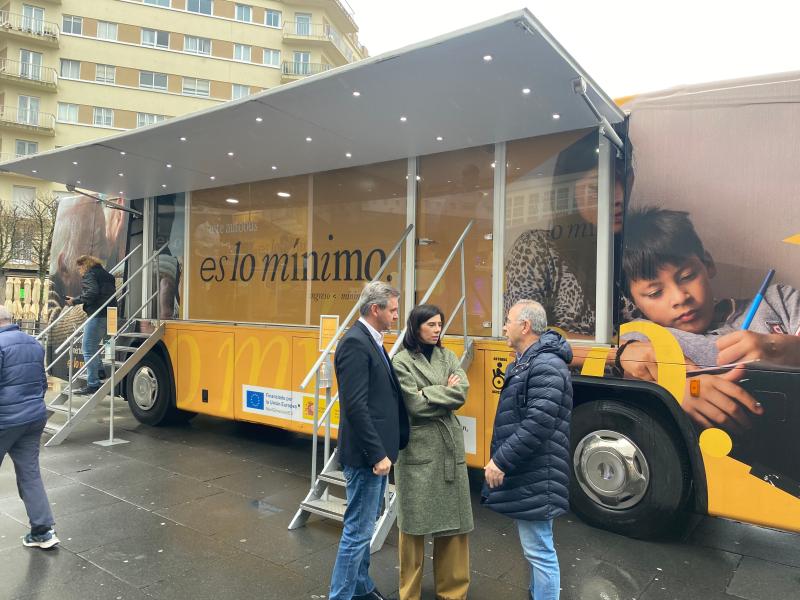
The government delegate in Galicia, José Miñones, has stressed that the Minimum Vital Income (IMV) has been consolidated in Galicia and allows progress in the social justice of the Community, where it already reaches 29,000 homes where 74,500 Galicians and Galicians reside who have this monthly income insured: “We are facing one of the most important policies of inclusion and income redistribution of the Government of Pedro Sánchez and that responds to the motto that since the pandemic has marked the action of the Executive: Leave no one behind.”
José Miñones has made this assessment after visiting in the center of Santiago the bus set up by the Ministry of Inclusion and Social Security to provide information to citizens about the Minimum Vital Income and facilitate their application. On this visit, he was accompanied by the mayor of Santiago, Xosé Sánchez Bugallo, and by the provincial director of the National Social Security Institute (INSS), Eva Fernández.
Reducing child poverty
José Miñones has meant the role of the IMV in reducing child poverty, which is reflected in the weight of the underage population in the group of perceptors. Thus, in Galicia, “one in four beneficiaries are minors, up to 30,000 boys and girls,” he said. They are part of 15,366 Galician families that receive the child support supplement, a monthly supplement to the benefit for each minor child
The delegate explained that the Minimum Vital Income is a social policy that encompasses more elements than the economic benefit. It is complemented by other measures to ensure the full integration of families and perceptive individuals. In addition, in a “living policy” that adds layers of protection and adapts to the reality of the perceptors, with special attention to single-parent families (in Galicia almost 8,000) and with disabilities.
“A few months ago we approved the employment incentive, which is the compatibility of the minimum vital income with the income from work,” the delegate said. This possibility allows to improve the real opportunities for social and employment inclusion of the people benefiting from the benefit, encouraging them to seek employment.
In addition, the Government is promoting in several autonomous communities and with various social organizations a pilot project to create inclusion pathways for people benefiting from the Minimum Vital Income. It is a project within the framework of the Recovery, Transformation and Resilience Plan. “This project is being carried out in collaboration with the Xunta de Galicia, with an investment of 10.6 million euros from the Government of Spain, to reach 6,000 people who perceive the IMV”, added José Miñones
A bus that works as a mobile office
The government delegate explained that the IMV bus operates as a “mobile Social Security office”, staffed by IMV staff. The people who come will receive information about the benefit and will be helped in the application process if they meet the requirements
The bus will offer its service on a wide schedule (from 9 to 14 hours and from 15 to 18 hours) and without the need for an appointment. In Santiago, it will remain installed in the Red Square during today, Saturday, and on Monday, day 13. Then, you will travel to the city of Vigo, where you will offer this service, on Tuesday and Wednesday, in La Farola de Urzáiz.
This bus is part of an information campaign of the Ministry of Inclusion under the motto “It is the minimum”, to make known and inform the citizens about the Minimum Vital Income and all its policies. The campaign is funded by the Government’s Recovery, Transformation and Resilience Plan. Since its inception, it has served more than 3,800 people in 12 autonomous communities.